For positive differentiable speed and a smooth ray written as a graph , the Fermat principle minimizes travel timeA variation vanishing at the endpoints gives the Euler-Lagrange equation for . Its derivatives are and . Thusand multiplying by givesThe displayed differential equation requires differentiability, beyond mere continuity of . For constant positive speed it reduces to , so rays are straight lines; a straight segment minimizes travel time because it has the shortest Euclidean length.
For in the positive-height region, the Beltrami identity gives . Hence , whose nonvertical solutions are . Formally imposing the given boundary points fixes , , and gives the ray in a linear-speed mediumIt is the upper semicircle of diameter one, with vertical limiting tangents at its endpoints.
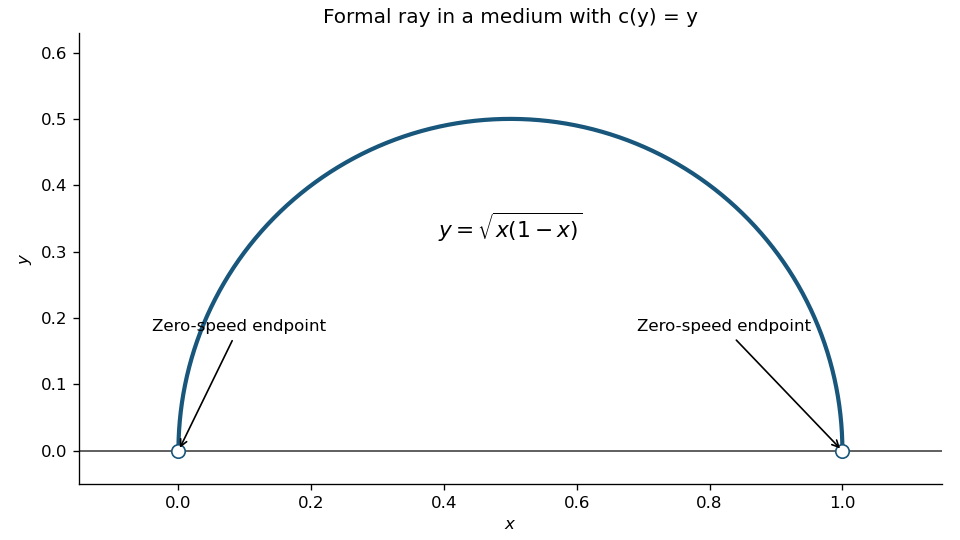

There is a necessary endpoint qualification. The speed is zero at the two stated endpoints. For any rectifiable path entering positive height, , and its travel time diverges logarithmically on leaving or approaching height zero. Thus the semicircle is the formal interior ray, but there is no finite-time minimizer between the zero-speed endpoints. For endpoints at height the circular ray has radius and finite travel time , which tends to infinity as . This explains the intended semicircle as a limiting hyperbolic geodesic, without asserting finite travel time where .
Articles by others on the same topic
There are currently no matching articles.