Introduce conformal timeIt satisfies and , so the metric becomes . Choose null coordinatesThus is positive on . Choosing the two null coordinates with these orientations gives the requested positive coefficient of .
There is a global-topology distinction in the source: unrestricted gives the universal cover of two-dimensional de Sitter spacetime. The usual two-dimensional de Sitter spacetime has periodic modulo . Indeed its standard embedding is , , , and is unchanged by . The local metric and the null-coordinate calculation apply to either choice.
The positive conformal factor leaves the causal structure unchanged. In the strip , a future-directed causal curve obeysand null geodesics have slopes . Its past and future conformal boundaries are spacelike. A finite conformal time interval limits the range of light signals: the observer at can receive a signal from before future infinity exactly when . Equality describes its observer-dependent cosmological event horizon.
For a finite Penrose diagram of the unwrapped spatial coordinate, set , , , and . Then the metric is conformal to ; light rays remain at degrees, and the boundaries are the images of . The figure also shows the spatially periodic de Sitter cylinder so that the global distinction is explicit.
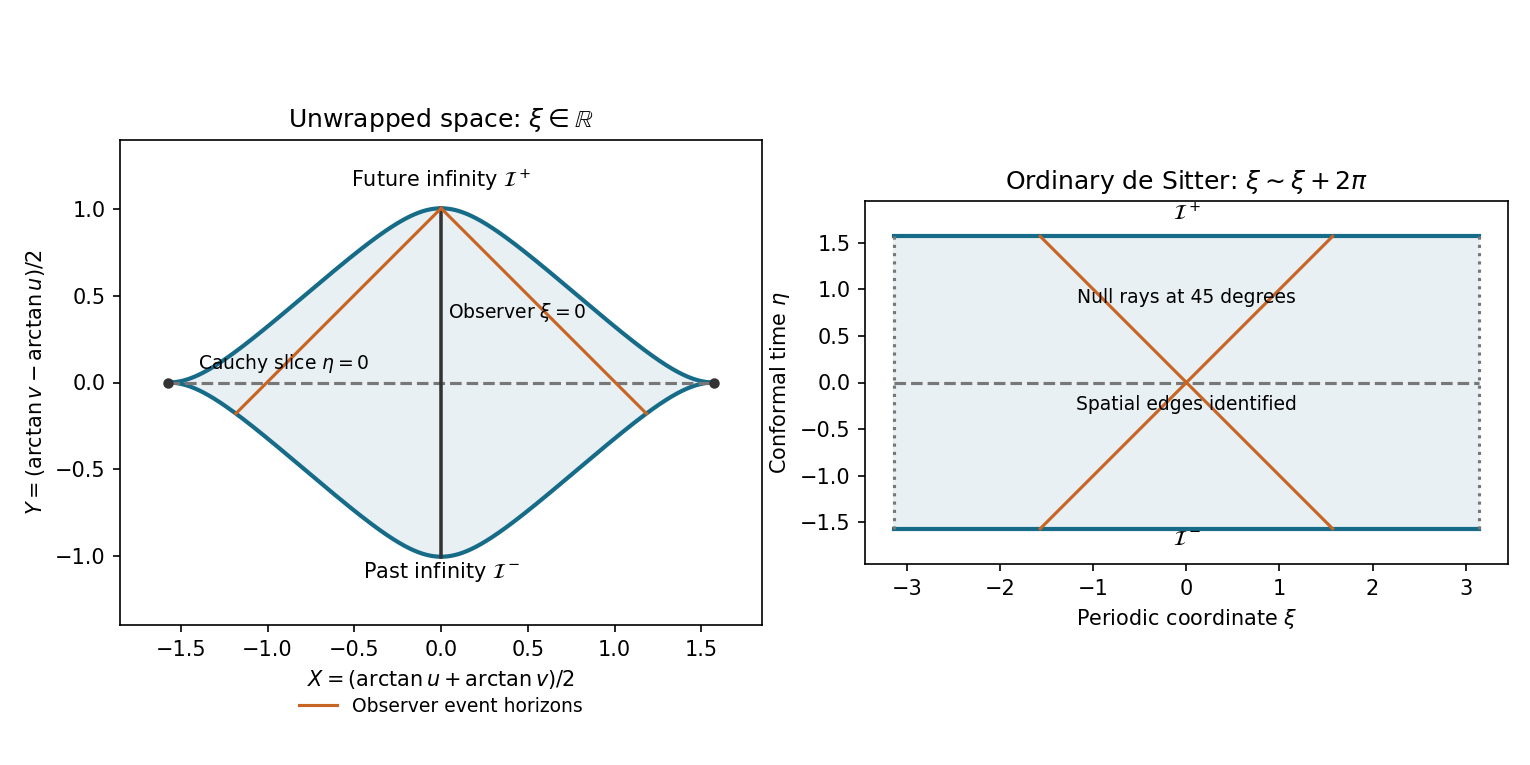
Causal compactification of the unwrapped de Sitter strip and the spatially periodic de Sitter cylinder
. Details. 
Both the covering spacetime and the de Sitter cylinder are globally hyperbolic. To see this directly in the covering spacetime, suppose an inextendible future-directed causal curve had a future limiting conformal time strictly below . The slope bound makes Cauchy as that time is approached, so the curve has a limiting point inside the spacetime and can be extended, a contradiction. The past endpoint similarly approaches . Thus every constant- line is crossed exactly once and is a Cauchy hypersurface. On the cylinder the same argument uses compactness of the spatial circle. Equivalently causal diamonds between finite events are bounded and closed within the strip, hence compact.
Initial field data on a complete Cauchy hypersurface determine a unique solution for a well-posed hyperbolic Cauchy problem, with the relevant constraints imposed for constrained systems. Spacelike conformal infinity does not require additional timelike-boundary conditions. An observer's cosmological horizon limits which data that observer can see; it does not destroy global uniqueness from data on the whole hypersurface.
Vary the action with compactly supported variations and integrate by parts. Its overall normalization does not affect the equation of motion:Here , so the massless scalar field obeysSeparate a spatial Fourier mode as . Its mode equation is . With conformal time , and , it becomesFor , put and . Direct differentiation reduces the equation tothe Spherical Bessel function equation with order one. Hence the complete classical mode basis isSince and , an equivalent complex basis isThe classical action does not select one frequency branch or a quantum vacuum. A real field has conjugate-related coefficients at opposite wavevectors. The zero mode, which is not obtained by treating these two basis functions as independent at , isAt late times one independent solution freezes and the other decays as . These are minimally coupled massless modes; the supplied action has no curvature-coupling term, so it should not be replaced by the conformally coupled wave equation.
Articles by others on the same topic
There are currently no matching articles.