For a relaxed cluster, galaxy motions act as tracers of its gravitational potential. The virial theorem gives a dynamical mass of orderwith a profile-dependent coefficient and a projection correction because the observed velocity dispersion is usually only the line-of-sight component. For an isotropic uniform-sphere estimate using its one-dimensional dispersion, and give . Measured dispersions require much more gravitating mass than the luminous galaxies provide, hence large cluster mass-to-light ratios. Interlopers, orbital anisotropy and departures from equilibrium are systematic uncertainties, so the independent gas and lensing measurements matter.
The hot intracluster gas emits X-rays, which constrain its temperature and density profile. If its pressure is predominantly thermal and it is in hydrostatic equilibrium,Eliminating the pressure givesHere is the mean mass per gas particle. A gas at the observed cluster temperatures would not remain confined without a deep gravitational potential; the inferred total mass exceeds the gas and stellar mass together. Nonthermal pressure, mergers, gas clumping and temperature-profile errors can bias this estimate, but do not turn X-ray luminosity itself into a direct measurement of total mass.
Gravitational lensing probes the cluster's projected mass through the deflection of background light. Strong gravitational lensing produces arcs and multiple images; weak gravitational lensing measures coherent distortions of many background galaxies. The lensing convergence is , withThus the image geometry and shear constrain the projected surface density without assuming the cluster is in dynamical or hydrostatic equilibrium. The reconstructed total mass again exceeds the visible stellar and gas contribution. Source-distance errors, line-of-sight structures and the mass-sheet degeneracy affect the reconstruction, but the independent agreement of lensing, galaxy motions and gas confinement is strong evidence for cluster dark matter.
An initially overdense spherical region first expands approximately with the background, but its self-gravity slows it more strongly. It reaches turnaround of spherical collapse at its maximum radius, recollapses, and forms a bound approximately stationary object when infall energy is redistributed into random motions. An exactly cold, uniform pressureless solution would instead collapse to zero radius; virialization replaces that formal endpoint.
For fixed mass and no cosmological constant, integrate for a bound shell. Its specific energy can be written , and the cycloidal parametrization isSubstitution in verifies this parametrization. At , and ; formal collapse occurs at , so .
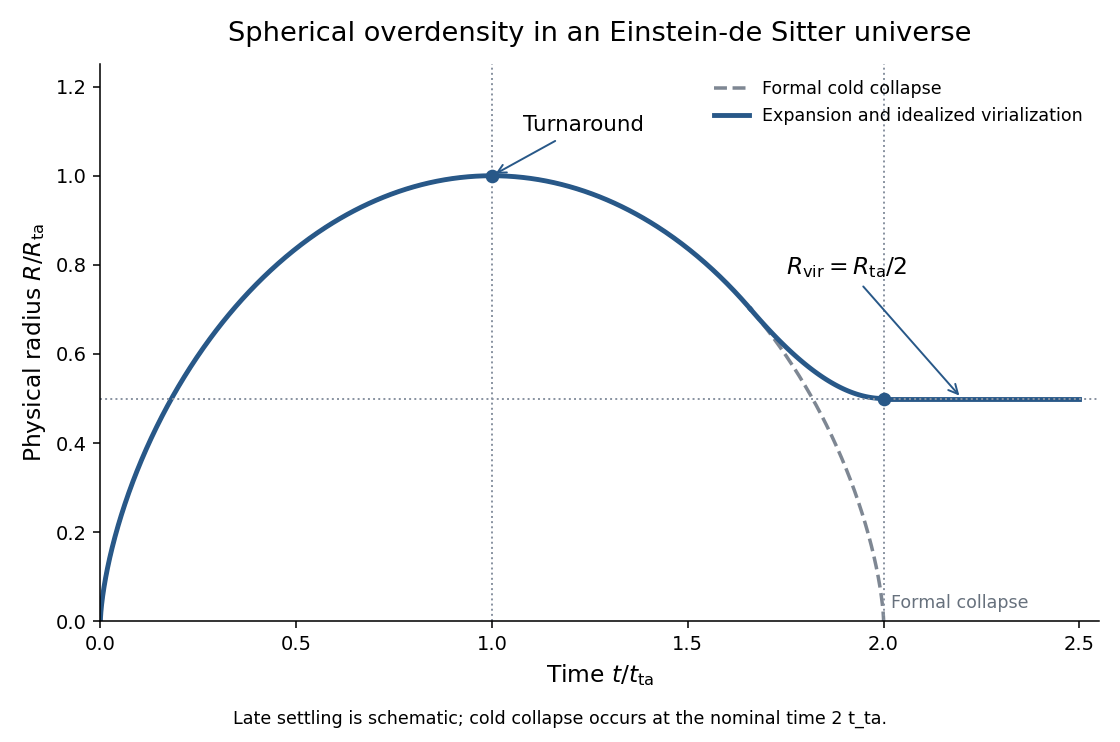
Expansion, turnaround and idealized virialization of a spherical overdensity, compared with formal cold collapse
. Details. 
For a uniform sphere, . At turnaround the coherent kinetic energy vanishes, so . At the final equilibrium, the virial theorem gives , whence . Conservation of energy therefore impliesThis virial radius from turnaround energy assumes conserved mass and energy, negligible surface-pressure/tidal terms, and the same gravitational profile coefficient. The sketch's settling segment is qualitative; the cycloid is the exact pre-virialization cold model, not a dissipative relaxation solution.
To compare with the cosmological density, use in an Einstein-de Sitter universe. The turnaround sphere hasSince the background density falls by four between and , the Einstein-de Sitter virial overdensity isFinally , so assigning the nominal collapse redshift givesThe density ratio eight compares the same object's physical densities at turnaround and virialization; compares its final density with the background at the later collapse epoch.
Follow a conserved mass element from its Lagrangian coordinate to its Eulerian coordinate . The integrated continuity equation giveswhere and the Lagrangian labels are chosen with uniform reference mass per . These equations hold before shell crossing, when the oriented determinant is positive. If are the eigenvalues of , thenFor an irrotational displacement the deformation matrix is symmetric, so these eigenvalues are real. Using the conventional positive collapse eigenvalues , equivalently the eigenvalues of , givesThere is a sign mismatch in the printed pairing of this last expression with eigenvalues of : for the displayed plus-sign displacement map, those eigenvalues give plus signs in the determinant. For example, , makes , so mass conservation gives , not . The corrected eigenvalue convention restores the intended formula without changing the map.
Now take and . The physical trajectory is . Differentiating at fixed givesThe physical derivative in the perturbed direction is . The two transverse directions still have the background acceleration. ThereforeUse the pressureless, background acceleration equation to obtainThis proves the planar exactness of the Zeldovich approximation for the requested full force-divergence equation. The displacement depends on only one coordinate, but the divergence includes all three physical directions; discarding the transverse background terms would give the wrong result. The proof is valid until shell crossing. With the planar gravitational boundary condition fixing the possible spatially uniform force, it is the exact single-stream dust evolution; it does not describe the multistream density by a single invertible map after crossing.
Articles by others on the same topic
There are currently no matching articles.