Gravitational lensing is the deflection and focusing of light by spacetime curvature along the line of sight.
A useful first model is a point-mass gravitational lens: one displaced source gives two images of a point-mass lens, while exact alignment gives an Einstein ring. The Einstein angular radius sets the angular scale, and image parity in gravitational lensing explains why the two images have different handedness. The spectroscopic test of the Twin Quasar lens shows how optical spectra can test whether two apparent quasars represent one source.
The projected gravitational field of a galaxy cluster bends light from background sources, producing strong-lensing arcs and multiple images near critical curves, and weak coherent shape distortions farther out. Joint analysis probes total projected mass rather than just luminous matter. Source distances, shape calibration, line-of-sight structure and degeneracies in the mass model limit inference; lensing alone does not identify a dark-matter particle.
The gravitational lensing approximation in which deflection is concentrated in a plane whose thickness is small relative to the relevant observer-lens-source distances. The reduced angular deflection includes the distance ratio. A projected surface mass density then determines the lensing potential and the image-to-source mapping. This is distinct from a refracting thin optical lens.
The merger separates X-ray-emitting collisional gas from galaxies and lensing mass concentrations. Comparing those observables provides evidence for a dominant less-collisional unseen gravitating component, without identifying its particle species.
In geometric optics without absorption, phase-space conservation preserves along a ray. Relative images of the same source at a common redshift therefore preserve surface brightness while changing apparent angular area and integrated flux. Source structure and propagation effects can introduce observed wavelength dependence.
For a single source plane, adding a uniform sheet and rescaling the original projected lens mass as shown leaves the reduced shear unchanged. Rescaling source coordinates by also preserves the image positions and shapes. Thus image geometry alone need not determine absolute lens mass normalization. Absolute magnification, independently known source sizes, time-delay information with a fixed distance scale, or additional geometric/dynamical constraints can break or restrict this mass-sheet degeneracy.
A gravitational lens is a foreground distribution of matter whose gravitational field deflects light from a background source. Its projected surface mass density determines the mapping in the thin-lens approximation. The lens is the deflecting object; gravitational lensing is the resulting optical process.
The signed magnification is the reciprocal determinant of the Jacobian matrix of the thin gravitational lens equation. Its absolute value gives the flux and solid-angle amplification; its sign gives image parity. Gravitational lensing preserves surface brightness in the geometric-optics approximation.
Image parity in gravitational lensing is the sign of the determinant of the source-from-image Jacobian matrix . A positive sign preserves the local handedness of a small source pattern; a negative sign reverses it. Negative signed lensing magnification therefore means a reflected orientation, not negative received light. This is a two-dimensional property: the derivative of a signed radial equation alone does not determine it.
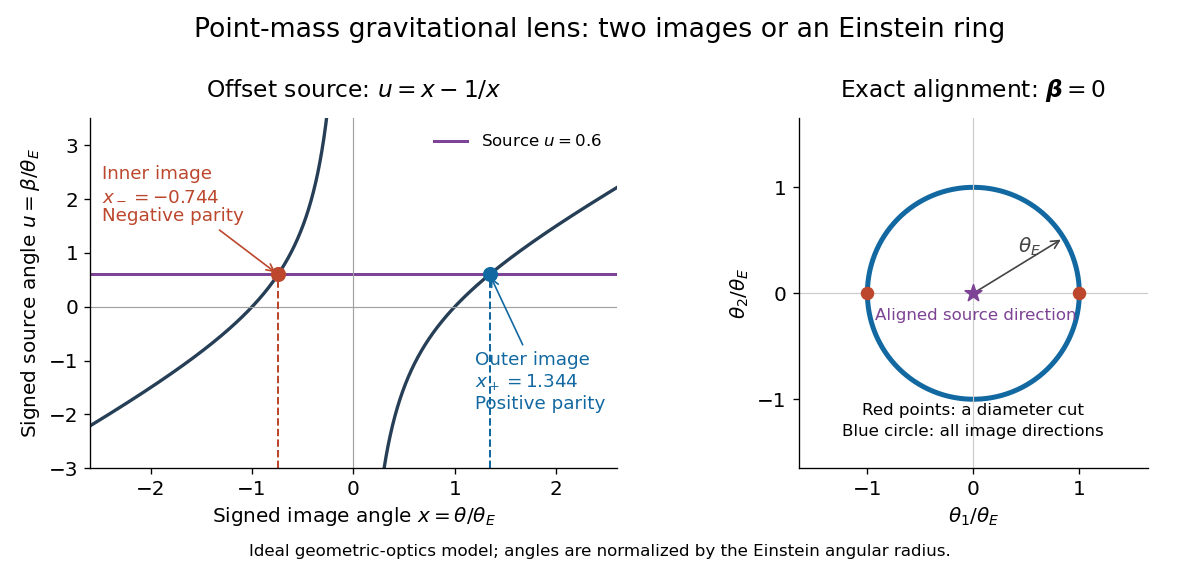
For a point-mass gravitational lens, differentiate , where . The radial and tangential eigenvalues of areConsequently the outer member of the two images of a point-mass lens has positive image parity in gravitational lensing; the inner member has negative image parity in gravitational lensing. At the tangential eigenvalue vanishes: this is the tangential critical curve of an axisymmetric lens, and its gravitational-lensing caustic is the aligned source point. The signed lensing magnification is , but measured total light uses .
A thin lens maps apparent image angle to unlensed source angle . In the usual outward reduced-deflection convention, for a projected lensing potential. For an axisymmetric lens its magnitude is . The mass here is projected inside a cylinder, not the three-dimensional mass inside a sphere.
A point-mass gravitational lens is the ideal gravitational lens obtained by concentrating a positive mass at one location. Use geometrical optics, the weak-field approximation, small angles in radians, and a stationary lens whose deflecting region is short compared with the observer-lens and lens-source distances. At impact parameter , require , the Schwarzschild radius, and a ray passing outside any opaque body. The physical bend has magnitude from Schwarzschild light deflection; is the gravitational constant and the speed of light. Multiple images can occur within this weak-field approximation: strong gravitational lensing does not require a ray to approach a black hole closely.[ref]
Gravitational Lensing by Matthias Bartelmann. Section 1.2, printed p. 2: geometrical optics, weak fields and slowly moving lenses; compact-object near-field propagation excluded
Let , and be angular diameter distances from observer to lens, observer to source, and lens to source, respectively. They refer to the background geometry used in the thin gravitational lens equation. In nearby Euclidean geometry, ; in cosmology, do not make that subtraction. The angular source coordinate is the direction the source would have without this lens; the observed image coordinate is . Both are measured relative to the observer-lens optical axis.[ref]
Lectures on Gravitational Lensing by Ramesh Narayan and Matthias Bartelmann. Section 2.1.3, pp. 8-9, equations (13)-(15), including the warning that lens-source angular diameter distance is not the difference of the observer distances
For the flat sketch below, extend the observer-side light ray backwards to the source plane. Its transverse position would be , whereas the actual source is at . Their separation is . Here is defined outward along the lens-plane impact vector, as in the thin gravitational lens equation; the physical ray bends toward the mass. Substituting givesThe same thin gravitational lens equation uses angular diameter distances in the cosmological setting. The factor converts the physical bend into the reduced angular deflection; these are different angles.
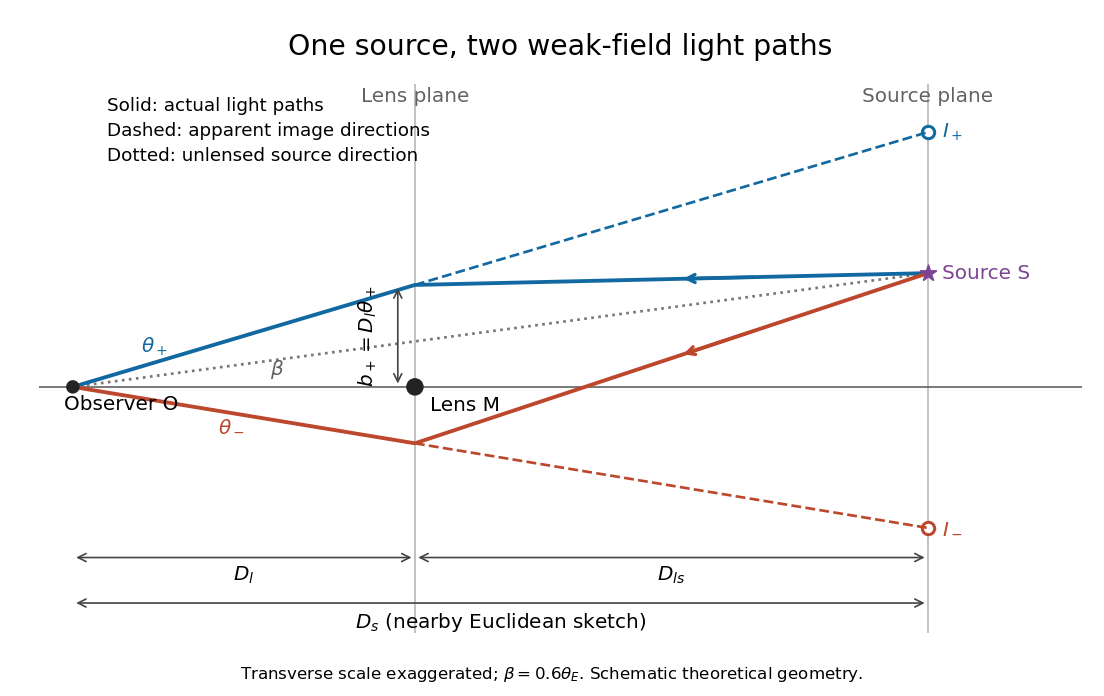
Choose a signed angular coordinate along the source-lens line. The point-mass gravitational lens becomesFor , multiplication by gives the quadratic equation . Its positive discriminant yields the two displayed roots. Their product is , so they lie on opposite sides of the lens. With , and : the outer image lies on the source side. For , the outer image is instead the minus root. These are image directions seen by the observer, not two emitting objects.[ref]
Gravitational Lensing by Matthias Bartelmann. Section 2.2, printed pp. 15-16, equations (100)-(110): point-mass model, two roots, critical circle and magnification
For a dimensionless example, set and . Solving gives and , with separation . The lensing magnification follows from image parity in gravitational lensing: , , and total amplification . Changing or the distances rescales the angles through the Einstein angular radius, while these dimensionless values remain the same.
For , the quadratic equation gives and . Using , the outer image tends to unit lensing magnification and the inner image has . Two mathematical images can therefore look like one at finite sensitivity or angular resolution. Furthermore, the inner impact parameter eventually becomes too small for the stated weak-field approximation or passes through the opaque lens: the ideal formula must then be replaced by an appropriate physical model.
Deflection changes one light ray's direction; focusing concerns relative directions of neighboring light rays and their bundle's cross section. To see the difference for a point-mass gravitational lens, send parallel incident light rays past the lens. A ray at impact parameter meets the optical axis approximately beyond the lens. Doubling quadruples this crossing distance. Thus the lens does not have a common focal length for all rays, although it can produce lensing magnification and an Einstein ring for a specified source-observer geometry.
The point-mass gravitational lens also illustrates why focusing must not be identified just with positive lensing convergence. Away from the central mass, differentiate the reduced deflection : its two-dimensional divergence is zero, so there. Nevertheless its radial and tangential derivatives differ, giving lensing shear of magnitude and . A vacuum ray bundle can be distorted and magnified. In the same ideal transparent geometrical optics model, surface brightness is preserved; the larger apparent solid angle supplies the increased received light.
This circular lensing potential has reduced deflection , mean lensing convergence and local convergence . Its central convergence is finite for . As the core shrinks to zero, the deflection tends to that of a singular isothermal sphere lens. This softening of the projected lensing potential must not be confused with replacing a three-dimensional density by a different cored profile.
For , the signed circular lens mapping has radial stationary points at . Substituting them gives the displayed caustic radius. An offset point-like astronomical source has three images when , a merging pair plus a separate outer image on the fold, and one image outside. At alignment, the two off-centre images form a ring while a central image remains. For the mapping is monotone and there is no finite multiple-image region. The zero-core singular limit loses the central image and has a different image-count exception.
For a point lens of mass at observer distance and source distance in a nearby Euclidean geometry, the Einstein radius in the lens plane is . Its angular version is . This is the ring radius for perfect alignment and the characteristic transverse scale of a gravitational microlensing event. A crossing timescale is , proportional to the square root of lens mass at fixed geometry and speed.
The Einstein angular radius is the angular form of the Einstein radius: in the lens plane. Its displayed value applies to a point-mass gravitational lens with the angular diameter distances defined above. It depends on source distance as well as lens mass and position. At fixed distances, multiplying by four doubles .
At exact alignment, the vector thin gravitational lens equation is . For a nonzero image direction it requires and leaves the direction unrestricted: all azimuths form an Einstein ring. The signed equation's roots are only a diameter cut through that circle. A source of finite angular size makes an annulus or arcs with finite received light; the infinite point-source lensing magnification at alignment is an idealization. An Einstein ring expresses rotational symmetry and source alignment, not a circular arrangement of emitting stars.
When gravitational lensing gives small angular distortions without generic multiple imaging, its deflection field changes source positions, magnification and shear. Angular derivatives of the lensing potential determine these distortions. Ensemble galaxy-shape distortions and cosmic microwave background remapping probe the foreground gravitational field.
A correlation of galaxy shapes caused by their formation environment or tidal fields rather than by the gravitational lensing of their light. It can contaminate a weak-shear correlation used to infer structure growth and dark energy. Redshift separation, population dependence and physically motivated modelling help distinguish it from a lensing contribution.
Cosmic shear is the statistically correlated lensing shear of distant galaxies produced by the intervening large-scale matter distribution. Correlations across angle and source redshift constrain clustering, the growth of structure and distance geometry, thereby testing dark matter and dark energy. Intrinsic galaxy alignments and measurement errors must be separated from the lensing signal.
The trace-free part of the angular lensing-potential Hessian stretches an image anisotropically. The source-image Jacobian matrix has eigenvalues . Thus a circular source becomes an ellipse in the local linear approximation; the orientation follows the shear axes.
The combination of lensing shear and lensing convergence governing the local shape distortion of background sources. Galaxy ellipticities estimate it statistically under a specified ellipticity convention and intrinsic-orientation model. It is invariant under the mass-sheet degeneracy, so shape information alone does not generally fix absolute projected mass normalization.
The shear-to-isotropic-focusing ratio inferred from background image shapes. The mass-sheet transformation rescales numerator and denominator equally, leaving this quantity unchanged.
The trace of the angular derivative of the reduced deflection defines convergence in the standard thin gravitational lens equation convention. It equals projected surface mass density divided by the critical surface density, . If deflection is instead defined as source minus image angle, the divergence relation has a minus sign.
The geometrical projected density scale converting a thin lens surface mass density into convergence. Its value depends on the angular-diameter distances to lens and source, not only on lens matter.
For a source at comoving distance in a spatially flat universe, define deflection as apparent minus unlensed source direction. The transverse Weyl lensing potential gradient along the ray receives the distance weight . Integrating the transverse photon acceleration twice and dividing the source displacement by gives the formula. Reversing the definition of the deflection reverses its sign. Its angular lensing potential is .
In a first-order light-deflection calculation, evaluate the Weyl lensing potential and its gradients on the unperturbed null geodesic. The position correction is first order, so inserting it into an already first-order potential produces a second-order correction. This approximation omits repeated deflection and lens-lens coupling.
Strong gravitational lensing produces multiple resolved images, arcs, or rings when a sufficiently massive foreground lens lies close to the source's line of sight.
For a thin lens, relative arrival times follow the difference of between images, multiplied by . Both geometry and gravitational potential contribute; an additive delay common to all images is unobservable.
The distance combination converts a dimensionless thin-lens delay difference into an observed time delay. Inference from a variable lensed source also requires a mass model and control of external convergence.
The two resolved quasar images of 0957+561 provide an observational question: are they separate sources, or different light paths from one source? In May 1979, spectrophotometry used the McDonald Observatory 2.7 m reflecting telescope, the UVITS spectrograph, and an intensified dissector scanner at the f/9 focus of the Cassegrain reflector. A 600-groove-per-millimetre diffraction grating produced 4100-7100 ångström scans sampled every 2 ångströms, with about 7 ångström resolution over most of that range. Two spectrograph slits, about 52 arcseconds apart, recorded object and sky background simultaneously for subtraction. Interleaving observations of the two images reduced instrumental and atmospheric gain changes.[ref]
Spectrophotometry of the Double QSO, 0957 + 561 by Beverley J. Wills and D. Wills. Section II, printed p. 2: instrument, grating, sampling, resolution, two apertures, sky subtraction and interleaving
The readout was received light versus wavelength for each image. Closely matching absorption line redshifts supported a common source and absorber; differences in continua and line strengths motivated differential interstellar extinction. Spectral agreement supplied evidence for gravitational lensing, rather than proving the point-mass gravitational lens model. The authors discussed a physical double and discrepant optical and radio light ratios. Their note added in proof attributed the redder spectrum to foreground galaxy contamination and emphasized an extended mass distribution.[ref]
A critical curve is a locus in the image plane where the Jacobian matrix of the thin gravitational lens equation becomes singular. Its formal point-source lensing magnification diverges, while finite source size regularizes the measured flux. Its mapped locus in the source plane is a gravitational-lensing caustic.
The local and mean lensing convergence obey . Hence the radial derivative of the lens mapping is . Its zeros are radial gravitational-lensing critical curves, where radial stretching diverges and images merge on crossing the mapped gravitational-lensing caustic.
For circular reduced deflection , a displacement perpendicular to the radial direction is multiplied by . Vanishing of this eigenvalue gives a tangential gravitational-lensing critical curve. Its source position is , so its caustic is the origin in the circular model. Near it, images are stretched tangentially into arcs or an Einstein ring.
A caustic is the source-plane image of a gravitational-lensing critical curve. Crossing a generic fold caustic creates or destroys a pair of images of opposite parity. For a circular lens, a tangential critical circle maps to an aligned-source point, while a radial critical circle can map to a finite source-plane circle. Critical curves and caustics consequently occupy different planes and must not be identified as the same angular locus.
An aligned source behind an axisymmetric gravitational lens produces a circular image at an Einstein radius. Its angular radius satisfies . Exact alignment gives a ring; displaced sources generally give arcs or distinct images rather than a complete ring.
Gravitational microlensing is lensing by compact masses whose individual image splitting is unresolved, so their motion is observed through time-dependent magnification.
The microlensing optical depth is the probability, when small, that a source lies within one Einstein radius of a foreground lens. For point lenses and compact-object mass density in nearby Euclidean geometry,The individual lens mass cancels because and . Detection efficiencies and event durations still depend on individual masses and survey cadence.
Articles by others on the same topic



Gravitational lensing is a phenomenon that occurs when the gravitational field of a massive object, such as a galaxy or a cluster of galaxies, bends the path of light coming from a more distant object, like another galaxy or a quasar. This effect is a prediction of Einstein's theory of general relativity, which describes how mass curves spacetime.