The shallow-water approximation requires the depth to be small compared with the horizontal scale of variation, small vertical accelerations and nearly hydrostatic pressure. Take cross-sectionally uniform lower-layer velocity and a sufficiently deep, effectively stationary upper layer. Under the Boussinesq approximation, is the reduced gravity. Conservation of lower-layer volume gives constant discharge .
Dividing the Bernoulli equation by gives the shallow-water specific energyAt fixed , the energy curve has its minimum at the critical depth , where . Above this minimum there are two depth branches: deeper subcritical flow has , and shallower supercritical flow has .
The two long-wave speeds relative to the bed are . In subcritical flow one family can propagate upstream and one downstream; in supercritical flow both travel downstream for . At hydraulic control, , and a smooth transcritical solution must also satisfy the geometric regularity condition. The flow may remain entirely on either branch, cross smoothly through the control from subcritical to supercritical, or take the reverse smooth branch under appropriate boundary conditions. A downstream hydraulic jump can return supercritical flow to the subcritical branch while losing energy.
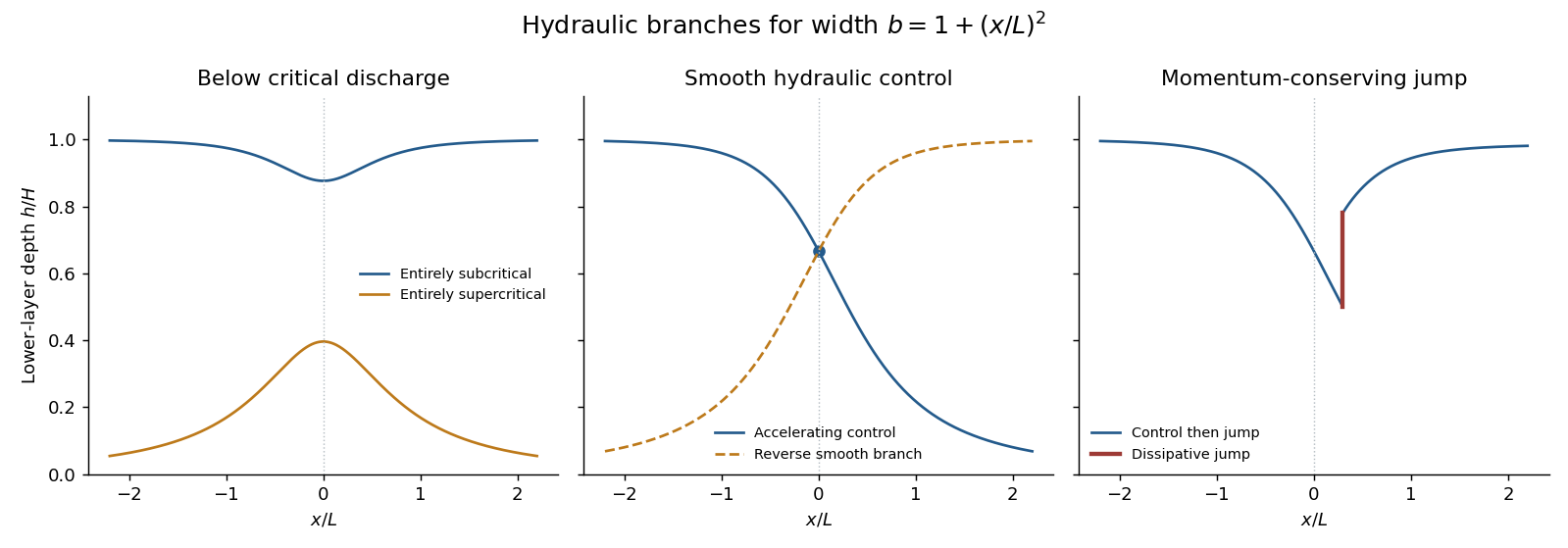
Depth branches in a contracting and expanding channel, including hydraulic control and a dissipative hydraulic jump
. Details. 
The sketch distinguishes smooth branch changes at a critical section from a jump: a jump conserves mass and momentum, not the original Bernoulli head.
Differentiate the specific energy at fixed discharge:In the lossless flat channel is constant. A smooth hydraulic control has , so regularity requires . For the prescribed width this occurs at the minimum width . The required minimum specific energy is largest at the narrowest section; a controlled flow supplies exactly that head.
Far upstream , so the velocity of a finite-discharge flow with depth tending to tends to zero. Thus the Bernoulli equation gives . At the control and , henceThe printed width normalization has . Downstream on the accelerating controlled branch the flow becomes shallower and supercritical.
Assume the jump is stationary, short compared with the scale of width variation, hydrostatic on either side, and has negligible bed stress integrated over its short length. Treat its width as constant. It must occur on the downstream supercritical branch, at . The discharge from the control gives the local unit-width dischargeBefore the jump the energy is still . Writing , its equation is . Its positive roots are and ; the former is supercritical. ThusMass conservation gives . The hydraulic jump momentum balance conserves . Factoring out the non-jump solution gives the conjugate-depth relationConsequently the conditions immediately after the jump areIts Froude number is below one. The specific-energy loss isSelecting the deeper root of the unchanged energy equation would be wrong: that would conserve the energy across a turbulent jump instead of the momentum.
Bed and sidewall stress, turbulent mixing at the interface, wave radiation and hydraulic jumps convert or remove mechanical energy. In the specified local head-loss model, differentiate while keeping constant:At a regular hydraulic control the coefficient of vanishes. Therefore requiresThus the control moves to the widening downstream side, . This is the exact local compatibility condition; it is the head-loss correction to hydraulic control with loss expressed as Bernoulli potential per unit length.
For a small loss and a control remaining near the throat, use the lossless depth and . The leading displacement isFor a finite loss, the local derivative alone does not specify the accumulated loss from the far-upstream reservoir, so it does not fix a unique revised discharge or numerical control depth. Given , the exact condition can instead be solved implicitly for ; if the inviscid discharge is imposed, it becomes . The small-displacement root is the one continuous from the throat. This distinction avoids treating the original upstream energy as unchanged after an unspecified finite upstream loss.
Articles by others on the same topic
There are currently no matching articles.