Let denote the signed opening, positive when the faces separate, and let be the crack surface. Its displacement jump is . The singular strain associated with this jump has moment density . For the isotropic elastic stiffness tensor, contraction givesThe equivalent distributional body force is the negative divergence of this prescribed moment density:The resulting forced elastic wave in an isotropic solid equation is . This is a tensile-crack seismic source; it need not be represented as an ordinary smooth volume force. For a small nearly planar patch of area , uniform normal and opening , define its volume change . Its seismic moment tensor and point-source force areThe sign convention makes a positive opening a positive extensional moment. Reversing the convention for the displacement jump changes both signs together; the force is independent of reversing the orientation of the crack normal.
Complete the crack normal to an orthonormal basis with the first two vectors in the crack plane. The seismic moment tensor is diagonal in this basis:Each term gives an elastic force dipole, : two equal and opposite forces in direction , separated along , with moment . Hence there are two identical in-plane dipoles of strength and one normal dipole of strength . For positive opening and ordinary positive Lamé parameters, all are extensional and the normal one is larger by .
More generally, stable isotropic linear elasticity requires and . These imply , so the normal dipole has greater magnitude even if an auxetic material has negative and compressive in-plane dipoles. The point source has zero net force, because it differentiates a delta function, and zero net torque, because its moment tensor is symmetric. Its normal moment distinguishes opening from a pure shear dislocation.
Treat a small patch as the point tensile-crack seismic source at , with and . Let , , , and . Source convolution and an integration by parts give the point-moment elastodynamic displacementThe derivatives act on angular factors and on retarded times as well as on powers of ; keeping only the explicit Green-function terms would miss the static displacement.
Set , andConvolving the elastodynamic Green tensor with the opening history givesUse , , , andFor example, , while differentiating the near-field angular tensor gives . Combining these with the endpoint terms in yieldsFor the normal crack, , , and . Explicitly, the three nonradiative vector coefficients in the last two lines areThus those lines are . The small-source approximation assumes the patch size is small relative to both and the wavelengths of interest; a finite crack is obtained by integrating the same point-patch expression over its surface with its local opening and normal.
The first two terms are the radiative P wave and S wave displacements:They decay as and are purely transient: once the opening rate vanishes, each disappears after its respective arrival time. The P displacement is longitudinal and the S displacement transverse. An abrupt opening history makes these formulas distributions; a smooth finite-duration intrusion gives ordinary pulses.
Suppose the source starts from zero opening and ends with volume change . At times later than the end of intrusion plus , both retarded openings equal andThe remaining terms combine to the static displacement fieldIt decays as , so it must not be identified with the transient far-field pulses.
For a Poisson solid, , and . Let be polar angle from the crack normal, with unit vector in the increasing- direction. Then and . The tensile-crack radiation pattern becomesAt fixed and positive opening rate, the P pattern is outward, has no angular node, and is three times larger along the normal than in the crack plane. The signed S amplitude has four alternating lobes: it vanishes along the normal and in the crack plane, and its magnitude is maximal at to them. Neither field has an azimuthal SH component about the crack normal.
The final static field simplifies toIts radial part is outward near the poles, changes sign at , and is inward in the crack plane. The tangential part has the same signed angular factor as the S radiation, but is permanent and has a different distance dependence. Its radial sign changes are not nodes of the whole vector because the tangential component generally remains nonzero there. Rotating a meridional sketch around the crack normal gives the complete three-dimensional axisymmetric pattern.
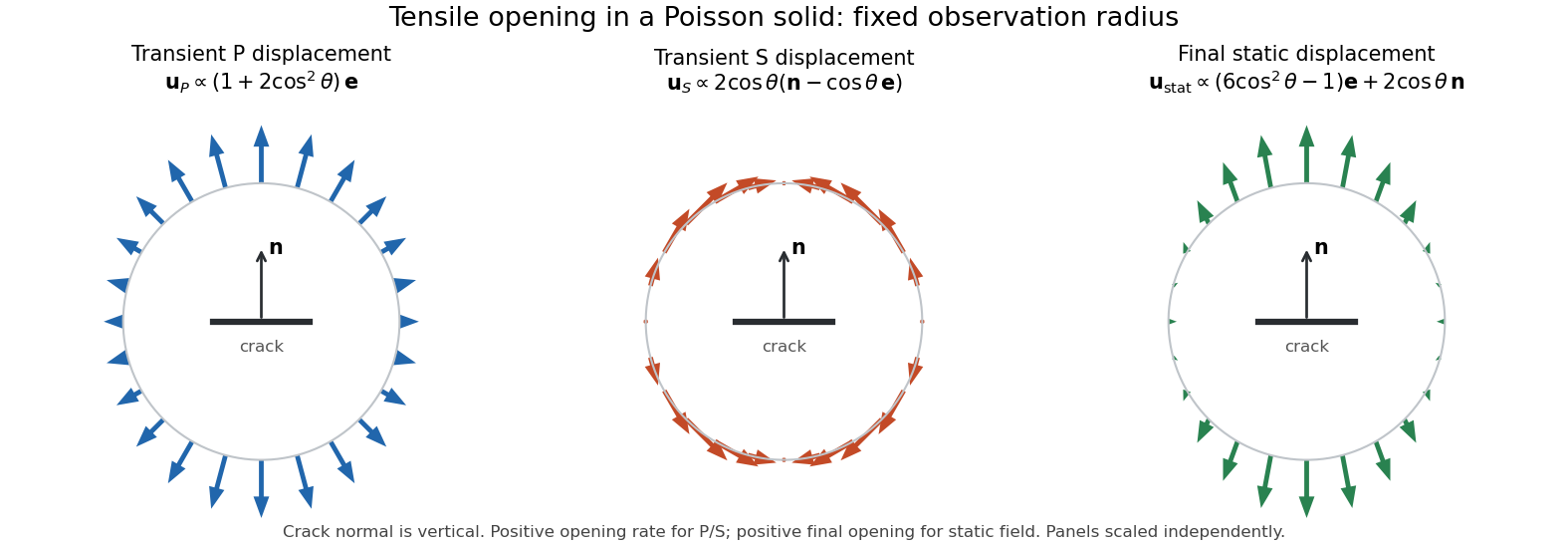
Transient P and S displacement patterns and final static displacement for a tensile crack in a Poisson solid
. Details. 
Articles by others on the same topic
There are currently no matching articles.