A positive-radius horizon occurs at a zero of V. Set ; multiplying by gives . Thus real roots require . With , the horizon condition and radii areFor both roots are positive, giving an outer event horizon and an inner Cauchy horizon. For they coincide at . For only is a horizon: the formal root was introduced by multiplication and is the singular origin, where the original expression for V is undefined. For there is no horizon and the central singularity is naked. Each positive root is regular in ingoing coordinates , where the radial metric is .
At a horizon, use in to obtain . A double root therefore requires , and the horizon equation then gives . Conversely at ,Hence . It is a degenerate Killing horizon of an extremal black hole. For distinct charged roots, the normalized signed surface gravities are , so neither is degenerate. The neutral positive-radius horizon is also simple.
Suppress the angular three-spheres and use radial null coordinates , with . Compactifying these null coordinates puts radial light rays at 45 degrees in the Penrose diagram. Simple zeros of V give logarithmic ends of the tortoise coordinate and are crossed by regular null charts. The sign of V distinguishes static blocks, where r is spacelike, from inter-horizon blocks, where r is timelike.
The center is a genuine curvature singularity. An orthonormal-frame calculation gives the Kretschmann scalar of a five-dimensional charged black holeIt diverges at zero radius and is finite at positive horizons. Since the normal to a constant-r hypersurface has squared norm V, the singular boundary is spacelike when V is negative near zero and timelike when V is positive there.
For , V is negative inside the sole horizon and the maximal extension is Schwarzschild-like: two asymptotically flat exteriors, a future black-hole triangle ending at a spacelike singularity, and a past white hole triangle beginning at a spacelike singularity. The two pairs of horizon branches meet at a regular bifurcation sphere.
For , V is positive for every positive r. The radial conformal domain is a single exterior with a timelike naked singularity at its left boundary and the usual past/future null infinities on its outer boundaries. There is no horizon. These two cases are shown together below; red zigzags denote curvature singularities.
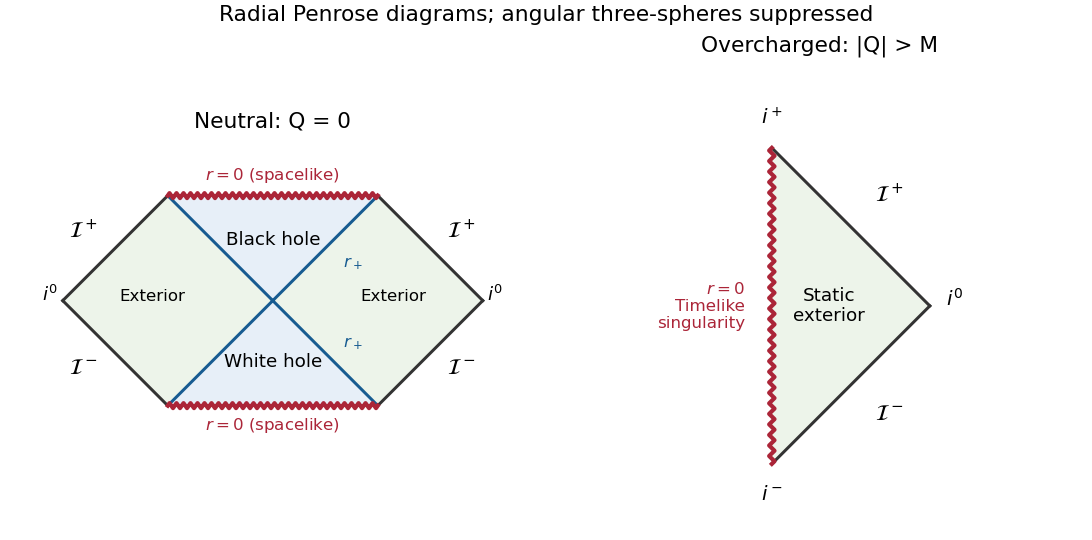
Neutral and overcharged radial Penrose diagrams in five dimensions
. Details. 
For , the exterior and deep interior are static, while is a trapped or time-reversed band. The outer roots are event horizons for a chosen exterior, and the inner roots are Cauchy horizons. The center is timelike because there. In the exact analytic extension, crossing successive inner and outer horizon branches produces an infinite succession of exterior, trapped, inner-static and white hole blocks. The following finite strip specifies the repetition; it does not terminate the spacetime at the drawing's upper or lower edge.
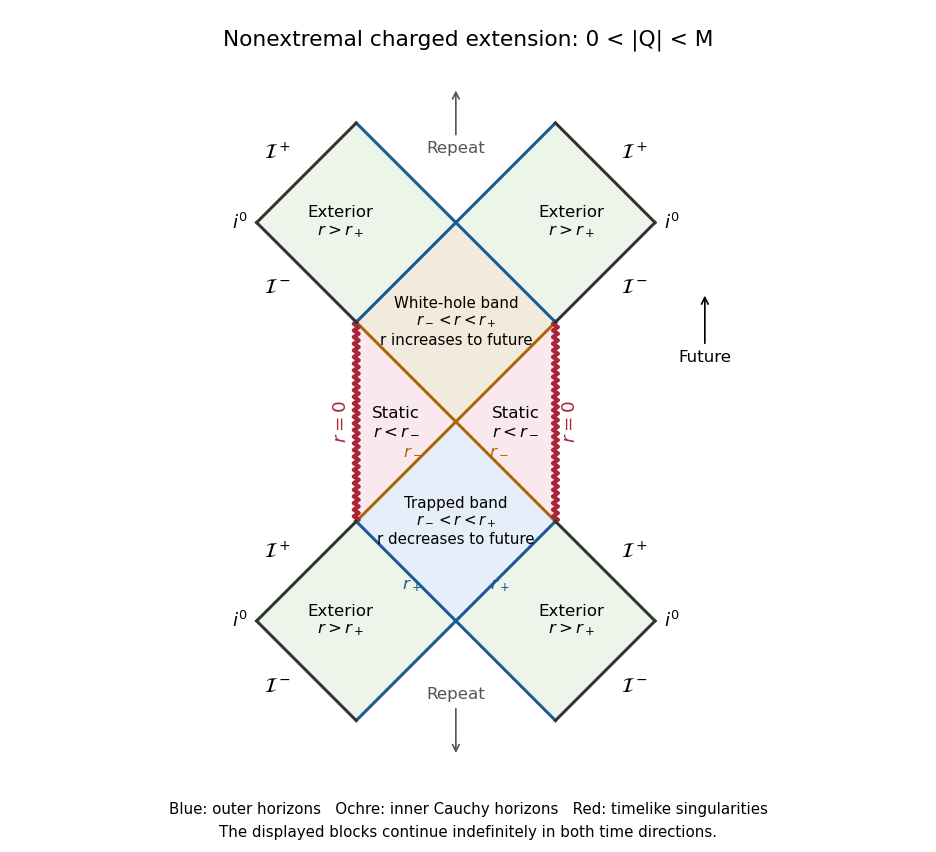
Repeated nonextremal charged blocks with outer and inner horizons and timelike singularities
. Details. 
For , is nonnegative on both sides of . There is no inter-horizon trapped band. Near the horizon, , so the horizon is an infinite throat end of each static coordinate block. It is null and degenerate, without a regular bifurcation surface. The extension consists of alternating exterior and inner-static blocks, with timelike singularities in the latter. The separate conformal blocks below, together with their future-to-past horizon gluing rule, describe the full repeated extension. The open throat endpoints are ideal boundaries, not additional events where horizon branches meet.
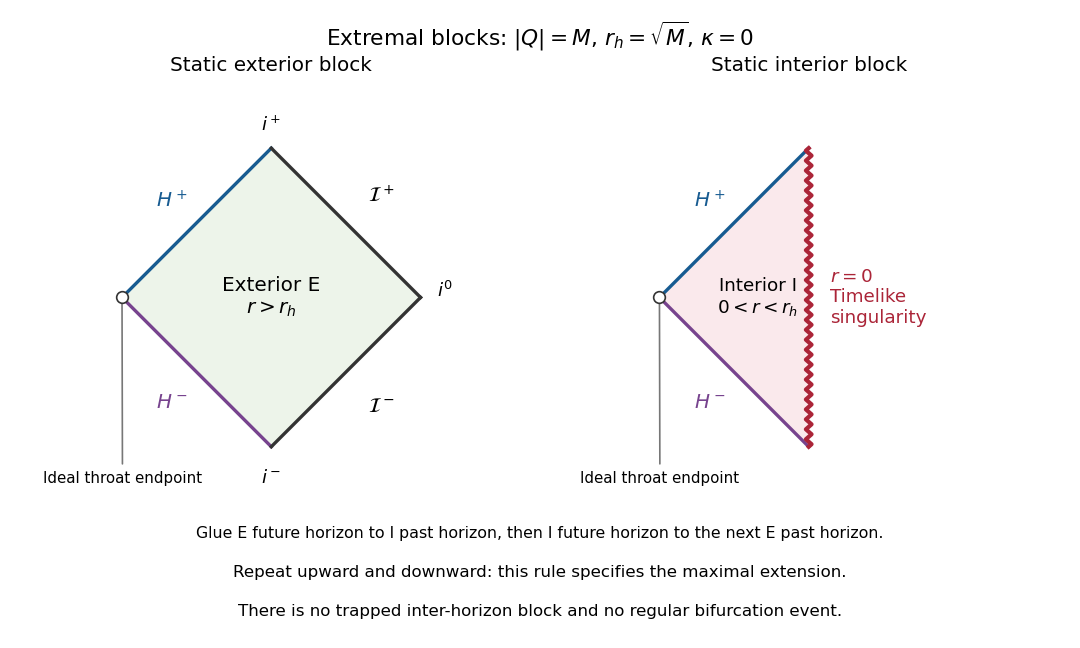
Extremal static conformal blocks and the gluing rule for their maximal extension
. Details. 
Thus the neutral, strictly subextremal charged, extremal and overcharged cases all have distinct causal structures. These drawings describe the maximal analytic stationary metrics. The additional angular dimension changes areas and curvature falloff, but does not change these radial causal block types.
The Wick rotation gives the radial Euclidean metric . For a simple root, write and choose the side with V positive. There for , so andThe leading geometry is a plane in polar coordinates with angle . For a time identification of period beta, the circumference/proper-radius ratio approaches . Unless it is exactly , the origin is a conical singularity, with deficit or an excess if this is negative. This is the Euclidean metric near a simple static horizon, rather than a divergent Lorentzian curvature invariant at the horizon. The side with V negative does not give a positive-definite metric under this real Wick rotation.
Smoothness requires the polar angle to have period exactly . Therefore Euclidean time must be identified byA nontrivial integer multiple of this fundamental period still gives an excess-angle cone at the tip; it is not a smooth plane there. The static time has already been normalized at infinity because V tends to one.
For distinct charged roots, writing gives . These unequal periods cannot simultaneously remove both simple-root cones using one common time identification; the outer and inner static Euclidean regions are in any case separated by a band where V is negative. The physically relevant asymptotically flat exterior uses . The neutral outer horizon gives .
In natural units, periodic Euclidean time of period beta is the inverse temperature of a thermal quantum state. The horizon regularity calculation therefore gives the Hawking temperatureThis agrees with the radiation calculation based on the near-horizon redshift. Restoring constants with multiplies the expression by . In the neutral case ; the temperature is positive for every nonextremal outer horizon.
The extremal limit is different. At , , so the proper Euclidean radial distance to the horizon diverges logarithmically. This extremal Euclidean throat is an infinite end, with no finite polar origin on which to impose the cone-removal condition. Local smoothness therefore does not select a finite period by the preceding argument. The vanishing surface gravity and the nonextremal limit give , rather than a universally nonzero temperature for all horizon solutions. A geometry with has no black-hole horizon and no Hawking temperature inferred from this horizon argument.
Articles by others on the same topic
There are currently no matching articles.