The initial table of content was limited to the first level because it is larger than 1000 articles. There are 1751 articles in total. Expand a branch to load its children.
The Hilbert basis theorem says that if is a commutative Noetherian ring, then is Noetherian; iteration treats any finite number of variables. Here is a complete leading-coefficient proof. For an ideal , let be the set of degree- coefficients of its polynomials of degree at most , including zero coefficients. These are ideals of , and multiplication by gives . The ascending chain condition makes the chain stationary from some onward. Choose finite generators for and lift them to polynomials of degree at most . If has degree , set and express its leading coefficient as , where is the chosen degree- coefficient. Then has smaller degree. Induction proves that the finitely many lifts generate . This proves the theorem, including coefficient rings with zero divisors.
Put and . The infinite dihedral group has normal forms and . The relations move every to the right and reduce its exponent modulo two; the action , on shows that these forms are distinct. ThusThe Hilbert basis theorem makes Noetherian, and its localization is Noetherian: an ideal of a localization is generated by the images of the finite generators of its contraction. Since is free of rank two over on the left, it is a Noetherian module over . Every left ideal of is an -submodule, so all its ascending chains stabilize. Therefore is left Noetherian.
For the center of the infinite dihedral group algebra, write an element as . Commuting it with gives in the Laurent integral domain, forcing . Commuting with then gives . A symmetric Laurent polynomial is a linear combination of and , . With , the recursionexpresses as a polynomial in . Conversely every polynomial in is central. The highest Laurent exponent of a nonzero polynomial in shows that is transcendental. HenceThe identities and give . Independence follows by applying to a relation and subtracting: , so . Consequentlyis a free -module of rank four.
Let be a nonzero simple module on the left. For any , , so it is finite over . Every central acts bijectively: its kernel and image are -submodules, and simplicity forces kernel zero and image . To prove that is maximal, not merely prime, put ; then is a faithful finite -module. For , . If generate , write . The adjugate matrix identity for shows that annihilates every generator and hence . Faithfulness makes this determinant zero in . Its constant term is one, so it has form , proving . Thus is a field, and is a maximal ideal of . This proves the general principle for simple modules over an algebra finite over its center in this instance.
Every maximal ideal of is for some , by factorization of complex polynomials. The module is therefore a quotient of the four-dimensional algebra . In particular , as required.
The actual simple dimensions are at most two. If , choose with . The matrices and give a representation of onto : polynomial functions of give the two diagonal matrix units, and multiplication by gives the off-diagonal ones. Both algebras have dimension four, so this is an isomorphism. If , the element has square zero and is conjugated to its negative by ; its generated two-sided ideal is square zero. It annihilates every simple module, since its action on a simple module is either zero or the whole module, and the latter contradicts its square being zero. The remaining quotient is , whose two simple modules have . Thus the generic simple modules have dimension two, and the four exceptional one-dimensional characters have , .
If , all its localizations are zero. Conversely, take . Its annihilator is a proper ideal, so it is contained in a maximal ideal , which is prime. The zero criterion for module localization says that in only if some satisfies . This would put , a contradiction. Therefore , provingIn fact maximal ideals suffice, and neither finite generation nor Noetherianity is needed for this implication.
Set . The natural map is onto. Its kernel is the image of : a fraction maps to zero precisely when for some . If , then . This proves the localized cokernel identity directly:Thus is a surjection for every exactly when for every . Part (i) makes this equivalent to , or to being a surjection. Hence surjectivity is detected at all prime localizations, and again maximal ideals alone would suffice.
Let . If is a prime ideal, then . Its extension isIt is proper: would give for some , and hence , impossible because . If a product lies in , clearing a denominator gives for some . Primeness and imply or . Thus is prime. Its contraction is , since implies for some , forcing .
Conversely, contract a prime ideal of to . This is a prime ideal of . It contains no element of , since such an element becomes a unit and cannot belong to the proper ideal . Hence . Also exactly when , because is a unit, so . These extension and contraction operations are inverse, giving the prime ideal correspondence for localization:
An associated prime of a module is an annihilator of a nonzero element. Suppose is prime and . Then in : a denominator killing would belong to . MoreoverIndeed, if , some has , so ; primeness and imply . The reverse containment is immediate. This proves one inclusion in the localization of associated primes formula.
For the other, let be an associated prime of and contract it to . By part (iii), is prime, and . Since is invertible, is also the annihilator of . The Noetherian ring hypothesis makes finitely generated. For each , the equality supplies with . Put , taking for the zero ideal. Then annihilates , while because is a unit and .
If , then annihilates , so . Therefore , and . We concludeThe single common denominator is the key point: one must turn a localized annihilator into the annihilator of one actual nonzero element of , not merely assert that annihilators commute with localization.
Use generators with . The ordered monomials form a basis: construct the Weyl algebra as the differential Ore extension of with , which has unique ordered polynomial expressions. Giving both generators degree one produces the Bernstein filtration, whose associated graded ring is . If , their nonzero leading symbols have nonzero product in this polynomial integral domain. Thus has nonzero leading symbol and cannot vanish. Hence has no nontrivial zero divisors.
Here is the left-handed Ore theorem. Let be a multiplicative set of regular elements of a ring, containing and excluding . There is an injective Ore localization whose elements are left fractions if and only ifThis is the left Ore condition. For a noncommutative domain, taking gives a division ring exactly when this condition holds. With zero-divisor denominators a further left reversibility condition is needed; the regular-denominator statement is the one used here.
Necessity follows by writing in the quotient and multiplying by and , giving in the embedded original ring. For a construction proving sufficiency, use the left Ore fraction construction: pairs represent , and and are equivalent whenfor suitable . Reflexivity and symmetry are immediate. For transitivity, combine and by a common left multiple . Then , so regularity gives , which combines the numerator equalities and proves transitivity.
Addition uses the common denominator , with numerator . To multiply by , choose with ; setThe Ore condition supplies a common refinement whenever a representative or an Ore relation is changed, and regularity cancels the shared denominator, proving independence of choices. The same refinements verify the ring axioms; the formulas are simply addition and multiplication after clearing left denominators. The map is injective, since equivalence to zero would give with . Each becomes invertible. A homomorphism inverting extends uniquely by , giving the universal property. For all nonzero denominators in a noncommutative domain, a nonzero fraction has inverse , so the quotient is a division ring. This is the requested proof sketch, with the fraction equivalence and multiplication made explicit.
It remains to check the left Ore condition for . Its graded polynomial ring is Noetherian by the Hilbert basis theorem. Lifting homogeneous generators of a graded left ideal and successively cancelling leading symbols proves that the filtered algebra is a left Noetherian ring: each subtraction lowers the nonnegative degree, so it terminates.
In any left Noetherian noncommutative domain, nonzero principal left ideals intersect. Otherwise with would makean infinite direct sum of nonzero left ideals. To verify directness, reduce a finite relation modulo to make its first summand zero, then cancel on the right and repeat. Its increasing finite partial sums contradict the ascending chain condition. A nonzero element of therefore has the form , with , proving the required condition. Consequently has a classical ring of left quotients, and it is a division ring.
For , the Weyl algebra is generated by with and the other generator commutators zero. Iterating the differential Ore extension construction gives the ordered basis . In the Bernstein filtration, both kinds of generator have degree one, andLeading symbols show that is a noncommutative domain. The Hilbert basis theorem and homogeneous-generator lifting by decreasing degree make it both left and right Noetherian.
It is also a simple ring. In a nonzero two-sided ideal, choose a nonzero element and a monomial of maximal total degree with nonzero coefficient . Applying eliminates every lower-degree term and every different term of that maximal degree. The result is the nonzero scalar . Thus the ideal contains . Here the scalar extraction by iterated Weyl commutators uses characteristic zero. Despite simplicity, has no nonzero finite-dimensional modules: in such a representation would have trace , impossible over . Its interesting module theory is necessarily infinite-dimensional.
For a finitely generated left module , choose a finite-dimensional generating subspace and set . This is a good filtration of a module. Its associated graded module is finite over the graded polynomial ring, so its cumulative Hilbert function is eventually a polynomial,with positive integer multiplicity . These are the Bernstein growth dimension of a Weyl algebra module and its multiplicity of a filtered module. Two good filtrations bound each other after fixed shifts: lift finite homogeneous generators in one filtration, bound their degrees in the other, and use compatibility with ; then reverse the roles. The growth degree and leading coefficient therefore do not depend on the good filtration of a module. The degree is also the Gelfand–Kirillov dimension of a module and the dimension of the characteristic variety of a Weyl algebra module, the support of . Since is a quotient of a finite sum of copies of , .
The essential lower bound is the Bernstein inequality for Weyl algebra modules:Here is a full proof. Multiplication gives a linear map . Prove it injective by induction on . At a scalar killing must vanish. If kills , then for every generator , its commutator kills : both and are zero for . Induction gives for all generators. In the ordered basis, differentiates the exponents and differentiates the exponents with a minus sign. Vanishing of all these commutators in characteristic zero forces to be a scalar. It then vanishes because it kills . This proves the faithful finite-step action of a Weyl algebra and henceComparison of degrees gives , proving the inequality. Equally, without invoking eventual polynomiality, this estimate directly bounds the Gelfand–Kirillov dimension of a module below by . Right modules satisfy the same inequality through the filtration-preserving isomorphism , , .
A nonzero finitely generated module with is a holonomic Weyl algebra module; the zero module is conventionally included. This minimal-growth class is stable under submodules, quotient modules and extensions. For , take the induced and quotient filtrations. Their graded sequence is exact; Noetherianity of makes the induced filtrations good. Thus the Hilbert functions add andif both nonzero terms have the top dimension, their multiplicities add. For a holonomic Weyl algebra module, every nonzero subquotient has dimension , by the upper bound inherited from and Bernstein's lower bound. Each nonzero factor in a strict chain therefore consumes positive integral multiplicity. This proves the multiplicity bounds the length of a holonomic Weyl module:In particular a holonomic module is both Noetherian and Artinian and has finite length, although its vector-space dimension is infinite. This distinction separates finite-dimensional representation theory from finite-length Weyl module theory.
The polynomial module , with acting by multiplication and by differentiation, is generated by . Its consists of polynomials of degree at most , with dimension , so and . It is simple: differentiating a maximal-degree monomial of a nonzero polynomial isolates a nonzero constant, and multiplication by polynomials then generates the whole module. A second basic example is the delta moduleUsing the reverse ordered basis , its vector space is ; acts by multiplication and by negative differentiation. The same argument proves simplicity and holonomicity. These two examples are exchanged by the automorphism , . Free modules, in contrast, have growth dimension and are not holonomic. Thus the central organizing invariants are good filtration of a module, growth dimension, characteristic support and multiplicity, with Bernstein's estimate explaining why dimension is the natural smallest nonzero size.
Specify a commutative ground ring and a unital associative -algebra . For an -bimodule , the Hochschild cochain complex hasand coboundaryThe bimodule identities and associativity cancel the terms of in pairs. The Hochschild cohomology is ; the paper's uses the regular bimodule as coefficients.
Over a field, the bar resolution of an associative algebra explains its homological meaning. Put . The degree- bar term is , with the outer factors supplying the action, boundary obtained by multiplying adjacent factors with alternating signs, and augmentation multiplication . Inserting at the left gives a -linear contracting homotopy, proving exactness. The terms are free -modules after choosing a -basis for the inner tensor factors. Applying gives precisely the displayed cochain complex and thereforeThis ground-ring qualification in Hochschild cohomology matters for an arbitrary ring: one can take , but the bar terms need not be projective over . The ordinary cochain complex then computes relative Hochschild cohomology; the absolute Ext identification needs, for example, projective over . Likewise the extension classification below applies to ground-ring-linearly split extensions. For algebras over a field these qualifications are automatic.
In degree zero, , so . In degree one the cocycle equation isexactly the Leibniz rule for a derivation of an algebra. The coboundaries are the inner derivations . Thus the First Hochschild cohomology as outer derivations isIts significance is infinitesimal automorphisms modulo inner ones. Over the dual numbers , the map is multiplicative precisely when satisfies the Leibniz rule. Conjugation by gives , an inner derivation with the opposite sign convention. The quotient therefore measures infinitesimal symmetry not arising from conjugation.
Degree two controls extensions and changes of multiplication. A -linear split square-zero extension of an algebra with prescribed kernel bimodule can be written as . Choose a unital section and let be the difference between its product and its value on . ThenComputing both parenthesizations of a triple gives the associativity conditionnamely . A unital product has , so one uses the normalized Hochschild cochain complex. Changing section by gives . Conversely the displayed product for any normalized two-cocycle constructs such an extension, and a section change gives the corresponding extension isomorphism. This proves that second Hochschild cohomology classifies split square-zero extensions:The zero class is the split algebra extension with no extra product term. With , this gives one meaning of the requested .
For a first-order associative deformation, retain the underlying -module and put . Expanding modulo gives exactly . A coordinate change transports the product to , whose first-order coefficient is . HenceThis classification is of infinitesimal deformations, not a guarantee that all classes extend to every order. For modulo , the next associativity equation isSubstitution of shows the right-hand side is a three-cocycle. Its class in is the second-order obstruction to an associative deformation. It must vanish for a second-order extension to exist. At higher orders the same expansion gives further obstruction cocycles. If , every first nonzero coefficient of a formal associative deformation is a coboundary and can be removed by a coordinate change. Repeating this order by order gives formal rigidity from vanishing second Hochschild cohomology, with the transformations converging in the -adic topology. Vanishing of instead removes these extension obstructions; these are distinct roles.
Examples make the two low degrees concrete. For over a field, inner derivations vanish and every derivation is , determined by its value on . The bimodule resolutionis exact: the middle tensor ring is the polynomial integral domain , multiplication identifies its quotient by , and multiplication by is injective. Applying bimodule Hom gives zero differential. Consequently the Hochschild cohomology of a polynomial algebra in one variable isThis algebra has many infinitesimal automorphisms, while its ordinary associative multiplication is formally rigid.
For in characteristic zero, the bilinear map is a two-cocycle: substitution in and the two product rules cancel its four terms. It is not a coboundary, because every on a commutative algebra is symmetric in its two inputs, whereas . This class integrates to the Weyl deformation of a polynomial algebra in two variables, with . The differential Ore extension construction supplies the ordered basis over , so the -adic completion has the fixed underlying module . Its first multiplication correction is exactly this . This displays a genuinely noncommutative formal associative deformation detected by .
Finally, the Hochschild cup product descends to the graded cohomology algebra, and the Gerstenhaber bracket organizes the interaction of derivations and formal associative deformation cocycles. The calculations above explain why the first two positive degrees are especially useful: measures outer infinitesimal symmetries, while measures split extensions and infinitesimal associative structures, with degree three detecting the first obstruction to continuing them.
The Frattini subgroup is the intersection of the maximal subgroups of , with . A useful equivalent property isIndeed, a proper subgroup lies in a maximal subgroup, which also contains . The Frattini subgroup is a characteristic subgroup, since automorphisms permute the maximal subgroups.
The Fitting subgroup is the largest nilpotent normal subgroup. To prove its existence, first form the p-core : the product of all normal p-subgroups. For two such subgroups, their product is normal and has order , a power of . There are only finitely many subgroups, so exists. For distinct primes ,Thus the product of the p-cores is a nilpotent normal subgroup, a direct product of groups of its Sylow subgroups. Conversely, a finite nilpotent normal subgroup has unique Sylow subgroups, each a characteristic subgroup of . Each is normal in and lies in the corresponding p-core. Consequently the required largest subgroup exists, and
Put and choose a Sylow subgroup of . Since is normal, the Frattini argument gives : for , the Sylow subgroups and of are conjugate by an element of , leaving an element of . The non-generator property of the Frattini subgroup proved above forces . Thus every Sylow subgroup of is normal. Distinct such Sylow subgroups commute because their group commutators lie in their trivial intersection. Hence is a nilpotent normal subgroup, and
Write , and . Both and are normal in . Suppose . Choose a minimal normal subgroup of contained in . In a finite soluble group, such a minimal normal subgroup is elementary abelian: the last nontrivial term of its derived series is an abelian characteristic subgroup, so minimality makes the whole subgroup abelian; its primary components and subgroup of elements killed by then force one prime and exponent .
It follows that . Moreover centralizes , so . Therefore is a nilpotent group of class at most two. Since is normal in , the definition of the Fitting subgroup gives . But then , a contradiction. This proves the Fitting subgroup is self-centralizing in soluble groups:
It suffices to centralize each minimal normal subgroup . The subgroup is normal in , so it is either or . In the first caseIn the second case is a nilpotent group. Its nontrivial group center is a characteristic subgroup of , hence normal in , so minimality makes abelian. The primary components, which are characteristic subgroups, and the subgroup killed by a prime show that is elementary abelian of exponent . Thus .
The finite p-group acts by conjugation on . Its orbits have prime-power sizes; hence the number of fixed elements is congruent to modulo . The identity is fixed, so there is a nonidentity fixed element. Therefore . This intersection is normal in , and minimality makes it . The other p-cores commute with , and hence with . Thus every factor of centralizes . Since the group socle is generated by these minimal normal subgroups,
Put and let be the full preimage of in . The preceding part gives , so the normal nilpotent image lies in .
For the reverse inclusion, choose a Sylow subgroup of . Its image is the unique Sylow subgroup of the nilpotent group , hence a characteristic subgroup there and normal in . Thus . The subgroup is also a Sylow subgroup of : the p-part of lies in , because is a Sylow subgroup of the normal subgroup of . Apply the Frattini argument to :The Frattini subgroup property forces . Hence every Sylow subgroup of is normal, so is a nilpotent group and . Together the inclusions proveThis is Frattini lifting of nilpotence; simply calling an extension of nilpotent groups nilpotent would not establish it.
A soluble group is a group whose derived series , terminates at . Equivalently, it has a finite subnormal series with abelian factors. For the reverse implication, if has derived length , then ; if has derived length , then . Iterating this observation through the series proves the equivalence. For a finite group, refining the abelian factors to composition factors says that solubility is equivalent to all composition factors being cyclic of prime order.
Subgroups and quotient groups of soluble groups are soluble, since their derived series lie in, or are images of, the original series. The same calculation proves closure under group extensions. Finite p-groups are nilpotent groups, hence soluble: their nontrivial centers allow induction to construct a central series. Every finite nilpotent group is a direct product of groups of its Sylow subgroups. The converse fails: has the abelian-factor series , but its order-two Sylow subgroups are not normal. The symmetric group is also soluble, with series and abelian factors. A finite soluble group has elementary abelian minimal normal subgroups, by the argument in 1(c). In contrast, a nonabelian simple group is a perfect group and is not soluble.
The Fitting subgroup collects the normal nilpotent structure. For a nontrivial finite soluble group it is nontrivial, since it contains an elementary abelian minimal normal subgroup. Part 1(c) proves , so conjugation embeds in . This shows why controlling a soluble group through normal abelian or nilpotent layers is effective, even when the whole group is not a nilpotent group.
For a set of primes , a Hall subgroup of type has order divisible only by primes in and index divisible only by primes outside . The Hall theorem for soluble groups says that a finite soluble group has such subgroups, any two are conjugate, and every subgroup of -order is contained in one. These assertions generalize the Sylow theorems, which treat a single prime. Here is a proof of all three assertions.
First we need coprime splitting over an elementary abelian normal subgroup. Suppose is an elementary abelian p-group and has order prime to . A section defines an action on and an additive factor set by . Associativity saysSumming over and dividing by in gives , where . Replacing by removes the factor set, giving a complement. Two complements differ by a map satisfying . Averaging over gives , so the complements are conjugate by an element of . This proves both splitting and conjugacy, without assuming that an arbitrary extension splits.
Induct on , taking an elementary abelian minimal normal subgroup of exponent . Choose a quotient Hall subgroup and let be its preimage. If , then itself is a Hall subgroup. If , the preceding splitting argument gives a complement to in , and that complement is a Hall subgroup of .
For conjugacy, the images of two Hall subgroups are quotient Hall subgroups, so induction allows them to have the same image and lie in the same . If , every Hall subgroup contains : its product with is a -subgroup and cannot be larger by the subgroup-order formula. Both are then . If , both are complements to in , so the averaging argument conjugates them.
Finally let be any -subgroup. By induction its image lies in a quotient Hall subgroup, so . If , is already a Hall subgroup containing . Otherwise write . In , both and the inverse image in of the image of are complements to . Complement conjugacy therefore places in a conjugate of . This proves embedding and completes the induction.
Thus existence, conjugacy and containment all hold for every prime set in a finite soluble group. The solubility hypothesis matters: has no Hall subgroup for . Such a subgroup would have index three; its coset action would give a nontrivial group homomorphism , impossible because is a simple group and has order . This example also distinguishes a Hall subgroup from a merely arbitrary subgroup whose order uses the chosen primes.
Since the two-transitive group action is primitive, the orbits of any nontrivial normal subgroup form only the single block . Thus is transitive. If is regular, identify with by . Then , , and conjugation by gives automorphisms of . The two-transitive group action makes these automorphisms transitive on . All nonidentity elements therefore have the same order, which must be a prime : a suitable power of an element of composite order would have a smaller nontrivial order. Cauchy's theorem for finite groups now shows .
The center of a group of prime-power order is nontrivial and is a characteristic subgroup. The transitive conjugation action on nonidentity elements therefore forces . Hence is an elementary abelian group, which we identify with the additive vector space . Conjugation by is linear on this vector space. It is faithful: an element fixing and centralizing fixes every , hence is the identity permutation. ConsequentlyHere the general affine group acts by translations followed by invertible linear maps.
The orbits of on have a common size , because is transitive there. Suppose has a block system of block size , . Since and , . Let be the block of and another block. The union is a union of blocks and of r-element point-orbits, so its size is divisible by ; it is at most . Equality means each of the b point-orbits meets once. Thus fixes pointwise for . Interchanging also makes it fix . All two-point stabilizers have order . Therefore for every . Varying outside shows this same subgroup fixes every point, so it is trivial. We have proved uniform subdegrees force an imprimitive action to be Frobenius: no nonidentity element of fixes two points.
Write . The distinct point stabilizers meet only at , and . Thus the set of fixed-point-free elements of has sizeCount triples with and : there are , exactly the number of ordered distinct pairs. Conjugation by the two-transitive group makes every pair occur, hence each pair has a unique such . It follows that conjugates all elements of transitively.
Also , since acts freely on the remaining points. For each prime , Cauchy's theorem for finite groups supplies an order-p element of ; it cannot fix a point, since . Conjugacy of forces all these primes to coincide, so and every element of has order . A Sylow subgroup of has order , because . Every nonidentity element of is fixed-point-free, so . This uniquely described subgroup is normal in . Minimal normality of gives , and . Therefore is regular. The proof establishes closure through a Sylow subgroup; it does not assume that a set of derangements is automatically a subgroup.
A finite minimal normal subgroup is a characteristically simple group, and has the direct-product structure of a finite minimal normal subgroupwith isomorphic simple groups . For completeness, choose a minimal nontrivial normal subgroup of . Its distinct -conjugates are minimal normal subgroups of , so they centralize one another. Their product is normal in , hence equals . If is abelian the product is abelian and minimal primary characteristic subgroups make elementary abelian. Otherwise each has trivial center: its center is a characteristic subgroup of , hence normal in , and minimality would make abelian. Each new conjugate then meets the product of previous conjugates trivially, because it centralizes that product and is centerless. The product is direct. Every normal subgroup of a direct factor is normal in , so minimality of that factor makes it simple.
Assume now that acts primitively and nonregularly. Any nontrivial normal subgroup of this faithful primitive action is transitive. Thus each is transitive. If , the transitive commuting groups and are regular: an element of one fixing commutes with the other and hence fixes its entire orbit. But the centralizer of a regular group has order , as its elements are determined by the image of . Therefore all remaining factors lie in the order-n centralizer of , and the transitive group already fills it. There can be only two factors, with . Now , whereas its common nontrivial subdegree divides both and . Hence , making trivial, a contradiction. Thus , and is simple. An abelian transitive group is regular, so is nonabelian.
Finally is normal in the primitive group . If nontrivial it would be transitive, and commuting with transitive would force regular. Thus , and conjugation embeds in . The centerless simple group is identified with its inner automorphism group. Therefore
By 3(a), identify with and let . Four-transitivity means is transitive on ordered triples of distinct nonzero vectors, and in particular on ordered pairs of distinct nonzero vectors.
If and , the pairs with and with linearly independent cannot be interchanged by a linear map. Thus if . Then , whereas pair-transitivity on the nonzero points requires . This forces , incompatible with four-transitivity, whose degree is at least four.
Hence . If , the triples and for linearly independent cannot be interchanged: the first is linearly dependent and the second is not. Thus . The general affine group has order . Four-transitivity on four points requires , and . Consequently
The orbits of a normal subgroup are blocks for the primitive group action. If every orbit is a singleton then , giving the second alternative. Otherwise is transitive, and .
Work in . Every can be written with , . Conjugation by has no effect on the image of a subgroup in this quotient, while normalizes . Thus every conjugate of has the same image . The generation hypothesis says this image generates all of . But it is already an abelian subgroup, so is abelian and . This proves the Iwasawa simplicity lemma in its possibly nonfaithful form:
For , put . When this is a transvection: it fixes the hyperplane pointwise and has rank-one difference from the identity. Its inverse is and its determinant is one.
Left multiplication performs a row addition. For an invertible matrix, bring a nonzero entry into a pivot position by a signed interchange, then clear its column by row additions. A signed interchange on two coordinates is itself a product of row additions, becauseRepeating the pivot construction and then clearing above the pivots reduces any determinant-one matrix to a diagonal matrix of determinant one. FinallyA determinant-one diagonal matrix is a product of such two-coordinate matrices, using the last coordinate to compensate each of the first diagonal entries. Each displayed matrix is a product of elementary transvection matrices. Hence reversing the elimination provesThis argument works over every field, including characteristic two.
Let and let be its scalar center. Its action on the lines of has kernel exactly : a linear map fixing every line is diagonal in a basis, and fixing the lines spanned by makes all its diagonal entries equal. The action is two-transitive. Indeed an ordered pair of distinct lines can be represented by two independent vectors and extended to a basis. A linear map between two such bases can be adjusted to determinant one by scaling one target basis vector; this preserves both target lines. Therefore has a faithful primitive group action.
Fix . The mapsform an abelian subgroup: all products of the rank-one terms vanish. It is normal in the line stabilizer, since conjugation replaces by a scalar multiple and transports . Its conjugates contain every transvection, and hence generate by 4(b). The same statements hold for its image in .
It remains to prove perfectness rather than assume it. Use the group commutator convention . If , distinct giveEvery elementary generator is consequently in . If and , choose with . There are at most two roots of , so such a choice exists. For ,Varying gives every upper transvection; conjugating by gives every lower one. Again , and its projective quotient is a perfect group.
Apply 4(a) to this faithful primitive projective action. Every nontrivial normal subgroup contains the commutator subgroup, which is the whole quotient. ThusThe restriction is real: and are not simple.
Replace by a symplectic vector space of dimension , and elementary row operations by symplectic transvectionsThe cross terms in cancel, and , so these maps preserve . Their inverses are .
They generate by the following symplectic basis elimination. If , a single transvection with direction and parameter sends to . If and , choose with both and nonzero: the union of two proper hyperplanes does not exhaust a vector space, even over . Two transvections then suffice. Thus one can make a form-preserving linear map fix the first basis vector . Next align its partner , while keeping fixed. Two partners have difference in , so the preceding single-transvection construction uses a direction in whenever their mutual pairing is nonzero. If it is zero, the intermediate partner , , has nonzero pairing with both. All these transvections fix . Once both are fixed, recurse on their nondegenerate symplectic orthogonal complement. This proves generation over every field.
Use the action on the points of projective space, whose kernel is the scalar center . For this is the case. For the action is primitive, although it is generally not two-transitive. The stabilizer of a line has two orbits on other lines: those orthogonal to and those not orthogonal to . This follows by extending a hyperbolic pair, or an independent isotropic pair, to a symplectic basis. A block containing and a second line contains the entire corresponding orbit of the stabilizer of . The stabilizer of then supplies a line of the other type: choose a vector orthogonal to one of and not to the other. Nondegeneracy and independence guarantee such a vector, also in dimension four. Hence the block contains both orbits and is the whole set.
The transvections along form an abelian normal subgroup of its stabilizer; their conjugates generate the group. Thus the Iwasawa simplicity lemma applies as soon as perfectness is established. For , every transvection lies in an embedded acting on a hyperbolic plane, and 4(c) proves that embedded group perfect.
For the remaining fields, the perfectness of finite symplectic groups has a short direct proof. Over with , all parameter-one transvections have the same class in the abelianization, and . In an isotropic plane with basis , the four directions give commuting transvections whose product is : their rank-one terms add to zero, sinceover . Thus , giving . Parameter-two transvections are inverses, so all generators vanish in the abelianization. Over with , use the seven nonzero vectors of an isotropic three-space. Their commuting transvections multiply to , since each diagonal coordinate of occurs four times and each off-diagonal coordinate twice. Their common abelianized class satisfies , and again the group is perfect.
Consequently the projective symplectic group is simple, with the necessary exceptionsThe first two are the linear exceptions; the last is , proved in 6(c). The word “projective” matters: the unquotiented symplectic group may have the nontrivial scalar center .
For , make a module over the polynomial ring by . The structure theorem for finitely generated modules over a principal ideal domain and primary decomposition giveHere ranges over monic polynomials that are irreducible polynomials, and is excluded because is invertible. Associate the integer partition having parts equal to . It has finite support and satisfies . Two matrices are conjugate exactly when their R-modules are isomorphic, so this gives a bijective parameterization of conjugacy classes.
The centralizer is the R-module automorphism group. Homomorphisms between distinct primary components vanish: coprimeness of their annihilating polynomials makes each such map zero. Fix one of degree , put , and write . A map is determined by an image killed by , so its space has dimension over . Consequently the endomorphism algebra haswhere is the conjugate partition.
Its semisimple quotient is : reduce the maps between the equal-length summands modulo and discard the maps between unequal lengths. Composition through a different length acquires a factor of when it returns to the original length, so these reductions define an algebra homomorphism. It is onto, and its kernel is nilpotent. One can see the latter directly by expanding a sufficiently long product into paths through the finitely many possible summand lengths: repeated returns through unequal lengths or equal-length kernel factors accumulate powers of , while a strictly monotone path has bounded length. Eventually every path vanishes in every summand.
An element is invertible exactly when its image in that quotient is invertible, since a nilpotent error is inverted by a finite geometric series. The fraction of units is therefore . Multiplying the independent primary contributions gives the primary matrix centralizer formula:
The generating function for integer partitions is , since independently choosing the multiplicity of each part size gives a geometric series. Applying the parameterization in 5(a),Unique factorization of monic polynomials showsIndeed the left side counts monic polynomials with nonzero constant term; in degree there are choices. Reordering the formal products is legitimate because only finitely many factors contribute to any fixed coefficient. Substituting for each gives the conjugacy-class generating function for finite general linear groups:The constant term corresponds to the trivial zero-dimensional group.
Translation is a bijection from nilpotent matrices to unipotent matrices. We can count the former without requiring a further partition identity. Let be their number, with .
Every linear operator has a unique decomposition from the Fitting lemmaon which it is respectively nilpotent and invertible. To justify the decomposition, kernels and images stabilize by step ; if , then , so . The dimensions then show the sum is all of , and stabilization makes invertible on the image. These two summands are determined by , so there is no overcounting.
For a nilpotent summand of dimension , the number of ordered complementary subspaces is , by transporting two fixed bases. The restrictions of have and choices. Summing all matrices givesWrite , so . Subtract the same equation for :Thus counting nilpotent matrices by the Fitting decomposition provesThe supplied product identity is consistent with the resulting mass series: taking its variables to be , gives .
For the fixed degree-two irreducible polynomial , a matrix with minimal polynomial a power of has only one primary component. Its conjugacy classes correspond to integer partitions of . By the primary matrix centralizer formula, its centralizer has exactly the same order as the centralizer of the corresponding unipotent matrix in .
Sum the conjugacy class sizes:The same sum times is the number of unipotent matrices of , which 5(c) shows is . Hence counting matrices with a fixed primary polynomial givesIn particular the exponent of the minimal polynomial is not fixed in advance: summing all integer partitions includes every possible largest block size. The usual statement takes ; dimension zero can instead be included with its identity convention.
Let have dimension over the finite field , with a nondegenerate alternating bilinear form . The symplectic group over a finite field isIt acts simply transitively on ordered symplectic bases: a linear map between two such bases is uniquely specified and preserves all pairings, hence the whole bilinear form.
Count a first hyperbolic pair . There are choices for . Nondegeneracy makes a nonzero linear functional, so there are choices of with . Their span is nondegenerate, and its symplectic orthogonal complement is a symplectic vector space of dimension . Recursing, with , yieldsThe construction also proves the existence of the required symplectic bases, in characteristic two as well as odd characteristic.
Represent a subset by the coordinate vector of its indicator function in . Symmetric difference then becomes coordinatewise addition, and the proposed pairing is the dot productIt is a symmetric bilinear form, and it is nondegenerate because its Gram matrix in the singleton basis is the identity. Coordinate permutations preserve the sum, so the natural action preserves the bilinear form.
Let , the vector representing the full set. Thenis the even-weight subspace. For even , in , so . Moreover for , making the restricted bilinear form alternating. Nondegeneracy on the ambient space implies , so the radical of is exactlyThus it descends to an alternating bilinear form on , independent of the representatives, and that quotient form has zero radical. The induced form is nondegenerate, and its dimension is . This is the symplectic quotient of the binary subset module; at it is the zero-dimensional nondegenerate space.
Take in 6(b). The symplectic quotient of the binary subset module has dimension four, so the action gives a group homomorphismIt is injective. If acts trivially on the quotient, every two-element subset has . Hence equals or its complement. The latter has size four, whereas has size two; therefore fixes every two-element subset. Given , choose distinct . It then fixes the intersection , so it fixes each point and is the identity.
Finally 6(a) givesAn injective group homomorphism between these finite groups of the same order is surjective. Thus
The derived series of a Lie algebra is defined recursively by and , where the bracket denotes the linear span of all brackets of pairs of elements. A solvable Lie algebra is one whose derived series of a Lie algebra terminates at zero:The solvable radical of a finite-dimensional Lie algebra is its largest solvable ideal of a Lie algebra. A semisimple Lie algebra has no nonzero solvable ideals of a Lie algebra, equivalentlyThese are definitions; identifying semisimplicity with a direct sum of simple ideals additionally uses the structure theorem in characteristic zero. The calculations and representation theorems below are over , as in the complex representation setting of this paper.
Let and be left and right multiplication by on the vector space . Then . On matrix units, or from , one obtainsFor example, the coefficient of in is ; summing over proves the mixed-trace identity. Expanding the product of the two adjoint operators therefore gives the Killing form of the general linear Lie algebra:For in the special linear Lie algebra, both individual traces vanish. Furthermore , and every adjoint operator kills the scalar summand, so its product has the same trace on and on . Consequently the Killing form of the special linear Lie algebra isNo uniqueness theorem for invariant bilinear forms on a Lie algebra is needed: this calculation establishes the constant directly. For the degenerate case , the Lie algebra is zero, both forms vanish, and proportionality does not determine a unique constant.
For this diamond Lie algebra, every bracket lies in , and each of these three vectors occurs as a bracket. Thus its derived algebra is exactly . Inside that subalgebra the only nonzero bracket is a multiple of , so . Centrality of then gives . HenceIn particular it is a solvable Lie algebra, although its lower central series of a Lie algebra does not terminate: . Solvability does not imply nilpotence.
Define a symmetric bilinear form by pairing with and with , each with value one, and setting all other pairings of basis vectors to zero. Its Gram matrix in the order isThe determinant is one, so this is a nondegenerate bilinear form.
For invariance, put . The nonzero values on distinct basis triples are generated byand the reversed triples have value minus one. Every value involving , or a repeated basis vector, vanishes. Thus is an alternating trilinear form, explicitly . In particular . By symmetry of , this reads , the defining identity for an invariant bilinear form on a Lie algebra.
Suppose a finite-dimensional Lie algebra representation realized this form as . The Lie theorem says that every finite-dimensional representation of a complex solvable Lie algebra admits a basis in which all representing matrices are upper triangular. A commutator of upper triangular matrices has zero diagonal, hence is strictly upper triangular. Therefore is strictly upper triangular, and its product with any representing matrix still has zero diagonal. It follows thatThis is the general fact that trace forms of solvable Lie algebras annihilate the derived algebra. Here , so such a trace form would have , contradicting the constructed value one. Thus the nondegenerate invariant form exists, but no finite-dimensional representation has it as its trace form. Finite dimensionality is implicit in the ordinary representation trace; no trace on arbitrary infinite-dimensional endomorphisms is being assumed.
Put and let denote a matrix unit. The antidiagonal matrix satisfies , so the orthogonal condition is , or entrywise . Consequently the diagonal Cartan subalgebra isWe first take . Since , the matrix root basis of the even orthogonal Lie algebra givesThe zero weight space is ; its basis is . No vector of weight occurs, because the corresponding matrix unit is forced to be its own negative. These spaces account for dimensions, exhausting the Special orthogonal Lie algebra. Thus its decomposition as a -module and its Dn root system areEach nonzero root space has dimension one; the zero weight has multiplicity .
The upper triangular root spaces are precisely those of weights and with . ThereforeThese roots form the simple roots. To check that they generate the chosen positive system with nonnegative coefficients, write . For ,and for use . Empty sums are zero. Their linear independence and these expansions identify the base of the root system.
Equip the real span of the roots in with the inner product making the orthonormal. All roots then have squared length two. The coroots of are , so the fundamental weights of Dn, characterized by , areTaking their pairings with and verifies the defining identities directly. For each pair , the sum of its two positive roots is . Hence the half-sum of positive roots is
The Dynkin diagram has a chain ending at , which is joined to both and . Every edge is a single bond because the root lengths agree; the nonzero off-diagonal simple-root pairings are minus one. The labelled Dn Dynkin diagram and its low-rank versions are shown below.
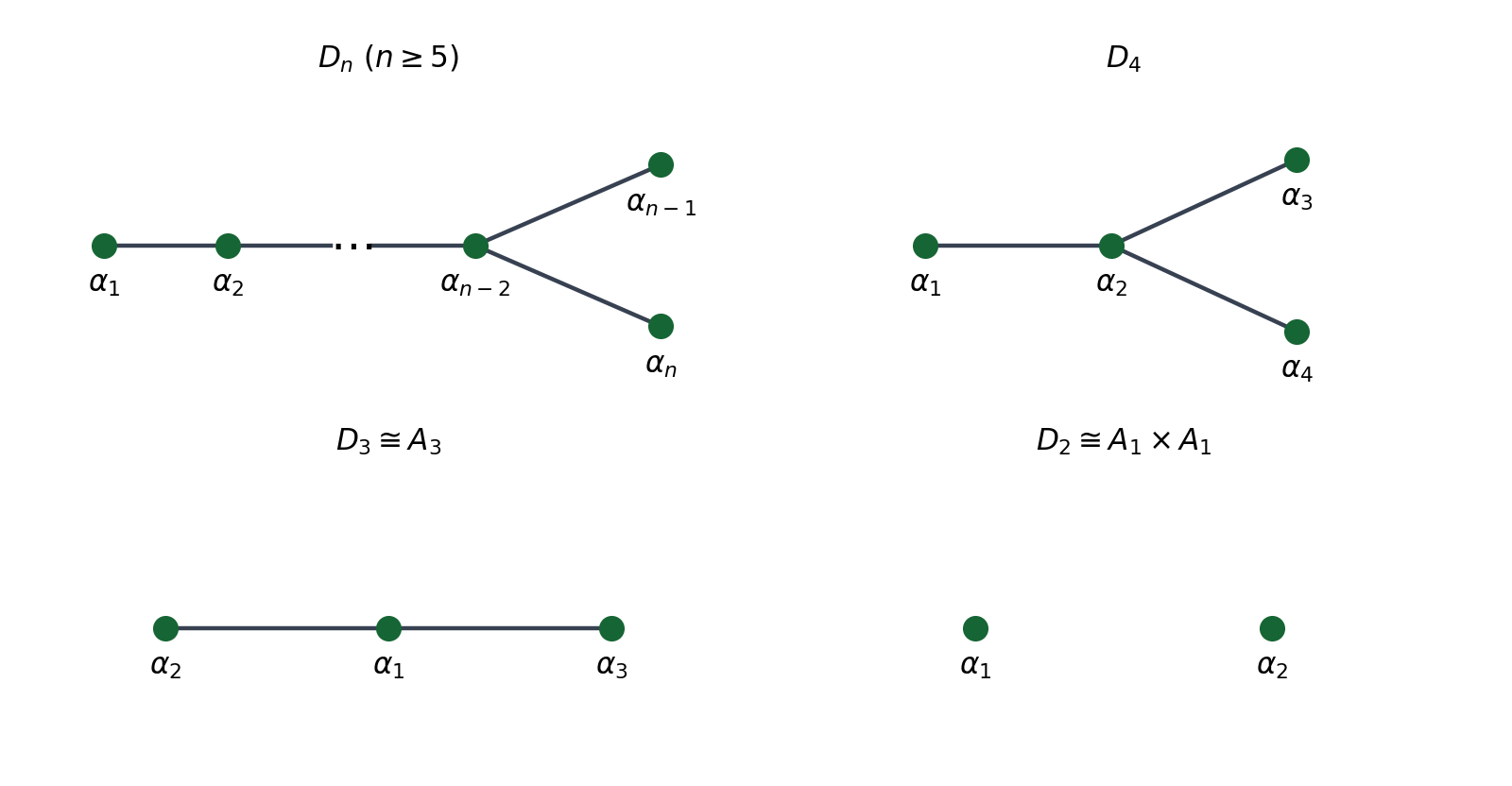
Labelled D-type Dynkin diagrams, including the low-rank cases
. Details. For , and are orthogonal, giving two disconnected A1 root systems. For , the diagram is the chain , of type A3 root system; the displayed weight formulas still apply. If is allowed, is one-dimensional and abelian: there are no roots or fundamental weights, and .
In dimension four, the two positive roots are and . Using the matrix root basis of the even orthogonal Lie algebra, defineThe matrix unit identity gives , , and for . Thus each triple spans an sl2 Lie algebra.
The two triples commute. Their Cartan actions on one another vanish because ; their mixed root-vector brackets vanish because none of , namely and , is a root. This can equally be checked from the displayed matrix units. The six vectors are linearly independent, occupying the four distinct root spaces and two independent Cartan directions, so they exhaust the six-dimensional so4 Lie algebra. The two commuting spans are consequently ideals, andThis gives an explicit Chiral decomposition of the complexified so4 Lie algebra, including generators for both factors.
Identify with the coordinate vector through . A root reflection is . Since , for the two possibilities areEvery other coordinate is unchanged, and , so these formulas cover every root. The complete diagonal matrix is reconstructed with its last entries the reversed negatives of the first entries.
The Weyl group of Dn consists of all permutations of the coordinates together with an even number of coordinate sign changes. Equivalently,Its order is . The difference-root reflections give ordinary transpositions; composing a sum-root reflection with the corresponding difference-root reflection negates precisely the two selected coordinates. These describe the generators of all even signed permutations. For the group has four elements; for the toral case it is trivial.
In the defining representation , the basis vectors and have weights and , respectively, each with multiplicity one. Thus its formal character isThe vector is killed by every positive root space, since all positive-root matrices are upper triangular, and is a highest-weight vector. Any nonzero invariant subspace splits into weight spaces and therefore contains one of the natural weight vectors, since those weight spaces are one-dimensional. The root matrices connect that vector to all the others, so this representation is irreducible for . In terms of the fundamental weights of Dn, its highest weight is for and for .
The flip of the two tensor factors is equivariant, henceUse the invariant symmetric bilinear form . Contraction is an equivariant map to the trivial Lie algebra representation. Its inverse-form tensoris invariant and satisfies . ConsequentlyThe traceless summand contains the highest-weight vector of weight . The Weyl complete reducibility theorem states that every finite-dimensional complex semisimple Lie algebra representation is a direct sum of irreducible representations, so the submodule generated by this highest vector is . The Weyl dimension formula verifies that it is the entire traceless space: only positive roots involving change their factors, andThis equals . Thus the traceless symmetric square of the defining even orthogonal representation is irreducible, including .
For the other summand, the exterior square of the defining orthogonal representation has the equivariant identificationThe image is skew relative to , and in a basis making the identity the images are the independent elementary skew matrices. The map is therefore an isomorphism onto the Adjoint representation of a Lie algebra. For , the connected Dn Dynkin diagram gives a simple Lie algebra (with ); its adjoint module is irreducible because its invariant subspaces are exactly its ideals. Its highest weight is , and is a highest vector. The tensor-square decomposition of the defining even orthogonal representation is consequentlyThe three dimensions are , and one, adding to . The highest weights are , and zero for ; for the middle weight is .
For , the Chiral decomposition of the complexified so4 Lie algebra splits the adjoint module into its two three-dimensional ideals. ThusThe weights are , , and zero. Equivalently, labelling highest weights by the two sl2 Lie algebra factors, this is . If is allowed, the abelian algebra has and ; there is then no single highest weight for an irreducible natural module.
Let be a finite-dimensional complex semisimple Lie algebra, choose a Cartan subalgebra and a set of positive roots, and write for the Weyl group. Let be a dominant integral weight and the finite-dimensional irreducible highest-weight representation with that highest weight. If denotes its weight space of weight , its formal character is . The symbols belong to the group algebra of the weight lattice and multiply by ; they are formal symbols, not matrix exponentials.
Put , the half-sum of positive roots, and let be the Coxeter length of , the least number of simple reflections expressing it. Then in the real reflection representation. The Weyl character formula statesBy the Weyl denominator formula, the denominator is , giving the equivalent expressionThe quotient can be interpreted in the fraction field of the formal group algebra; the theorem says it simplifies to the finite formal character above. In particular the apparent denominator does not mean that the representation has infinitely many weights.
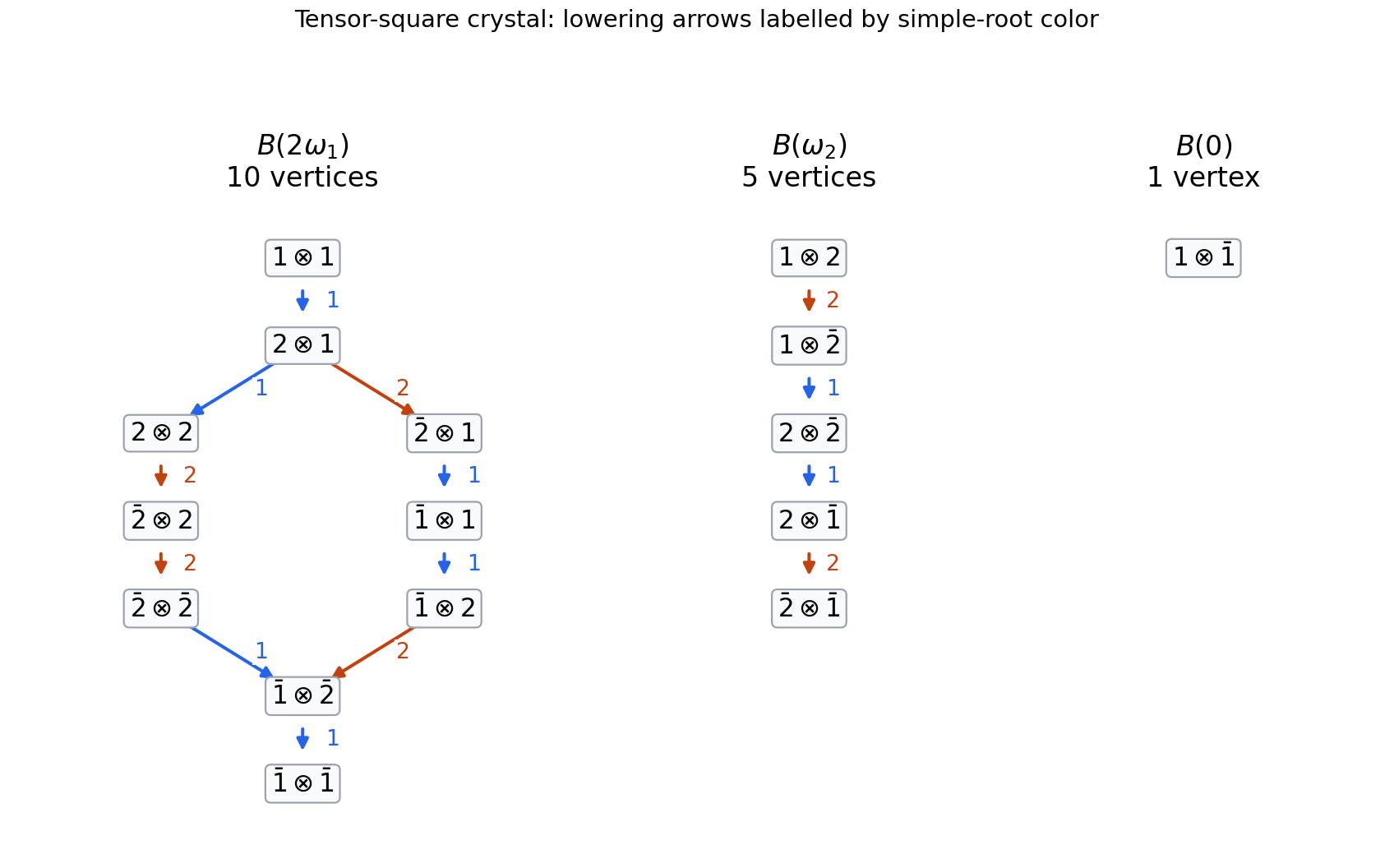
Name the four vertices in their displayed order. This is the crystal of the defining symplectic representation in rank two, of highest weight for the C2 root system. Its weights are respectively , with simple roots and . Each lowering arrow subtracts the corresponding simple root. Thus and .
Use the crystal tensor-product rule in which acts on the first factor if , and on the second factor otherwise. The raising operator acts on the first factor for , on the second otherwise. Here and count the raising and lowering steps available in color . The data for the four vertices areThe strictness difference between raising and lowering ensures that they are inverse along each colored edge. Testing the sixteen ordered tensor vertices gives exactly three vertices killed by both raising Kashiwara operators:Their highest weights are , and zero.
For completeness, successive lowering generates the following connected components of the tensor product of crystals:
They have sizes ten, five and one, are disjoint, and exhaust all sixteen vertices. This proves the tensor square of the defining C2 crystal decompositionEquivalently, the representation decomposes as . The dimensions agree with the Weyl dimension formula for C2, . The ordered highest vertices would change under the opposite tensor convention, but the irreducible decomposition would be the same.


Use the standard sl2 Lie algebra relations , and . The classification of finite-dimensional sl2 representations says that every finite-dimensional complex module is a direct sum of , , where has weights . The raising operator and lowering operator move weights by two and minus two. On each therefore has st power zero. There is consequently one integer such that on all of .
The matrix exponentials are thus finite polynomials in nilpotent operators:Each is a well-defined endomorphism, and its inverse is obtained by negating the argument. Their product is therefore a linear automorphism,This Weyl reflection lift in an sl2 representation is algebraically defined by finite sums; no choice of topology or convergence of an infinite series is needed.
Let be the highest vector of the Verma module and set . The Poincaré-Birkhoff-Witt theorem implies that is a basis, so none of these vectors vanishes. The actions areThe raising operator is a locally nilpotent operator: on every vector, repeated application of eventually removes all its finitely many basis terms. Thus its algebraic exponential of a locally nilpotent operator is defined, and . But the middle factor in the proposed product would have to send this vector towhich has infinitely many nonzero, linearly independent basis coefficients. An element of the algebraic Verma module is a finite linear combination of the , so this expression is not in . In particular the lowering operator is not locally nilpotent.
Even for integral , is nonzero in the Verma module; it becomes zero only in its finite-dimensional irreducible quotient . Hence is not defined as the displayed composition of endomorphisms of the algebraic Verma module. Working in a completion would be a different problem and is not part of the module specified here.
The classification of finite-dimensional sl2 representations identifies with . In the defining two-dimensional representation,so andOn the th tensor power, the infinitesimal operator associated with is the sum of its actions on the individual factors. These actions commute, so exponentiating their sum is the tensor product of the individual exponentials; the same holds for . Restricting to the symmetric power consequently identifies the operator on with . It follows thatIndeed contributes one minus sign from each of the tensor factors. The Weyl reflection lift in an sl2 representation can therefore square to minus the identity, even though its image in the Weyl group is an involution.
An inverse system of topological spaces over a directed set consists of spaces and continuous maps for , with and . Its inverse limit is a space with compatible continuous projections such that every compatible family of continuous maps factors uniquely through a continuous map . To construct it, takewith the subspace topology inherited from the product topology. The map has values in and is continuous by the definition of the product topology; its coordinates force uniqueness. If is another inverse limit, the two universal properties give continuous maps and whose composites have all the same projections as the identity. Uniqueness makes these composites the identity. The inverse limit exists and is unique up to a unique projection-preserving homeomorphism. An arbitrary inverse limit may be empty; nonemptiness requires additional hypotheses.
Use the usual Hausdorff convention for a topological group. An inverse limit of finite discrete groups is a closed subgroup of their product: each compatibility condition is closed because the finite factors are Hausdorff spaces. The Tychonoff theorem gives compactness, and distinct tuples are separated by a clopen coordinate cylinder, so the limit is totally disconnected. Coordinatewise multiplication and inversion are continuous, giving a profinite group.
Conversely, let be a compact Hausdorff space and a totally disconnected topological group. We use the standard topological fact that a compact Hausdorff space that is totally disconnected has a basis of clopen sets. Given an identity neighbourhood, choose a clopen identity neighbourhood inside it. Compactness of and continuity of multiplication give a symmetric identity neighbourhood with : cover by finitely many neighbourhoods on which multiplication by a sufficiently small identity neighbourhood stays inside , then intersect those identity neighbourhoods. Symmetry gives for . Consequently is a subgroup containing , hence an open subgroup, and since . Its open cosets cover the compact group, so there are finitely many. The normal core is a finite intersection of open subgroups, hence an open normal subgroup contained in . Thus the open normal subgroups form an identity-neighbourhood basis and have trivial intersection.
The canonical group homomorphism is continuous and injective. For a compatible tuple of quotient elements, its inverse-image cosets in are closed and have the finite intersection property: a finite family is refined by the quotient for the intersection of its normal subgroups. Compactness gives an element in all those cosets, proving surjectivity. A continuous bijection from a compact space to a Hausdorff space is a homeomorphism. The compact totally disconnected and inverse-limit definitions of a profinite group agree.
Index the finite nonempty sets by open normal subgroups, with the transition from to when given by image under . Images of Sylow subgroups under surjections of finite groups are Sylow subgroups. These transitions are surjective: if is a Sylow subgroup, choose a Sylow subgroup in its full inverse image in . It maps onto , and its order has the full -part of , so it is a Sylow subgroup of too. The transitions respect composition, giving an inverse system of finite sets.
Its inverse limit is nonempty. Indeed, finitely many compatibility conditions can be satisfied by choosing one Sylow subgroup in a quotient refining all the involved quotients and taking its images; compactness of the product of the finite sets then gives a compatible family . DefineThis is a closed subgroup of . Its image in is exactly : for a prescribed , each finite collection of conditions defining together with is satisfiable in a common refining quotient, because the transitions on the chosen Sylow subgroups are surjective. The finite intersection property again supplies . Hence is a pro-p group and for every .
Finally, if a pro-p subgroup contains , its image in every finite quotient is a p-group containing the Sylow subgroup , so that image equals . Thus every belongs to every , whence . The constructed is a maximal pro-p subgroup.
Articles were limited to the first 100 out of 1751 total.
Articles by others on the same topic
There are currently no matching articles.