For , the polar coordinates satisfyA positive constant radius must therefore be one. The nonconstant periodic solutions arewith least period and counterclockwise orientation. The origin is also a stationary solution, hence periodic in the degenerate sense of a constant function; it is a point rather than a nontrivial closed orbit. There are no other constant-radius solutions.
For , put . Then , a logistic differential equation. Solving this separable differential equation givesThe denominator is positive for every forward time. When , the radius increases monotonically to one; when , it decreases monotonically to one; and when it stays there. Thus every nonzero orbit approaches the unit circle while continuing to rotate. More precisely, its distance from the phase-matched circular solution tends to zero; its Cartesian coordinates do not converge to a single point. For , the solution stays at the origin.
The origin is the only equilibrium point. Its Jacobian matrix iswhose eigenvalues are . It is an unstable focus. The unit circle is an attracting limit cycle, rather than a curve of equilibria: on it the vector field remains nonzero. Linearizing the radial equation at gives , confirming radial attraction. All other radii are strictly monotone, so there are no additional nontrivial periodic orbits.
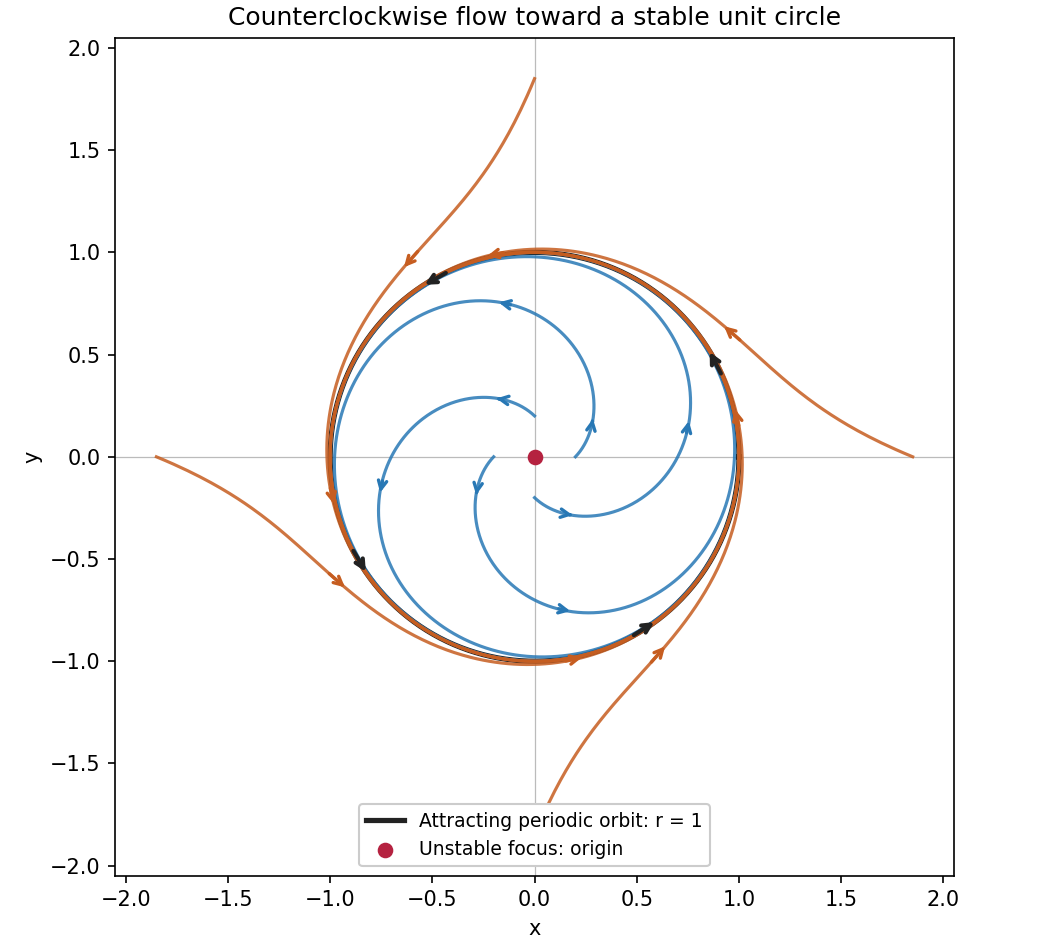
Counterclockwise spirals approach an attracting unit circle around an unstable equilibrium
. Details. 
Articles by others on the same topic
There are currently no matching articles.