At a fixed point , and the first equation factors. The branches areThe three branches meet at , and the positive square-root branch meets the quadratic branch at . The Jacobian matrix at a general fixed point isOn , its trace is and determinant : the branch is attracting for and a saddle for or . On , the eigenvalues are and . The negative branch is always a saddle for ; the positive branch is a saddle for and attracting for . At the bifurcation values the zero eigenvalue requires the nonlinear analysis below.
For , , , the equations areThe extended centre manifold has with no linear terms. Since has degree at least three, its invariance equation to degree two is . ThusThe reduced quadratic factors as . Its two roots have reduced eigenvalues and , respectively, and the transverse eigenvalue remains negative. They exchange stability at , a transcritical bifurcation. The exact branches have and , consistent with this second-order evolution equation.
Near , the slow equation has leading form , so this is a subcritical pitchfork bifurcation with the parameter orientation displayed. For there is one nearby saddle, whose unstable direction is close to and stable direction close to vertical. For the central branch is attracting and the outer two equilibria near are saddles; their separatrices distinguish attraction toward the central equilibrium from departure outwards. The actual central location is , not exactly the origin away from .
Adding positive breaks the pitchfork symmetry. The leading equilibrium equation near zero is : the diagram unfolds into a single branch plus a saddle-node pair, with the latter appearing for positive of order . More precisely the fold is at , at leading order. Near one the reduced equation becomes . Its discriminant is ; the crossing is replaced by two saddle-node endpoints with a no-equilibrium gap for to leading order. Outside that gap, the lower reduced root is stable and the upper one unstable. These local approximations describe the sketch; the exact perturbed curves have higher-order corrections.
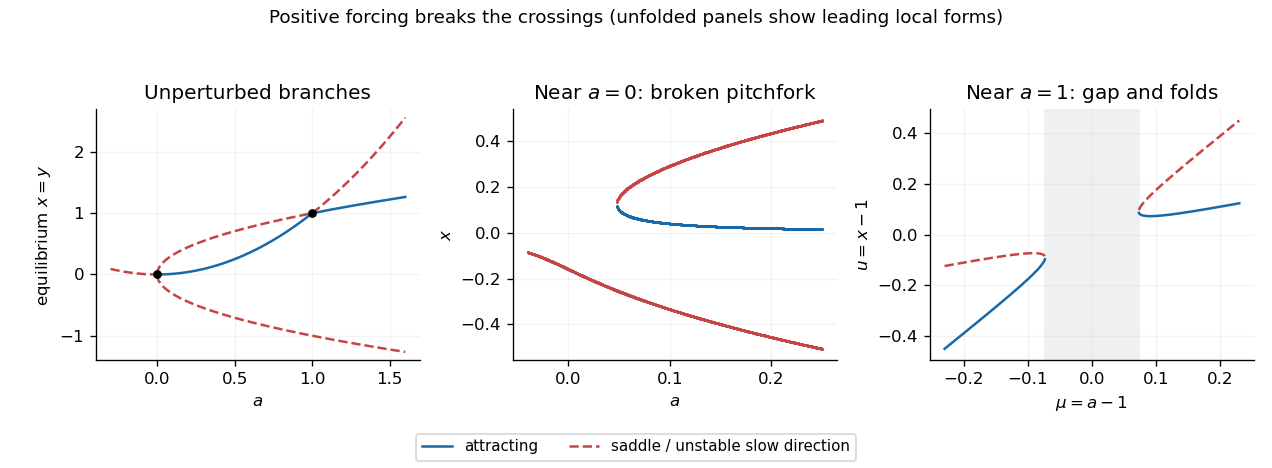
Fixed-point branches, local phase portraits and the positive-forcing unfoldings of the pitchfork and transcritical bifurcations
. Details. 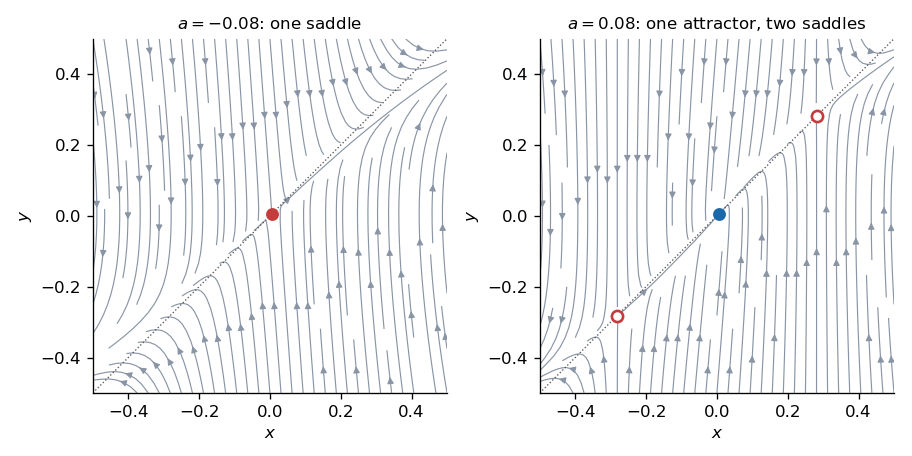


Articles by others on the same topic
There are currently no matching articles.