Let , and . Steady smooth adiabatic flow has with the entropy parameter fixed by infinity, andThe second expression follows by integrating the radial momentum equation with and imposing the outer rest condition. Differentiate continuity to give , and substitute into momentum. This yields the Bondi accretion wind equationAt a smooth positive-radius sonic point, and both sides' vanishing factors require . Evaluate the Bernoulli relation there:Both the squared sound speed and sonic radius must be positive and finite. HenceFor no finite-radius regular sonic crossing is possible; the critical solution discussed next approaches sonic speed only at the central limit.
At , the sound-speed relation becomes . With , mass conservation gives . ThusMultiply by and substitute. This provesFor the curves, define , and . ThenThe function decreases up to Mach one, increases thereafter, and has minimum . The original sketch uses rates relative to , that is :
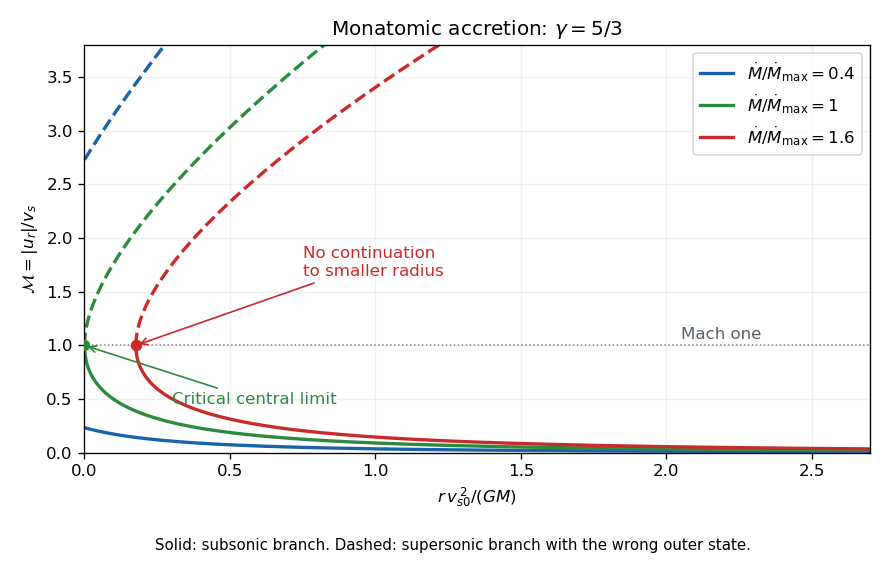
Mach-number branches of monatomic Bondi accretion below, at and above the maximum rate
. Details. 
For , the minimum of the formal radius curve lies at negative radius. Its physical parts are separate subsonic and supersonic branches extending to . Only the subsonic branch satisfies the specified outer state: as , it has , and . The supersonic branch instead has , and , so it is incompatible with that boundary condition.
At , the two branches meet at . The outer-rest branch remains subsonic at every positive radius and approaches Mach one at the centre. For , they meet at a positive minimum radius , and no real solution exists below it. Such a curve cannot describe a global smooth inflow to a point mass.
Thus globally defined positive-rate solutions satisfying the given outer condition are the subsonic branches with . These constitute monatomic Bondi accretion. The outer condition alone does not select a unique member; the conventional maximal Bondi solution is the limiting sonic one, while a specific inner accretor condition is additional physical information. Zero rate is the separate hydrostatic limit, not a positive accretion flow.
A solution reaching arbitrarily small radii must obey with . Taking therefore requires , or . This upper bound is attained: at the decreasing branch has one solution for every and approaches Mach one as . HenceThe argument establishes the maximum allowed by a globally continuing steady flow, without incorrectly claiming a finite-radius sonic point at .
Articles by others on the same topic
There are currently no matching articles.