The initial table of content was limited to the first level because it is larger than 1000 articles. There are 1857 articles in total. Expand a branch to load its children.
Use the standard sl2 triple , , . In the tensor product of Lie algebra representations, each operator acts on both factors. PutThese twelve vectors form a weight basis, and . Thus the bases of the weight spaces areThere are no other weights. The weight diagram shows their multiplicities, with the decomposition also displayed for comparison.
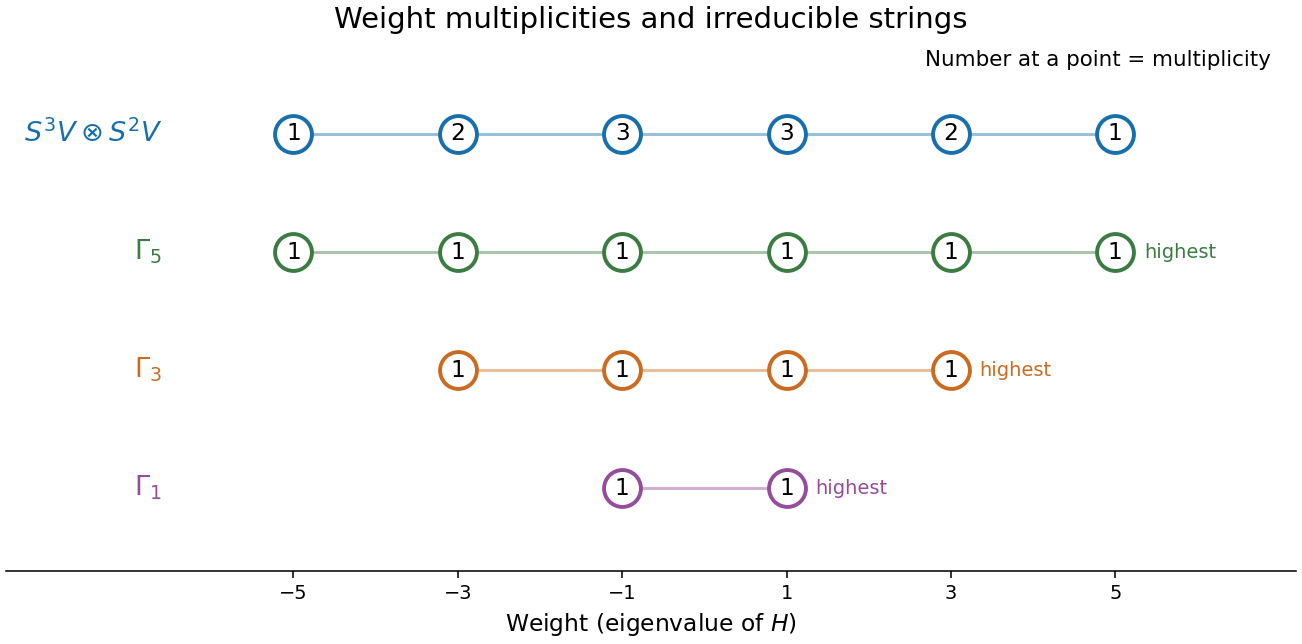
Weights and multiplicities of the cubic by quadratic sl2 tensor product and its irreducible summands
. Details. 
The raising operator acts bywith out-of-range terms omitted. At weights five, three and one its kernels are respectively spanned byAt weight one the kernel equations are and for . At weight minus one they are , , , which force zero; the maps on the two remaining negative-weight spaces are injective as well. Thus these three lines give all nonzero highest-weight vectors up to scalar, at their respective weights. A linear combination of different lines is killed by but is not a weight vector, so is not a highest-weight vector.
The lowering operator isIn particular,is an explicit basis for the submodule . Indeed , , , and the two vectors have weights . The analogous strings from have dimensions six and four. Their distinct irreducible highest weights and total dimension twelve give the sl2 tensor product of cubic and quadratic symmetric powers
Let be the dual basis of , and use . The elementary tensors have weight . Grouping them gives every weight space explicitly:The counts are , so this table exhausts the tensor product. The diagrams below use equilateral coordinates , , ; numbers at points are weight multiplicities.
To decompose the module, first split the first two factors into their symmetric and alternating parts. Put , including . The equivariant contractionis onto, since . Its kernel has dimension fifteen and contains the highest-weight vector of weight .
Here is an explicit weight basis of the trace-free symmetric-square dual tensor module, and thus the requested fifteen-vector basis:Every displayed vector contracts to zero. The first two families occupy distinct one-dimensional weights; at each weight the two vectors in the last family are independent because their respective terms are distinct. Thus all fifteen are independent and span .
For completeness, is irreducible, not just an invariant kernel of the right dimension. On elementary tensors the raising action isAt the six weights , both and kill the vector only for . At each weight , at least one of those operators is nonzero. At weight , write a vector as . The two raising equations are and , forcing zero. On the two-dimensional weight- space is injective, and on the weight- space is injective, as substitution in the same action formula shows. Therefore the common raising kernel in is the single line . By Weyl complete reducibility theorem, every irreducible summand supplies a highest-weight line, so has only one summand and is irreducible.
The symmetric-factor contraction splits off a defining copy ; explicitly is equivariant and its contraction is . For the alternating factor, the invariant volume form identifies , sending to , to and to . ThereforeThe symmetric dual module is irreducible of dimension six and highest weight ; its symmetric-monomial basis has weights and , all of multiplicity one. In the original tensor product its highest-weight vector isThe raising action above annihilates it, and its weight is .
Altogether the Triple tensor decomposition for the defining sl3 representation isThe fifteen-dimensional module has multiplicity one at each and , and multiplicity two at each . The six-dimensional module has multiplicity one at and . Each defining module has the three weights , once each. These add to the original table of multiplicities.
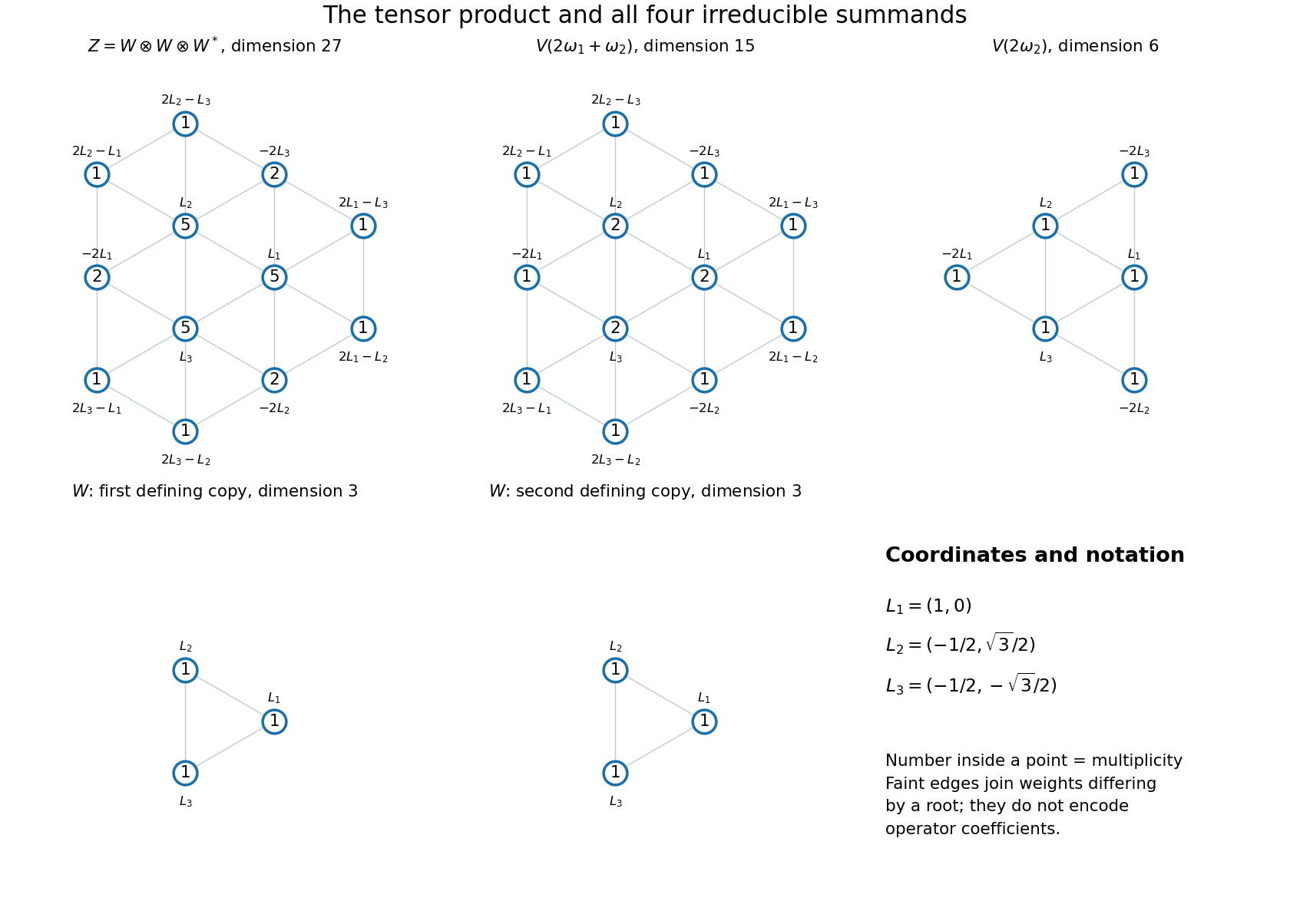
Weight diagrams of the 27-dimensional sl3 tensor product and its irreducible summands of dimensions fifteen, six, three and three
. Details. 
The two defining summands are not intrinsically distinguished: other diagonal copies inside their isotypic component have the same three-point weight diagram. Thus the displayed diagrams account for every irreducible submodule type, as well as showing both copies in this decomposition.
Work in finite dimension over ; the characteristic-zero real version follows by complexification. The Cartan solvability criterion isIts semisimplicity consequence, also often called Cartan's criterion, is is semisimple if and only if its Killing form is nondegenerate. We prove both forms.
The auxiliary results used are as follows. The Lie theorem simultaneously triangularizes every finite-dimensional representation of a complex solvable Lie algebra. The Engel theorem says that a matrix Lie algebra consisting entirely of nilpotent endomorphisms has a common annihilated nonzero vector and a basis making all its matrices strictly upper triangular; in particular it is a nilpotent Lie algebra. Nilpotent means that the lower central series terminates, which implies that the derived series terminates as well. Finally, the Additive Jordan decomposition writes any complex endomorphism uniquely as , where is diagonalizable, is nilpotent and they commute. On a generalized eigenspace , the two parts are and , and both are polynomials in . On endomorphisms, is diagonalizable, is nilpotent, and these are the Jordan parts of : the first assertion follows by splitting into maps between eigenspaces, and the second by expanding repeated commutators with the nilpotent .
First prove the linear trace version: if andthen is solvable. Fix and let be its generalized eigenspace decomposition. Define to act on by the scalar . We do not assume that , or belongs to .
On , has the form with nilpotent, whereas is multiplication by . Choose a polynomial with for every occurring eigenvalue difference , and with all its derivatives of positive order up to the relevant nilpotency index zero at . Such a polynomial exists by Hermite interpolation, or the Chinese remainder theorem for the pairwise coprime powers of . At its value is zero, so . Expanding now givesBecause and is an ideal, every positive power of sends into . The zero constant term therefore gives .
Express as a sum of commutators with . Cyclicity of trace and the hypothesis implyBut on , has trace , since the nilpotent part has trace zero. Henceforcing every eigenvalue of to vanish. Thus every member of the derived algebra is a nilpotent endomorphism. By the Engel theorem, is nilpotent and therefore solvable; its derived series terminates, and adjoining the initial term shows that is solvable.
Conversely, if is solvable, the Lie theorem makes it upper triangular. Commutators of upper-triangular matrices have zero diagonal, and multiplying such a commutator by an upper-triangular matrix still has zero diagonal. Therefore the trace condition holds. Apply this equivalence to . Its trace pairing is the Killing form, and solvability of its image is equivalent to solvability of : the kernel is its abelian centre, so a terminating derived series in the quotient terminates after at most one more step in . This proves the solvability criterion.
For the semisimplicity criterion, let be the radical of the Killing form. Invariance makes a Lie algebra ideal. For , their adjoint actions on vanish, so computing trace in a basis adapted to gives . The solvability criterion applied to shows it is a solvable ideal. Thus a semisimple Lie algebra has and a nondegenerate Killing form.
Conversely, any nonzero solvable ideal has a last nonzero term in its derived series; this is an abelian ideal of . For , , the map sends into and vanishes on , so has trace zero. Hence . A nondegenerate Killing form therefore rules out nonzero solvable ideals, exactly the definition of semisimplicity.
For classification, nondegeneracy of the Killing form provides the duality and root-space pairings used to extract a reduced crystallographic root system from a semisimple Lie algebra. Classification then reduces to the finite Dynkin diagrams and reconstruction of the Lie algebra from its root data.
For a Lie group with identity , its Lie algebra as a set is the tangent space :The ambient embedding identifies these tangent vectors with vectors in . For a matrix Lie group, the identity is and the tangent vectors are matrices.
If with , put . The determinant expansion follows directly from its permutation formula: to first order only the diagonal entries contribute. Since , differentiation gives . ThusIn fact equality holds: if , then has determinant and derivative at zero.
Take curves through the identity with tangent vectors . Form the local group commutator . In a smooth coordinate chart at the identity, its leading mixed term defines the Lie bracket:for a matrix group, where the identity's constant term has zero derivative. More generally take this derivative in the chart with the identity sent to zero. Since the first derivatives vanish on the coordinate axes, changing charts changes the mixed coefficient only by the tangent-space coordinate transformation, so the definition is intrinsic.
For the displayed nilpotent matrices choose and , which lie in . Their inverses are and . Direct multiplication givesIts mixed derivative is thereforeInterchanging the two curves giveswhose mixed derivative is . Thus directly from the curve definition. The general matrix expansion likewise gives the commutator .
A smooth vector field on a smooth manifold is a smooth section of its tangent bundle: it assigns smoothly to each point. On a Lie group, it is a left-invariant vector field whenFor , define . Smoothness of multiplication makes this a smooth vector field, and plus the chain rule proves left invariance. Every left-invariant vector field arises this way from its value at the identity.
For a matrix Lie group, , because the derivative at zero of is . The printed group name in this subpart must be read as , rather than the additive vector space : it is the matrix-group calculation consistent with the preceding subparts. At the specified matrix,A tangent vector at a nonidentity group element need not itself be trace-free; here is trace-free, as required. If one instead interpreted the printed as its additive Lie group, the field would be the constant field , a different problem.
For a finite-dimensional Lie algebra, define its Killing form byThe trace identity proves symmetry, and linearity of trace proves bilinearity. The Jacobi identity gives . Consequently, by cyclic invariance of trace,This is the invariance identity. Equivalently for all three elements.
If , and , invariance of the Killing form givesUnless , some makes its coefficient nonzero, so the two root spaces are orthogonal. Similarly for every root: choose with and use that is abelian.
Now take nonzero . Nondegeneracy on supplies some element pairing nontrivially with . Its root-space decomposition shows that only its component can contribute. Thus the pairing between opposite root spaces is nonzero, and indeed nondegenerate. ThereforeHere nonzero means the bilinear pairing is not identically zero, not that every pair of vectors has a nonzero value.
If is orthogonal to all of , it is also orthogonal to every root space, by the preceding orthogonality. It is therefore orthogonal to all of , forcing . Hence is nondegenerate.
Put and . On the root space spanned by , their adjoint eigenvalues are and ; both act as zero on the Cartan subalgebra. Thus the Killing form is the sum of their products over the six roots. The pair of roots contributes , the pair contributes , and contributes . HenceThis also agrees with the Killing form of the special linear Lie algebra, for .
The displayed identity is valid for a highest-weight vector , satisfying and , not for arbitrary . For example, in the defining module with , take : then but the proposed right side for is .
For a highest-weight vector, the sl2 triple relations give . The operator identitycomes from expanding a commutator with a product. Apply it to , using . Each term becomes , so the sum isThis proves the intended sl2 highest-weight lowering formula. The identity valid for an arbitrary vector is instead
On the basis of the irreducible module, has eigenvalue on , for . Summing gives the trace of a raising-lowering product in an irreducible sl2 module:The last equality follows by the formulas for the sums of the first integers and their squares.
For a root , choose normalized root vectors , and the coroot element withThe requested sl2 subalgebra associated with a root isThese bracket relations identify its basis with the standard sl2 triple. The notation here denotes this subalgebra, not the root reflection used for the Weyl group.
The weight diagram of the Adjoint representation of has its six roots , , each of multiplicity one, and zero of multiplicity two, from the Cartan subalgebra.
Restrict to the root subalgebra generated by , and . The explicit decomposition into irreducible modules isThe first summand has weights . The second has weights , since . The third likewise has weights , since . The last commutes with all three generators and is trivial. These subspaces are stable under the sl2 triple, are independent and have dimensions totaling eight, so they exhaust the Adjoint representation.
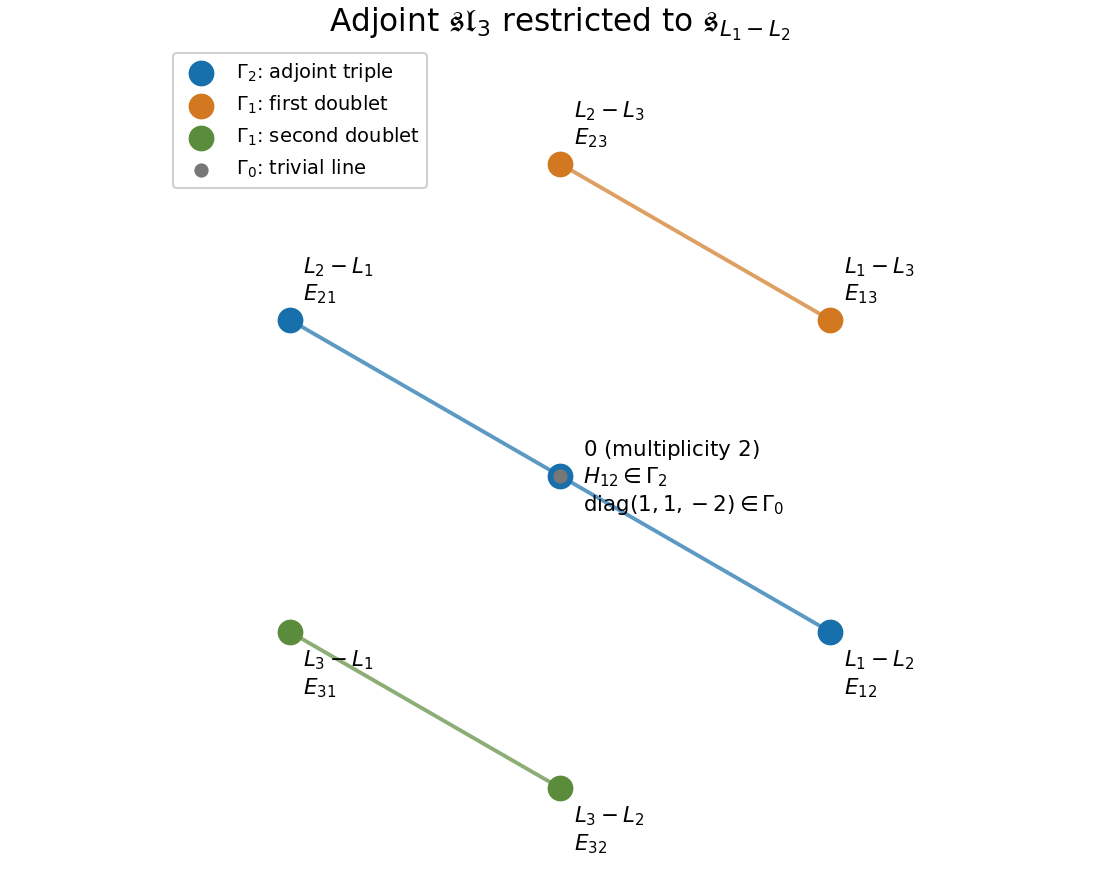
Adjoint sl3 weights coloured by their irreducible summands under the root sl2 subalgebra, with the two zero-weight vectors distinguished
. Details. 
The Killing form value is the trace of . By the formula just proved, the four summands contribute . Therefore
Identify the real span of the roots with its dual using the invariant inner product, and put . The weight lattice isThe Weyl group is generated by the root reflections . Each reflection permutes the finite set of roots and preserves their lengths, hence also permutes their coroots. Thus, for ,Every generating reflection therefore maps the weight lattice to itself, and so does every product. Since the inverse product has the same property, every Weyl-group element acts bijectively on . The roots span the ambient space, so the action on the finite root set is faithful; in particular the Weyl group is finite.
Choose simple roots . For the orbit statement one must use the Closed dominant Weyl chamberIts interior, defined using strict inequalities, is the open Weyl chamber. Weights on reflecting walls, including zero, cannot be moved into that interior, so closure is necessary here.
Choose strictly inside the chamber, for example the sum of the fundamental weights. The finite Weyl group orbit of contains an element maximizing . If for some simple root, thencontradicting the maximum. Thus every simple-root pairing of is nonnegative, and . Consequently some sends every integral weight into the closed fundamental chamber. The argument in fact works for every vector in the real weight space.
For the usual positive roots, the chamber condition is that the coefficients of be weakly decreasing, since their consecutive differences are the simple-coroot pairings. Adding the same constant to all three coefficients changes no weight, because .
The given coefficients are . Let exchange , and exchange . With the rightmost reflection acting first,ThusIts coefficients are strictly decreasing, so it lies even in the open Weyl chamber; its Dynkin labels are .
A reduced crystallographic abstract root system in a finite-dimensional real inner product space is a finite set such that: it spans and does not contain zero; the only scalar multiples of belonging to are ; every root reflectionpermutes ; and each Cartan integer is integral. These are the crystallographic and reduced conventions appropriate to roots of a complex semisimple Lie algebra. Without crystallographic integrality, the numerical restrictions in the following subparts would not hold.
If , then both Cartan integers are . This opposite-root case satisfies the printed inner-product hypothesis and must be included.
Otherwise reducedness makes the roots nonproportional. Writing the angle as , strict Cauchy-Schwarz inequality givesBoth factors are negative integers, so their product is or . The full list is thereforeThe nonproportional pairs correspond respectively to angles , and ; reversing the order of the roots reverses the unequal pairs.
There is an exception to the printed assertion: for , the inner product is negative but is not a root. This already occurs in the rank-one root system .
For the intended assertion, assume . By the preceding list, at least one of equals . If the first does, the reflection axiom givesIf the second does, use instead. Thus the precise reusable conclusion isThis proves that obtuse nonopposite roots have a root sum directly from the reflection and integrality axioms, without appealing to the classification of root systems.
Choose a linear functional which is nonzero on every root; one exists because there are only finitely many root hyperplanes to avoid. Declare a root positive when , and negative when . This orders the roots by sign, compatibly with addition whenever the sum is a root. One can refine it to a lexicographic total order by completing to a coordinate system. Since negation permutes the roots,A simple root is a positive root not expressible as the sum of two positive roots. If distinct simple roots had as a root, it would be either positive or negative. In the first case decomposes into two positive roots; in the second decomposes . Both contradict simplicity. If they are equal, their difference is zero and is also not a root. Hence the difference of two simple roots is never a root.
For use in the final subpart, the simple roots form a basis, and every positive root is a nonnegative integer combination of them. Here are the needed reasons. Repeatedly decompose a nonsimple positive root into two positive roots; their values decrease, and the finite root set makes this terminate. This gives the integer combinations. Distinct simple roots have nonpositive inner product: a positive inner product would make and obtuse, so the qualified root-sum lemma would make a root, just ruled out. Finally, a nontrivial linear relation between simple roots can be split into positive and negative coefficients, giving the same vector as positive combinations of disjoint sets. Its squared norm, computed using those two expressions, is nonpositive, whereas a nonzero positive combination has positive value. This contradiction proves linear independence. Their span is because they generate all roots.
The single bonds give equal simple-root lengths and inner products, after normalization,The positive roots of this A3 root system areThe first two sums are roots by the qualified obtuse-root lemma. The last is a root because . All have nonnegative simple-root coordinates, hence are positive.
To prove completeness, first note that every root is Weyl-conjugate to a simple root. For a nonsimple positive root , some , since . Reflection subtracts a positive integer multiple of , decreasing its integer height. The reflected root stays positive: it leaves the coefficients at all other simple roots unchanged, at least one of which is positive; a root has coordinates all of one sign. Repeating this height decrease reaches a simple root. Thus every root has squared length two in this connected single-bond system.
Write an arbitrary positive root as , with nonnegative integers . Its squared length condition isThus . For the equation gives ; for or it gives or ; for it gives . These are exactly the six coefficient triples in the displayed list. This proves completeness from the axioms, not merely from recognizing the Dynkin diagram.
Suppose first that is a Noetherian module. An ascending chain of submodules of is also a chain in , so it stabilizes. A chain in the quotient module lifts to a chain in , so it also stabilizes. Thus both and are Noetherian modules.
Conversely, let be a chain of submodules of . If and are Noetherian modules, both and stabilize, say for . For , equality of the images gives with . Then , and hence . This proves the extension direction of Noetherian modules in a short exact sequence.
The left regular module is Noetherian because is a left Noetherian ring. Applying the extension result inductively makes each finite direct sum Noetherian. Every finitely generated module on the left is a quotient module of such a direct sum, so it is Noetherian.
A poly-(cyclic or finite) group has a finite subnormal serieswhose factors are cyclic groups or finite groups. We prove that the group ring is a left Noetherian ring by induction. Put . A finite factor makes a finite free left -module, using a coset transversal. Its left ideals are -submodules, so finite-module extension preserves Noetherianity handles this case.
If the factor is infinite cyclic, choose a lift of a generator and let . The group ring is the skew Laurent polynomial ring . Here is the required left-sided skew Hilbert basis theorem. For a left ideal , defineEach is a left ideal of . Left multiplication by gives . The ascending chain condition makes these ideals constant for ; choose finitely many generators for each , , and lift them to polynomials .
If has degree and leading coefficient , writeSubtracting cancels the leading coefficient. For , use the lifts for instead. Induction on polynomial degree shows that the finitely many generate . Thus the skew polynomial ring of an automorphism is a left Noetherian ring.
Finally, for a left ideal of , its intersection with has finitely many generators. Every satisfies for some , so those same generators generate after multiplication by . This completes the induction and proves that is left Noetherian, the left-sided form of group rings of poly-(cyclic or finite) groups are Noetherian.
The Jacobson radical is , where runs over the maximal right ideals. Every proper right ideal lies in such an : the union of a chain of proper right ideals containing is a right ideal and remains proper because it omits . Thus Zorn lemma applies.
The right-module form of Nakayama lemma says that a finitely generated module with is zero. More generally, if is a submodule and , then . To prove the first statement, suppose and take a generating set of minimal size. Since , there are withThe unit criterion for the Jacobson radical makes a unit. Hence is generated by the other , a contradiction. Apply this result to the quotient module to obtain the general form.
For an injective module endomorphism of an Artinian module , the descending chain condition givesfor some . Given , write ; injectivity of gives . Thus is surjective, as asserted by Artinian modules are co-Hopfian.
Now is a semilocal ring and is a finitely generated module over the right Artinian ring . A finite direct sum of copies of , and hence its quotient module , is an Artinian module. The module endomorphism induces on , and the given inverse-image condition says precisely that . The preceding argument makes surjective, soThe quotient module is finitely generated and satisfies . Applying Nakayama lemma yields . Therefore is surjective, by surjectivity from injectivity modulo the Jacobson radical.
An essential right ideal intersects every nonzero right ideal nontrivially. A regular element of a ring is a two-sided non-zero-divisor: both and imply . Writing for the set of these elements, the classical right ring of quotients is a ring containing , with every invertible and every element of expressible as .
Goldie theorem states that a semiprime ring has a semisimple Artinian classical right ring of quotients if and only if it is a right Goldie ring: it satisfies the ascending chain condition on right annihilators and has finite uniform dimension. In particular, every semiprime ring that is a right Noetherian ring satisfies the theorem. We prove the requested case directly using the supplied assumption about essential right ideals.
First let . If a nonzero right ideal had , the sumwould be direct. Indeed, a finite relation gives , hence ; cancellation of repeats the argument. Each is a nonzero right ideal, so the partial sums form a strictly ascending chain. This contradicts right Noetherianity. Thus a regular principal right ideal in a right Noetherian ring is essential, and every right ideal containing is essential.
For and , putThis is an essential right ideal. To check this, take a nonzero right ideal . If , then . Otherwise is a nonzero right ideal, so it meets nontrivially; lifting an element of that intersection gives a nonzero element of . By the supplied assumption, contains some , givingThis is the right Ore condition. The set is multiplicatively closed, and the denominator cancellation condition holds because its elements are non-zero-divisors. Therefore Ore theorem constructs and embeds in it.
For every right ideal of ,Indeed, if , then . Contracting an ascending chain of right ideals of to therefore proves that is a right Noetherian ring.
Suppose is an essential right ideal of . For a nonzero right ideal of , choose . The right Ore condition gives a common right denominator for a finite expression of in , so there is withThus is an essential right ideal of . It contains a regular element of a ring, which becomes a unit in , and consequently .
Finally, for any right ideal of , choose by Zorn lemma a right ideal maximal subject to . Then is essential: a nonzero right ideal disjoint from would enlarge while keeping it disjoint from . Hence . Every submodule of the right regular module has a complement, making it a semisimple module. Since it is also Noetherian, it is a finite direct sum of simple modules. It is therefore Artinian, and is a semisimple Artinian ring. This is semisimplicity of a classical quotient from regular elements in essential ideals.
A filtration of a ring is an exhaustive increasing family of additive subgroups , indexed by the integers, with and . A compatible filtration of a module on a right module satisfies . The associated graded module has components , and its action by the associated graded ring isChanging either representative changes the product only by an element of , so the action is well-defined.
The subspace filtration on is . The quotient filtration is . Inclusion induces an injective map , and the quotient induces a surjective map to . If maps to zero in its degree- quotient, write with and . Then , so the kernel is exactly the image of . We have the short exact sequencewhich is exactness of associated graded modules for induced filtrations.
For the negative case, for . Completeness means that is an isomorphism; in particular the filtration of a ring is separated. If and , then . The geometric seriesconverges in the complete negative filtration and is a two-sided inverse of , by the finite geometric identity and continuity of multiplication. The unit criterion for the Jacobson radical now gives
Let be any right ideal. The associated graded module for its subspace filtration is a homogeneous ideal on the right in . If is a right Noetherian ring, choose homogeneous generators that lift to , with degrees .
For , cancel its degree- symbol by a sum with . The remainder belongs to . Repeat the cancellation in each succeeding degree. After steps,For every , the coefficient series converges to some by completeness. Passing to the limit gives . Thus these finitely many generate the actual right ideal ; no assumption that is closed is needed. Since every right ideal is finitely generated, is right Noetherian, by complete negative filtered-graded transfer of Noetherianity.
The prime radical of a noncommutative ring is , with ranging over all prime ideals of a noncommutative ring. Here primeness means that for two-sided ideals , implies or . A minimal prime over an ideal is a prime ideal containing with no strictly smaller prime ideal containing .
The ascending chain condition on left ideals also applies to two-sided ideals. We first prove by Noetherian induction that every proper contains a finite product of prime ideals, each containing . If there were counterexamples, choose a maximal one. It is not prime, so there are strictly larger two-sided ideals with . Neither is a counterexample; products of prime ideals contained in and in then concatenate to a product contained in , a contradiction.
Write . Every prime ideal over contains at least one , by primeness. The inclusion-minimal members of the finite list are therefore precisely the minimal primes over an ideal : any smaller prime over would contain a member of that same list. Consequently there are finitely many. Replacing each factor by a minimal prime contained in it giveswith each minimal over . Repeated factors may be necessary; in the sole minimal prime requires its th power to reach zero.
Apply this to . Since for every ,Thus the prime radical is a nilpotent ideal, as in finite minimal primes and nilpotent prime radical.
Now assume is commutative. A prime ideal is an associated prime of a module when for some . Every nonzero module over has an associated prime: the ascending chain condition gives a maximal annihilator of a nonzero element, and maximal annihilator of a module element is prime.
Since the given is a Noetherian module, repeatedly choosing such a cyclic submodule in the next quotient yields a finite prime filtrationThe process terminates by the ascending chain condition. In a short exact sequence , one has . Indeed, if and , the image of in still has annihilator . Otherwise choose ; then , and primeness gives . As , induction along the prime filtration provesIn particular there are only finitely many associated primes of a module.
Finally let be a minimal prime ideal of . Its localization at a prime ideal has exactly one prime, its maximal ideal . The preceding nilpotence result makes this maximal ideal nilpotent. Choose annihilated by , for example a nonzero element in its last nonzero power, or if . Since elements outside the maximal ideal are units, .
Write . The element is nonzero and also has annihilator . Generate by . For each , choose with , and put . Then remains nonzero after localization, while . If , localization forces , and hence . Therefore . This proves that minimal primes are associated primes.
Fix a finite-dimensional nonnegative filtration of a ring giving its almost commutative algebra structure, and choose a good filtration of a module on . When is a standard graded algebra, the Hilbert-Serre theorem makes the cumulative Hilbert function eventually a polynomial. For , define the dimension of a filtered module and multiplicity of a filtered module byUse and . With positive weighted generators instead of a standard grading, the cumulative Hilbert function is eventually a quasipolynomial with a common positive leading coefficient across residue classes. Equivalently, , and the definitions are and . The common leading coefficient follows from monotonicity: interlacing consecutive residue classes forces their leading coefficients to agree. For a standard grading, multiplicity is a positive integer, since an integer-valued polynomial has an integral expansion in the binomial polynomials; weighted normalization can instead give a positive rational number.
Two good filtrations of a module for this fixed algebra filtration bound each other after fixed index shifts. The corresponding Hilbert functions therefore satisfy for fixed . Comparing their leading growth shows that the degree and leading coefficient agree. Thus and are independent of the module filtration; the fixed algebra filtration is part of the multiplicity convention.
For a submodule , use its subspace filtration and the quotient filtration on . These are good because is Noetherian. The short exact sequence of filtered pieces givesNonzero leading coefficients are positive, soIf , those leading coefficients add andThis is dimension and multiplicity in a filtered exact sequence.
For the Weyl algebra in characteristic zero, Bernstein inequality for Weyl algebra modules asserts for every nonzero finitely generated module . Write its generators as , with and all other generator commutators zero. The ordered monomials give the Bernstein filtrationTake a finite-dimensional generating subspace of and put .
To prove faithful finite-step action of a Weyl algebra, consider and choose a nonzero coefficient of a monomial of maximal total degree . Applying to givesIndeed, these commutators differentiate the ordered coefficients: lower-degree monomials vanish, and another degree- monomial can survive only if all its exponents dominate , which forces equality. This is scalar extraction by iterated Weyl commutators.
Expanding these iterated commutators writes with . If annihilated , every summand would annihilate , contrary to . Therefore the action map is injective:Taking dimensions and comparing polynomial degrees giveswhich proves Bernstein inequality for Weyl algebra modules. The polynomial representation has dimension , so the bound is sharp.
The associated graded ring of the Weyl algebra is a polynomial ring, so ascending filtered-graded transfer of Noetherianity makes a left Noetherian ring. Thus every submodule of a finitely generated module is finitely generated. If , every nonzero subquotient has dimension at most by the exact-sequence formula, and at least by Bernstein inequality for Weyl algebra modules. Every such subquotient therefore has dimension and positive integral multiplicity.
In a strictly descending chain , each nonzero quotient consumes at least one unit of multiplicity, by dimension and multiplicity in a filtered exact sequence. Hence there are at most strict steps. This proves the descending chain condition, so is Artinian. In fact this holonomic Weyl algebra module has module length at most , as in multiplicity bounds the length of a holonomic Weyl module.
Choose free group generators . Construct the Schreier coset graph with vertices the right cosets and a positively oriented edge labelled from to . This is well defined and connected. Its inverse edge carries . A word in the group generators determines a unique path from the base vertex ; that path closes exactly when the word represents an element of .
Deleting a consecutive edge followed by its inverse corresponds exactly to free cancellation in the word. Since reduced words are unique in a free group, the resulting map from based loops modulo these cancellations to is injective as well as surjective, and respects concatenation. Thus is the fundamental group of . More explicitly, choose a spanning tree and, for each unoriented edge outside , choose one orientation. The tree path from the base vertex to that edge, followed by the edge and the returning tree path, defines an element of . Every loop is a product of these elements and their inverses: insert the appropriate tree paths between successive edges, and tree edges contribute trivial factors. Collapsing the tree leaves one loop for each remaining edge. A product of the chosen basis loops maps to the corresponding word in these loop labels. If the original path could cancel to the constant path, its image could do so as well, since collapsing tree edges preserves every backtracking cancellation. A nonempty reduced word in the remaining labels cannot cancel to the empty word, proving that there are no further relations. These elements therefore form a free basis. This proves that is a free group without assuming the subgroup theorem.
If is finite, the graph has vertices and unoriented edges, counted by their positive labels; loops and parallel edges count separately. A spanning tree has edges. The Nielsen–Schreier formula follows:For a sequence of finite indices , this gives the rank-to-index limit for subgroups of a free group
Finally, let be an endomorphism, and put . It is generated by the images . If its index is finite, it is free of rank . A rank- free group needs at least group generators: its abelianization is , and reduction modulo gives the -dimensional vector space , which cannot be generated by fewer than vectors. ThereforeSince , this forces , hence . This proves that a finite-index image of a free-group endomorphism is surjective:
A group is a finitely presented group if there is an epimorphism from a finite-rank free group whose kernel is the normal closure of finitely many words . Equivalently, with both and finite. Normal closure means that every kernel element is a finite product of conjugates of the chosen relators or their inverses.
For independence of finite presentation from finite generators, suppose , and let be any other finite generating set. Choose words representing and words representing . Consider the finite presentationSending each to its actual element gives a surjection . Conversely, send to ; the substituted relators make this a homomorphism . Their composition on fixes every , and their composition on fixes every by the extra relations. They are inverse isomorphisms. Hence finite presentability is independent of the chosen finite generating set.
For subgroups and an isomorphism , adopt the conventiona quotient of the free product . The generator is the stable letter of this HNN extension. Fix right coset transversals for and for , each with representing the subgroup itself. Thus each has a unique decomposition with , and a unique decomposition with .
A normal form is a stringwhere whenever . The case is just . The prohibition removes adjacent inverse stable letters that would cancel. The following permutation proof of HNN normal form uniqueness proves both existence and uniqueness.
Let be the set of these formal strings. A base element acts by left multiplication on the initial coefficient ; call this permutation . To define , decompose the initial coefficient as , with . Unless and the old first stable letter is , replace the initial segment byIn the exceptional case, if the old string begins , cancel the new with that and obtain the string beginning . These operations use the defining identity .
Define similarly: write with , prepend , and cancel with an old first exactly when . The resulting strings satisfy the normal-form conditions. These two maps are inverses. If the first operation inserts a letter, the reverse operation decomposes its new initial coefficient in the associated subgroup and cancels that letter. If the first operation cancels a letter, the reverse coset decomposition recovers the removed representative and reinserts it; an additional unwanted cancellation is excluded by the original normal-form condition.
The permutations satisfy andIndeed, in the decomposition , multiplying on the left by leaves its representative unchanged and changes to . Its image under is , exactly the coefficient produced by multiplying the normalized result on the left by . The cancellation case has the same representative and the same conclusion. ThereforeAll defining relations of the HNN extension hold in this action, so it induces a homomorphism from into the permutations of .
Starting with the empty string, successive left multiplications normalize any word, and every normalization step uses a defining relation. This proves existence. If two normal words represented the same group element, their induced permutations would agree. Applied to the empty string, each normal word gives exactly its own formal string, since its representatives are already chosen and all forbidden cancellations have been excluded. Thus the strings are equal. This proves the normal form theorem for an HNN extension, including the injectivity of the base group .
A reduced sequence in an HNN extension is a wordwith no pinch for and no pinch for . Equivalently, if adjacent exponents are , their intervening coefficient is outside ; if they are , it is outside .
Normalize such a word from right to left using the procedure above. Inductively its stable-letter length does not change. To see why, suppose the next letter has exponent . Moving an associated-subgroup factor through it contributes to its left an element of when , or of when . If the preceding exponent is , this factor belongs to that preceding letter's pinch subgroup. Multiplying an intervening coefficient outside that subgroup by an element inside it cannot put the product inside the subgroup. Hence no cancellation occurs; when the two exponents agree, cancellation is impossible anyway. Thus a reduced word with has a normal form still containing stable letters, which cannot be the identity normal form. This is Britton's lemma:
For the final example, write the centralizing extension asIt is generated by . Suppose it were finitely presented. By the finite-generator independence already proved, the kernel of would be normally generated by finitely many words. Each of these kernel group generators is a finite product of conjugates of the displayed defining relators, so only finitely many indices occur in all their expressions. Choose at least as large as all of them. The full kernel would then equal the normal closure of the first relators: one inclusion follows from those expressions, and the reverse inclusion follows because all these relators already belong to the kernel.
But the group with only those first relators is the identity HNN extension over . Since the are a free basis of , . The word is reduced in this partial extension, so Britton's lemma makes it nonidentity there. It is identity in , contradicting equality of the kernels. ThereforeThis is the free-basis instance of the general fact that finite presentation of a centralizing HNN extension detects finite generation of its associated subgroup.
For a finitely generated group , every quotient group is generated by the images of the . Thus finite generation passes to quotients.
For a group extension , suppose and are finitely generated. Choose finite group generators of and lifts to of finite group generators of . For any , a word in the lifts has the same image as in , so their difference belongs to . Thus the two finite sets together generate , proving preservation under extensions.
For a subgroup of finite index, choose representatives of the right cosets , with representing , and a finite symmetric generating set for . Write for the chosen representative of . The finitely many Schreier generatorsbelong to . If , set , so . ThenEach factor is a listed generator because . Therefore is finitely generated. This proves Schreier's lemma directly.
An infinite locally finite group isIts elements are binary sequences of finite support, with coordinatewise addition. It is infinite because the unit vectors are distinct. Any finite collection of elements has its supports contained in one finite set of coordinates, and the subgroup it generates lies in the corresponding finite product of copies of . Hence every finitely generated subgroup is finite.
Local finiteness passes to subgroups because a finitely generated subgroup of a subgroup is also one of the ambient group. It passes to quotients as well: lift finitely many group generators of a subgroup in the quotient; the subgroup generated by their lifts is finite, and its image is exactly the desired subgroup.
For local finiteness is closed under extensions, suppose and are locally finite, and take a finitely generated subgroup . Its image is finitely generated, hence finite. The map has kernel , soThe finite-index result already proved makes finitely generated. Local finiteness of makes it finite, and thenSince was arbitrary, is locally finite. Thus finite generation is preserved by quotients, extensions and finite-index subgroups; local finiteness is preserved by subgroups, quotients and extensions.
The assumed group is a Tarski monster group. For any , its cyclic subgroup must be proper. Otherwise would be infinite cyclic, and would be a proper nontrivial infinite subgroup, contrary to the hypothesis. Hence has order .
Choose , possible because is infinite. The subgroup contains strictly. If it were proper, it would have order and could not strictly contain the order- subgroup . ThereforeIn particular, is a finitely generated group, generated by two elements.
Suppose is proper. The defining property makes cyclic of order . Conjugation gives a homomorphismwhose kernel is the centralizer . The automorphism group has order , so the kernel has finite index in . It contains , because is abelian. If this kernel were proper, it would be an order- subgroup, and its finite index would force itself to be finite. Therefore , so is central.
Choose . Part (i) shows that has order . Its cyclic subgroup meets trivially, since two order- subgroups with nontrivial intersection are equal. Since is central,This subgroup has order and is proper because is infinite, contradicting the assumed order of every proper nontrivial subgroup. Thus no such exists:Together with part (i), this proves that Tarski monster groups are two-generated and simple.
For the replacement condition, interpret “every element has order ” in the usual exponent- sense: every nonidentity element has order , while the identity has order one. ConsiderEvery nonzero element has order . It is infinite, but no finite collection generates it: the supports of finitely many group generators cover only finitely many coordinates, so a unit vector outside those coordinates is missing from their generated subgroup. Also is abelian, and one coordinate subgroup is a proper nontrivial normal subgroup. ThereforeThe stronger restriction on all proper subgroups, rather than just individual element orders, is what forces the conclusions in parts (i) and (ii).
The requested representation is the left coset actionIt is well defined because equal cosets remain equal after multiplication by , and . It is transitive. For it is the left regular action; for general it is the associated transitive coset representation.
Its kernel is the normal core of a subgroupIndeed, fixes every precisely when for every . Thus and . If , the image lies in the finite symmetric group , soIn particular has finite index in .
For Higman group as an amalgam of iterated HNN extensions, use the cyclic squaring presentationFirst form , an HNN extension of the infinite cyclic group . Its base embeds, so has infinite order; has infinite order as well, since the homomorphism sending is onto. Consequently and are isomorphic infinite cyclic subgroups. Adjoining the stable letter with givesWe claim is a rank-two free group. No nonzero power of belongs to : applying the map would make that power equal to , contradicting the infinite order of . Thus no nonzero power of belongs to either. Any nonempty freely reduced word in that contains is therefore a reduced HNN sequence: between inverse letters, a nonzero power cannot create a pinch. Britton's lemma makes it nonidentity. A word containing only is nonidentity by the base embedding. This proves the claim.
Likewiseis obtained from by adjoining , and its subgroup is free of rank two by the same argument. Form the amalgamated free product , identifying these two free subgroups generator by generator. Its presentation is exactly that of . The component embeddings allowed in the question show that it contains , hence is infinite. It has four group generators and four relators, so it is finitely presented.
To show that this Higman group has no nontrivial finite quotient, consider any finite image and the orders of the four generator images. A relation makes and have the same order, so every generator order is odd. Suppose one is nontrivial, and let be the smallest prime dividing any of the four orders. Choose a generator whose order is divisible by , with predecessor satisfying the displayed relation. Iterating conjugation times givesThe multiplicative order of modulo thus divides . Also and , since . Any prime divisor of is smaller than and divides the order of , contradicting minimality of . Hence every generator image is trivial, so every finite image is trivial. A proper finite-index subgroup would give a nontrivial transitive finite coset image, which is impossible. Therefore is infinite and finitely presented, with no proper finite-index subgroups.
A maximal normal subgroup is a proper normal subgroup with no normal subgroup strictly between and . To prove that finitely generated groups have maximal proper normal subgroups, fix a proper normal subgroup and order the proper normal subgroups containing by inclusion. For a chain, its union is normal and contains . It is still proper: if the union were all of , each element of a finite generating set would lie in some chain member, and the chain order would put all these finitely many group generators in one member. That member would equal , a contradiction. The Zorn lemma therefore supplies a maximal proper normal subgroup containing .
Apply this to and . By the normal-subgroup correspondence, is nontrivial and simple. It is finitely generated as a quotient of . It cannot be finite, since has no nontrivial finite quotients. Thus
The final assertion for arbitrary proper subgroups is false. Take and . If a normal subgroup contained , it would contain all conjugate transpositions, which generate , so it would equal . Hence this proper subgroup lies in no proper normal subgroup, and in particular in no maximal normal subgroup. The maximal-normal existence result requires the starting subgroup itself to be normal.
Let . The subgroup correspondence for a surjective group homomorphism sends a subgroup to and a subgroup containing to . Inverse images are subgroups containing , and images are subgroups. Surjectivity gives . Conversely, if and , choose with . Then , so . Thus . These two assignments are inverse bijections.
For , the map of left coset setsis well defined and onto. If , then , so and . Hence it is injective, provingNo normality of is required; these are coset sets, not necessarily quotient groups.
The abelianization is , where the commutator subgroup is generated by the commutators . Conjugating a commutator gives another commutator, so this subgroup is normal. In the quotient all commutators are trivial, and therefore the quotient is abelian. If and is abelian, every commutator lies in , so . Henceis well defined and satisfies , where is the natural map. It is uniquely determined because is onto. This is the universal factorization property of abelianization.
Now write for the unique index- subgroup of . Since conjugation preserves index, as shown in part (ii), for every . Thus every is normal. For each prime the quotient has order and is cyclic, so there is a surjection . Being an abelian quotient, it factors through .
The abelianization is finitely generated because is. By the Fundamental theorem of finitely generated abelian groups,where is finite. If , choose a prime . The finite group could not surject onto the order- group , contradicting the preceding surjections. Hence , and projection from a free coordinate supplies
Every subgroup of finite index in has an inverse image of the same index in , so there cannot be two different subgroups of any given finite index in . If , reduction modulo a prime in the first and second free coordinates gives two distinct surjective maps to with different kernels: the first basis vector lies in one kernel but not the other. Both kernels have index , a contradiction. Therefore .
If , choose a prime dividing its order. The decomposition of a finite abelian group into cyclic factors gives a surjection . In , the mapshave distinct index- kernels, again distinguished by . This is another contradiction, so . We have proved uniqueness of finite-index subgroups forces infinite cyclic abelianization:
A residually finite group is one in which every nonidentity element has nonidentity image under some homomorphism to a finite group. Equivalently, the intersection of all finite-index normal subgroups is trivial: a finite separating map has such a kernel, and conversely quotienting by such a normal subgroup gives a finite separating map.
Choose the surjection . For each positive integer , the subgroup has index and hence equals . Its kernel is therefore contained in every finite-index subgroup. Indeed,If is residually finite, this intersection is trivial. Thus and is an isomorphism. The residually finite group with one subgroup of each finite index is infinite cyclic conclusion isResidual finiteness is used exactly to eliminate the commutator subgroup that all finite quotients would otherwise fail to detect.
For an arbitrary subgroup , the full inverse image of its image is , not generally . In fact, exactly when for some . Since is normal, is a subgroup. By the subgroup correspondence for a surjective group homomorphism,Multiplicativity of finite index givesThe map bijects the left cosets of in with those of in , since . ConsequentlyThis need not equal . For example, take to be reduction modulo and . Then , but has index one. If contains , however, the denominator is one andFor finite , equality holds exactly when .
Conjugation is an automorphism of sending to . It induces the bijectionbetween their left coset sets; conjugation by gives the inverse. ThereforeThis holds whether or not is normal, and whether the index is finite or infinite.
A representation over is a homomorphism on a finite-dimensional vector space. It is irreducible if it has no nonzero proper invariant subspace, and has absolute irreducibility of a group representation if it remains irreducible after every field extension. A representation over the rational numbers is one over ; an ordinary character is the trace of a characteristic-zero representation.
A partition of an integer is a finite weakly decreasing sequence of positive integers of sum , extended by zero parts when convenient. Its Young diagram has cells in row ; its conjugate partition has cells in column . Conjugacy classes of are indexed by cycle lengths, hence by partitions of an integer. The number of ordinary irreducible characters equals the number of conjugacy classes; we now construct that many mutually distinct representations over the rational numbers.
A Young tableau of shape bijectively labels its cells by . Its tabloid remembers the set of labels in each distinguished row, not their order. The Young permutation module is the vector space on these tabloids, with acting by relabeling. Its tabloid bilinear form makes the tabloid basis orthonormal. Let be the subgroup permuting labels within each column and putThus is a polytabloid and is a Specht module. Relabeling takes to , so any polytabloid generates the module. It is nonzero over every field: the coefficient of in is one, since the row and column stabilizers of a Young tableau intersect trivially.
Here is the elementary identity behind irreducibility. If a row of a tabloid contains two entries from one column of , their transposition pairs and cancels the terms in , including in characteristic two. Otherwise, for a tabloid of the same shape, its rows can be matched to those of by a column permutation, and . Looking at the coefficient of gives, for every ,Consequently a submodule of either contains , if one of these pairings is nonzero, or lies in . This proves the James submodule theorem used below.
Over , the restricted form on is positive definite, so its Gram determinant in a rational basis is nonzero. Extending scalars to any characteristic-zero field preserves that nonzero determinant and hence keeps the restricted form a nondegenerate bilinear form. The James submodule theorem applied to a submodule of now forces it to be zero or the whole module. Therefore is absolutely irreducible, not merely irreducible over .
To distinguish shapes, the cancellation argument above works for a -tabloid too. If , its first rows contain at most entries from column , soThus dominates . The operator acts nontrivially on because the restricted form is a nondegenerate bilinear form. An isomorphism would therefore imply , and reversing the roles gives equality of the partitions of an integer. Counting conjugacy classes proves exhaustion. All matrices in a rational polytabloid basis have rational entries, giving the requested representations over the rational numbers.
For positive characteristic , call a partition of an integer a regular partition if no part is repeated or more times. DefineThe James submodule theorem shows that every proper submodule of lies in . Whenever the restricted form is nonzero, is proper and its quotient is simple.
We verify exactly when this happens. Let be the number of rows of length . In the integral pairing , common tabloids are acted on freely by permutations of equal-length rows. Such a row permutation has sign in both polytabloids, so its contribution to the product of coefficients is unchanged. Each orbit has size . Thus that integer divides every pairing. On the other hand, reverse each row of to obtain . A tabloid common to and can only interchange entries between rows of equal length. There are independent choices in each of their columns, and the two signs agree. HenceThese two products have exactly the same prime divisors. All pairings vanish modulo precisely when some . Therefore exactly for -regular .
For such a shape, the displayed pairing gives with , and has nonzero image in . If , the same operator must act nontrivially on a quotient of , forcing by the cancellation argument. Interchanging the shapes proves .
For exhaustion over an algebraic closure use the general Brauer character basis theorem: the number of simple modules over an algebraically closed field of characteristic is the number of conjugacy classes of elements of order prime to . Here these are the cycle partitions of an integer with no part divisible by . The generating-function identityshows that their number equals the number of -regular partitions of an integer. We have already constructed that many distinct simple modules, so they exhaust all simples. The form, its radical and its quotient commute with field extension, and the same simplicity proof holds after every extension. The modules defined over the prime field are therefore absolutely irreducible and form a split complete list over arbitrary as well. In summary,For characteristic zero the list is instead all . In positive characteristic a Specht module itself need not be irreducible; the radical quotient is essential.
A standard Young tableau is a filling by , each used once, increasing along rows and down columns. A semistandard Young tableau is a filling by positive integers, weakly increasing along rows and strictly increasing down columns. Its content means that the entry occurs times. The Kostka number counts semistandard tableaux of shape and content . The dominance order on partitions isStrict dominance adds . The Young permutation module is .
Let be a composition factor of . It occurs as a submodule of some quotient , so its defining surjection gives a nonzero map . With the row reversal from Question 1, , , and the cyclic generator cannot have zero image under . Therefore acts nontrivially on , and hence on . The column-cancellation argument proves .
When , the identity shows more: the image of every nonzero map is . In a composition series of , a factor isomorphic to can thus occur only at the step where first becomes contained in the series term. Once contained, every later such map would have zero image. Since the quotient of the submodule certainly occurs when is regular, it occurs exactly once. If is not regular, no simple is indexed by . Consequently every other factor has a strictly dominating regular label. The same conclusion holds for ; when regular, its radical quotient supplies the unique factor.
The integral standard-basis theorem says that the standard polytabloids form a basis over every field. Thus is independent of characteristic. In the decomposition matrix, rows are indexed by all ordinary shapes and columns by regular shapes :Ordering shapes by a common linear extension of dominance gives a rectangular triangular matrix, whose regular-row square submatrix is unitriangular. The standard basis also gives .
Young's rule states that has a Specht filtration with copies of . In characteristic zero this is a direct-sum decomposition into irreducibles. In positive characteristic these are Specht factors, not simple factors; ratherFor content and shape , entries at most must lie in the first rows, because columns strictly increase. Their number is exactly the size of those rows, so successive rows must be filled by their row number. Hence . A one-row shape has a unique weakly increasing arrangement of any prescribed content, so . Content uses every label once, making semistandard and standard conditions identical, so .
For content only the entries are available; strict columns allow at most two rows. In shape every bottom entry is and every entry above it is . The remaining top row is uniquely fixed by the content, and such a filling exists exactly for when . Young's rule therefore giveswhere multiplication denotes induction from the indicated Young subgroup, not pointwise multiplication of characters of the same group. The dimension of this permutation module is . Subtracting the analogous identity with yieldswith for . This dimension holds over every field.
For , a cycle type lies in exactly when is even. Its conjugacy class is either one class or two equal-sized classes. Splitting occurs exactly when its centralizer in contains no odd permutation. An even-length cycle is itself odd; two equal odd-length cycles can be interchanged by an odd permutation. Conversely, for distinct odd cycle lengths the centralizer is a product of cyclic groups of odd order, all contained in . Thus the classes that split are exactly the partitions of an integer into distinct odd parts. Repeated fixed points count as repeated parts of length one.
For the group is trivial, with its single trivial representation. Assume for the index-two argument that follows. For ordinary representations work over . Tensoring by the sign representation gives . The index-two restriction identity, obtained by Frobenius reciprocity, isIf , restriction is irreducible, and the conjugate pair gives the same irreducible. If , the norm is two, so restriction is the sum of two distinct irreducibles. An odd permutation interchanges them, so both have degree . Every irreducible of occurs in some such restriction: induce it to and choose an irreducible constituent, then apply reciprocity. The displayed inner product distinguishes all the listed constituents. HenceThe first family has degree , the second degree . A choice of labels for the two split classes and constituents fixes the otherwise interchangeable signs.
The one-dimensional representations are characters of the abelianization. For , simplicity and noncommutativity of make its abelianization trivial. For , its commutator subgroup is the Klein four-group and its abelianization is , giving the three characters obtained by sending a quotient generator to . For , has the same three characters; for the group is trivial and has just one. The two additional linear characters at are the split constituents of shape ; at they come from .
Here is a dimension argument that also proves the asserted uniqueness without assuming a classification of small character degrees. Write for the number of standard tableaux. Removing the cell containing the largest label givesHook lengths, or direct Young tableau counting, give the following small cases: for every non-linear degree is at least , respectively. Among non-self-conjugate shapes excluding the row, column and standard pair, the minimum degree at is respectively . The self-conjugate shapes at these sizes have half-degrees , respectively, from .
Inductively, for every , a shape other than the row, column or standard pair has all its one-cell predecessors non-linear. If it has at least two removable corners, each predecessor has degree at least , so its degree is at least . If it has only one corner, it is a nontrivial rectangle . Remove that corner and then either of the two corners of . For these two size- shapes are non-linear, so its degree is at least . At there is no nontrivial rectangle. Together with the size-5 and size-6 checks this proves by induction that the standard pair is the only pair of shapes of degree for , and that every other non-linear degree is larger.
We must additionally exclude a self-conjugate shape of degree , since its restriction splits. For , if such a shape has at least three corners, the preceding lower bound gives . With two corners, its predecessors are a conjugate pair and are not standard shapes; the bounds just proved give . With one corner it is a square . For , the two size- predecessors obtained after two removals are nonstandard, giving . The remaining square has degree by the hook-length formula. The size-7 self-conjugate case has degree . This excludes both smaller split degrees and equality with the standard degree.
It follows that the lowest non-linear ordinary degree is for and for every . For no non-linear irreducible exists. The excluded case has lowest degree , although its standard degree- representation is unique. At there are two degree- irreducibles, from the standard conjugate pair and the pair .
Finally, for every the preceding proof gives a unique degree- irreducible, namely the restriction of . The small cases have unique degree , respectively, and has its unique trivial degree- representation. These prove exactly the requested uniqueness range; the omitted cases genuinely fail.
Use the pair of partitions for a generalized Specht module convention appropriate to generalized Specht modules. Put and . Here is a sequence of nonnegative row lengths of total , and is a proper partition of an integer satisfying and . The row-length sequence is allowed to be a composition; it need not decrease. The first cells of row are marked. This construction is not an arbitrary pair of unrelated partitions of an integer and is not simply a skew diagram .
A word has type if it contains occurrences of . Read it from left to right. Every occurrence of is good; an occurrence of is good exactly when there have so far been more good occurrences of than good occurrences of . Otherwise it is bad. DefineThus is the set of all words of type , and consists of lattice words when is a proper partition of an integer. Marking the whole first row makes no difference because every is good.
For a Young tableau with row lengths , let permute labels within each column of its marked subdiagram, fixing all unmarked labels. Its generalized polytabloid and generalized Specht module areIn particular and . The Young tableau shape in this definition must be the row sequence .
We give the filtration argument, keeping its combinatorial and module-theoretic steps separate. Normalize , and if choose the first row with . Then . Define if ; otherwise the add branch is empty. Define by moving the unmarked tail of row into row :with other row lengths unchanged. Re-normalize the first marked row if necessary. The Basic Combinatorial Theorem supplies the counting and formal-character recursionsAt a terminal pair the formal term is . Thus the second recursion specifies the Specht multiplicities by the terminal leaves, with repeated leaves counted separately.
Define an equivariant map by summing, on each tabloid, over all choices of the labels retained in row , moving the remaining labels to row . Column cancellation givesFor the first identity, terms that put two marked labels of one column in the raised row cancel in pairs; the surviving marked antisymmetrizer is the one for the raised pair, and every target generator has a preimage. For the second, the extra marked cell makes such a collision unavoidable, so the sum vanishes. Also antisymmetrizing the extra cell expresses its generator as a sum of old generators, proving containment in .
There is a characteristic-independent lower bound . Given a word in , place the label in its letter's row: good occurrences fill that row from the left and bad occurrences fill it from the right. The marked cells form increasing column chains because each good has an earlier unmatched good . Its generalized polytabloid has the original row-assignment tabloid with coefficient one; every other term changes an earlier member of a marked chain. Ordering these row assignments gives a triangular coefficient matrix. The resulting vectors are independent over every field.
Start with , where equality holds because the tabloid basis is indexed by all words of type . Any pair is reached from such a pair by a sequence of add and raise operations: reverse a raise by splitting a raised tail, and reverse an add by unmarking a cell; row by row these recover an entirely unmarked composition. Suppose equality holds at a pair. The map and kernel containment above giveEvery inequality is therefore equality. In particular the containment is the whole kernel, andis exact. The process terminates because each add marks an extra cell and each raise decreases the total row index of unmarked cells. Induction from the terminal Specht modules, splicing their filtrations through these exact sequences, proves a Specht series with factors precisely . No splitting of these sequences in positive characteristic is asserted.
Applying the same marking, raising and straightening procedure to the two sets of column antisymmetrizers in , where , , leaves the cells of fixed and records the added cells by their row labels from . The column relations require strict increase down columns, the row relations weak increase along rows, and the good-letter matching in a tableau word test requires a lattice word. Thus the surviving terminal multiplicity is the number of Semistandard Young tableaux of skew shape of shape and content whose word, read right-to-left along successive rows from top to bottom, has at least as many 's as 's in every prefix. The same triangular leading-tabloid argument identifies each quotient with . Consequently the Littlewood–Richardson rule isIt describes ordinary irreducible constituents in characteristic zero and Specht filtration factors over arbitrary .
For induction by one letter, content permits exactly one added cell and each multiplicity is one. A Specht series for the requested induced module has successive quotients, ordered by addable nodes from bottom to top,Equivalently there is with these four quotients in order. Their dimensions sum to , the dimension of the induced module.
Use the induction product of symmetric-group characters: for , is the trivial character of , is the unit and for . Products mean induction of external tensor products. The determinantal form iswhere . Each determinant term is a virtual character of , because its indices sum to .
Here is a proof. The Frobenius characteristic map sends to the complete homogeneous symmetric function , and induction products to multiplication. By Young's rule its value on is the Schur function , the generating function of semistandard tableaux of shape . To identify that function with , work in variables and take starting points and ending points . A path from to has east and north steps; each east step at height has weight and each north step has weight one. Its east-step count is , so its weight sum is . Expanding the determinant sums signed systems of paths with permuted endpoints. For a system with an intersection, exchange the two tails after the first intersection. This preserves its monomial weight and reverses the endpoint permutation's sign, so all intersecting systems cancel in pairs. Nonintersecting systems necessarily have the identity endpoint permutation and correspond precisely to weak rows with strictly increasing columns, namely semistandard tableaux of shape . Their signs are positive. This proves , the Jacobi–Trudi identity, and injectivity of the Frobenius characteristic map gives the character formula above. The path sum may be taken in finitely many variables first and then stabilized, so no infinite formal sum is required in the argument.
A removable rim hook, or border strip, of length is a connected skew diagram of cells with no square, where removal leaves a partition of an integer. Its leg length is the number of occupied rows minus one. The Murnaghan–Nakayama rule statesA proof sketch follows directly from the alternant form of Schur functions. Multiply an alternant by . In each term one alternant exponent increases by . Equal exponents cancel; otherwise reordering the exponents contributes the sign of the number crossed. In the beta-set description, increasing one exponent is adding a -rim hook, and the number crossed is its leg length. Therefore . Taking its adjoint in the Hall inner product of symmetric functions, where Schur functions are orthonormal and power-sum symmetric polynomials have squared norm , reads off the value at a -cycle and the remaining cycle type. This gives the stated rule and explains its sign.
The printed shape is , of size 11; the converted TeX's is incorrect and would have the wrong size. There are two removable length-5 rim hooks. They leave with leg length 2 and with leg length 1. ThusThe staircase has no removable length-4 rim hook, so its term is zero. The unique removable length-4 rim hook of leaves and has leg length 1. The remaining length-2 rim hook in also has leg length 1, giving . HenceAs a separate determinant check, the only term whose row sizes can be unions of cycles of lengths is the transposition term with sizes . Its permutation character has value one and its determinant sign is negative.
Taking in the Murnaghan–Nakayama rule removes a single corner and every leg length is zero. Evaluating on a permutation fixing the distinguished point therefore givesThis is the restriction branching rule for a symmetric group; ordinary semisimple representation theory converts the character equality into a direct-sum decomposition. Frobenius reciprocity gives the corresponding add-one-cell induction rule.
For a positive prime , the weight of a partition at prime modulus , denoted , is the number of length- rim hooks removed in reaching its partition core , so . On a prime-modulus partition abacus write its partition quotient as and put , with . Removing a length- rim hook removes one corner from one quotient partition of an integer. Complete removal sequences therefore numberwhere is the hook product of a partition and . Each component's standard tableaux encode its possible removal orders, and the multinomial coefficient interleaves the components.
All these sequences have the same total sign . To see this, label the beads on each runner in their preserved order. Each slide crosses exactly the beads counted by its rim-hook leg. Its sign is the change in the total order of bead labels, and the product telescopes to the permutation from the initial ordering to the final packed-core ordering, independently of the slides chosen. Repeating the Murnaghan–Nakayama rule on the distinguished -cycles givesHere acts on the complementary letters; no -regularity hypothesis on is necessary. If its cycle type contains a part divisible by , the partition core character is zero, since its partition abacus admits no hook removal of a length divisible by . For the coefficient and sign are one.
For a cell in the Young diagram of , its hook of a Young diagram consists of that cell, the cells to its right in row and the cells below it in column . Its length isA removable rim hook is a connected border strip containing no square, whose removal leaves a Young diagram. Its leg length is the number of rows it meets minus one. The hook graph is the Young diagram labeled at each cell by ; here “graph” means this labeled array, not a graph of possible hook-walk moves.
Choose , pad with zeros and form the beta numbersThey are distinct nonnegative integers in decreasing order and recover . For they equal the first-column hook lengths, since . If is increased, old beta numbers shift upward by one and a new bead at zero is inserted.
For a prime-modulus partition abacus arrange the nonnegative positions in runners: position lies at level on runner , . Put beads at the beta numbers and leave the other positions empty. Replacing a bead at by a bead at a vacant removes a rim hook of length ; its leg length is the number of beads strictly between these positions. This follows by tracing the boundary of the diagram: bead positions record vertical steps and gaps record horizontal steps, and exchanging one bead and gap removes the intervening border strip. In particular a removable -hook is exactly a bead that can slide up one place on its own runner.
The partition core at modulus is the result of sliding beads up until there are no gaps above any bead on a runner. If runner initially has beads, its final occupied levels must be , independently of slide order. Thus its packed beta set, and hence its core partition of an integer, is unique. Increasing the number of beta numbers merely re-expresses the same boundary by shifting positions and adding the new initial bead; the packed configuration represents the same partition of an integer. This proves well-definedness both with respect to removal order and to the chosen padding. The number of slides isThe partition quotient components record how far each runner's beads lie above their packed positions, giving the hook-removal interpretation used in Question 5.
A block of a group algebra in characteristic for is a two-sided ideal for a primitive central idempotent , meaning a nonzero central idempotent that is not a sum of two nonzero orthogonal central idempotents. The identity is the sum of these block idempotents and the group algebra is their direct product. An indecomposable module belongs to when , equivalently every other block idempotent acts as zero. Indeed ; indecomposability makes exactly one summand nonzero.
The Nakayama block theorem, historically called the Nakayama Conjecture, statesEquivalently the ordinary characters assigned to one modular block have a common partition core at modulus . Its simple modules are the with regular having that core. Only cores for which is a nonnegative multiple of occur. The block weight is ; a core alone determines the block at this fixed degree.
One route to the proof separates the combinatorial core invariant from the algebraic center invariant. Let be the number of cells of residue . A length- rim hook has one cell of every residue: along its border strip the contents are consecutive integers. Therefore removal subtracts one from every . More precisely, choose the number of beta numbers divisible by and write the runner charges as . Reading the boundary, or adding a cell and checking its two changed beta positions, givesThe charges determine the packed runners and hence the core. For fixed , two equal cores have the same weight, so their full residue multisets are equal. Conversely equal residue multisets give equal charges and the same core. This establishesfor partitions of an integer of the same integer. The fixed-degree condition matters.
For the center invariant, use the commuting Jucys–Murphy elements , with . In the Young seminormal form basis, has eigenvalue equal to the content of the cell containing . A symmetric polynomial in them therefore acts on as the same scalar for every Young tableau: its value on the multiset of all contents of . The integral Specht lattice makes this a scalar identity before modular reduction, so modulo these central scalars depend only on the residue multiset, and every composition factor inherits them.
The substantive center theorem used in this proof is that the center of the symmetric-group algebra, integrally and over a field, consists of symmetric polynomials in the Jucys–Murphy elements. Centrality of elementary symmetric polynomials follows fromthe coefficients are central class-sum combinations. The reverse inclusion requires the integral triangular class-sum argument: expand symmetric monomials in the as products of transpositions, group the leading terms by reduced cycle type, and eliminate these leading class sums in the resulting unitriangular order. The integral coefficients, with no division by multiples of , are crucial; knowing the center only over would not prove the modular assertion. This is the central algebraic ingredient of this proof route.
Thus equal residue multisets yield equal characters of the entire modular center. Different residue multisets are separated already by the coefficients of the central polynomial : its scalar on the shape reduces to , whose unique factorization records the multiplicities exactly, even in characteristic . In a finite-dimensional split algebra, two simple modules are in the same block exactly when their central characters agree: the center of each block is local, while different block idempotents separate different blocks. It follows that equal cores give one block and different cores give distinct blocks. This proves both directions rather than just observing that core is constant on known blocks.
Finally, each ordinary Specht lattice has a single reduced central character, so all constituents of its reduction lie in that one block. Question 1 supplies every simple module and its label; the regular labels therefore identify all the simples in each core block. The constructions use integer coefficients and absolutely irreducible prime-field modules, so the block description descends to the arbitrary characteristic- field in the question. This completes the main steps of the block proof without presupposing semisimplicity in positive characteristic.
The official PostScript edition has also been rendered and checked; it contains the same empty question templates.
Source unavailable. The supplied original PDF is an unfinished template: its cover has unfilled question counts, and its second and final page contains only the labels 1–5, with no question text. The PDF currently served at the official link above has the same content. There are no printed mathematical requests from which solutions can be derived; the scoped placeholders below are retained pending a complete source.
Articles were limited to the first 100 out of 1857 total.
Articles by others on the same topic
There are currently no matching articles.