Write and . The Euler equations and conservation of mass give and . The internal-energy density of the ideal gas is . The adiabatic pressure equation therefore givesMultiply the momentum equation by and use continuity to obtain the kinetic-energy balanceAdding the two equations moves into the flux. Thus the entire system is , whereThis derives the conservative energy flux of a polytropic ideal gas. In particular one-dimensional spatial dependence does not remove the transverse velocities from the total energy. The energy flux can equally be written with specific enthalpy .
Integrate any conservation equation from part (a) through a vanishingly thin control volume moving with shock speed . Its singular terms require . The stationary shock has , so all five fluxes are continuous. Substitution gives the Rankine-Hugoniot conditions for a perfect gas:Let the common mass flux be . Dividing the transverse conditions by proves and . Dividing the energy condition by shows that is unchanged. Thus tangential kinetic energies cancel when solving for the normal shock compression. No global equality of the entropy parameter across the shock has been assumed: physical dissipative shocks increase that parameter.
Set . Mass and normal momentum conservation implyAfter cancelling the unchanged tangential kinetic energies, the energy condition is . With and normal Mach number , rearrangement factors it asThe first root is the no-shock solution. The nontrivial perfect-gas shock jump conditions therefore giveIts density and pressure ratios arePhysical admissibility selects a compressive, entropy-increasing shock. This can be verified directly: with , define . The derivative of after inserting these ratios iswhere pressures are positive, and at . Thus the entropy increases precisely on the branch ; the positive-pressure expansion branch decreases entropy. Since the normal speed is positive,The endpoint one is the zero-strength limit, not a finite shock. The downstream normal Mach number obeys .
Let and , the strong-shock limit of the normal velocity ratio. In the plane containing the upstream direction and the shock normal, take and . The normal velocity is multiplied by while the tangential velocity is unchanged, henceEliminating gives the strong-shock polar for a perfect gas:Equivalently this is the circleBoth signs of the perpendicular component are possible by changing shock orientation. The endpoints lie on the upstream axis. An original sketch for illustrates the locus and a tangent ray:
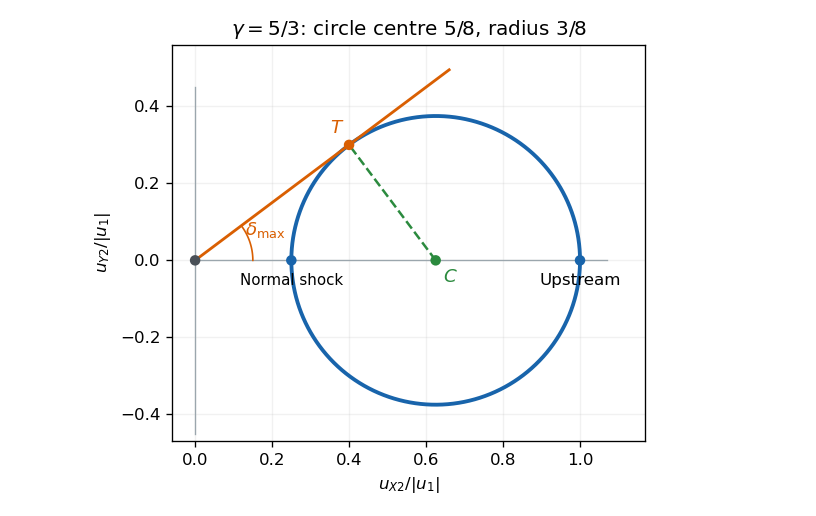

The deflection is the angle of the ray from the origin to the downstream velocity, rather than the shock-normal angle . Its maximum occurs where this ray is tangent to the circle. The circle's center is at distance and its radius is , so the tangent right triangle provesThis is the maximum deflection through a strong perfect-gas shock; for it is about degrees.
Axisymmetry makes all cylindrical components independent of . The divergence-free condition is therefore . On a simply connected meridional patch introduce a streamfunction so thatThese definitions satisfy the solenoidal condition identically and represent any such poloidal field locally. Since , they give . The toroidal field is independent of this constraint, yielding the full representation . Global use of a single flux function assumes the corresponding meridional domain has no obstructing flux topology; a regular field extends to the axis by the usual limiting construction.
The axisymmetric magnetic flux function has a direct physical normalization. The flux through an annulus in a plane of constant is . Thus is poloidal magnetic flux divided by , up to an arbitrary additive constant. Also , including the toroidal part, so its level surfaces are axisymmetric magnetic flux surfaces. Field lines remain on those surfaces even when they wind azimuthally.
Put and define . Direct cylindrical differentiation givesThe azimuthal component of the Lorentz force is proportional to . A force-free magnetic field therefore has parallel meridional gradients of and , implying on connected regular flux surfaces. ConsequentlyWith this dependence the poloidal part of is . Its full cross product with isVanishing force therefore requires wherever the flux gradient is nonzero, extending by regularity through ordinary isolated nulls. Finally, evaluating the three-dimensional cylindrical divergence gives , soThis derives the Grad-Shafranov equation for a force-free magnetic field. The function is set by boundary/current information; it is not an additional fixed constant. Its single-valued global form presumes the usual connected flux-surface labeling. The equation also makes , explicitly showing that current is parallel to the magnetic field.
For fixed volume define and . Differentiate and use the ideal magnetohydrodynamic induction equation. The vector identitythen gives the general balanceThe volume term is the work done by the magnetic force on the fluid, with the opposite sign for magnetic energy. Under the force-free assumption of part (b), it vanishes, leaving the requested boundary expression. Without that assumption, or another reason for zero net Lorentz work, a boundary-only balance is not generally valid.
For an axisymmetric boundary its normal has no azimuthal component. The differential rotation is tangential, so , and . Therefore . A thin axisymmetric tube between neighboring flux labels carries flux . Its exit endpoint contributes and its entry endpoint contributes . Pair the endpoints, counting each once, to obtainThe endpoint convention fixes the sign. Include each connected tube segment through once; a field line with no boundary crossing contributes nothing. This is magnetic-energy injection by differential boundary rotation. A common angular velocity at both ends produces no such injection.
Let , and . Steady smooth adiabatic flow has with the entropy parameter fixed by infinity, andThe second expression follows by integrating the radial momentum equation with and imposing the outer rest condition. Differentiate continuity to give , and substitute into momentum. This yields the Bondi accretion wind equationAt a smooth positive-radius sonic point, and both sides' vanishing factors require . Evaluate the Bernoulli relation there:Both the squared sound speed and sonic radius must be positive and finite. HenceFor no finite-radius regular sonic crossing is possible; the critical solution discussed next approaches sonic speed only at the central limit.
At , the sound-speed relation becomes . With , mass conservation gives . ThusMultiply by and substitute. This provesFor the curves, define , and . ThenThe function decreases up to Mach one, increases thereafter, and has minimum . The original sketch uses rates relative to , that is :
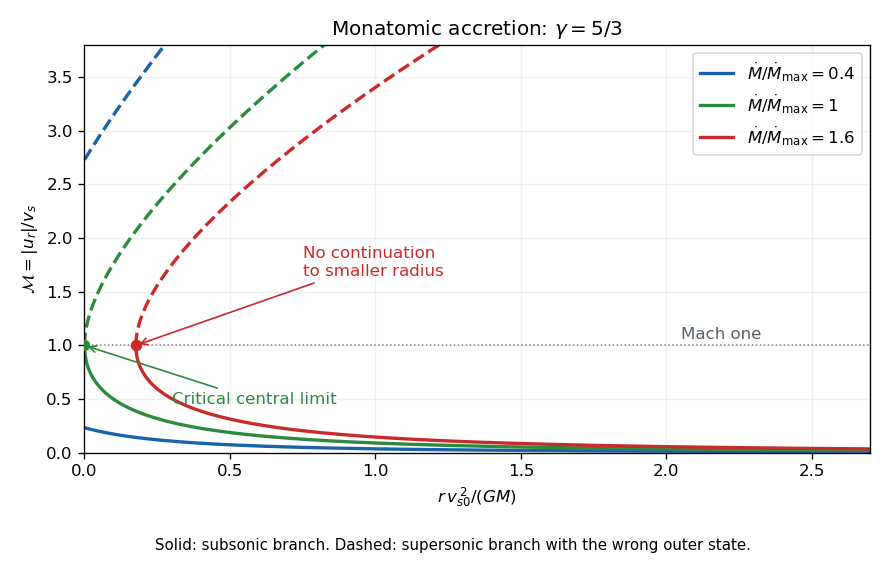
Mach-number branches of monatomic Bondi accretion below, at and above the maximum rate
. Details. 
For , the minimum of the formal radius curve lies at negative radius. Its physical parts are separate subsonic and supersonic branches extending to . Only the subsonic branch satisfies the specified outer state: as , it has , and . The supersonic branch instead has , and , so it is incompatible with that boundary condition.
At , the two branches meet at . The outer-rest branch remains subsonic at every positive radius and approaches Mach one at the centre. For , they meet at a positive minimum radius , and no real solution exists below it. Such a curve cannot describe a global smooth inflow to a point mass.
Thus globally defined positive-rate solutions satisfying the given outer condition are the subsonic branches with . These constitute monatomic Bondi accretion. The outer condition alone does not select a unique member; the conventional maximal Bondi solution is the limiting sonic one, while a specific inner accretor condition is additional physical information. Zero rate is the separate hydrostatic limit, not a positive accretion flow.
A solution reaching arbitrarily small radii must obey with . Taking therefore requires , or . This upper bound is attained: at the decreasing branch has one solution for every and approaches Mach one as . HenceThe argument establishes the maximum allowed by a globally continuing steady flow, without incorrectly claiming a finite-radius sonic point at .
Let be the fluid Lagrangian displacement, so about the static background. A displaced material volume changes by fractional amount . Mass conservation therefore gives the fluid Lagrangian perturbation of density . Converting to the fluid Eulerian perturbation by givesAdiabatic conservation of gives , and consequently .
Integrating the linearized ideal induction equation for a perturbation generated by the displacement gives . Since the equilibrium field is solenoidal, expansion yieldsThis is the displacement form of magnetic flux freezing. It also preserves .
Rewrite the magnetic force as . Linearizing the full momentum equation, subtracting static force balance, and setting givesTogether these are the linear displacement equations for a magnetized atmosphere. The density multiplying acceleration is the equilibrium value, because a perturbation of that factor would multiply a first-order acceleration and contribute only at second order.
Use complex Fourier amplitudes and let primes denote derivatives. Put , and . Static balance gives . The perturbations from part (a) then implyFor the last identity, combine with and use static balance; this is where the background magnetic-pressure gradient cancels.
Multiply the Fourier momentum equation by and integrate from to . Integrating the pressure-gradient term by parts gives . The gravity term is . The magnetic terms reduce toIndeed the term from cancels exactly the term arising from . This establishes, before completing the square,Now , soThus the magnetohydrodynamic energy principle has the requested quadratic formAll squares are squared complex moduli. With the prescribed vanishing surface term the quadratic form is real, as required for the self-adjoint stability problem.
For fixed smooth , the only appearances of are in and the nonnegative tension contribution . Positivity of makes the pressure square nonnegative too. Impose by choosingThen exactly and as , removing both nonnegative contributions in the limit. Since the remaining terms do not involve , no other choice can lower their limiting value. This is the short transverse wavelength limit for magnetic buoyancy.
Take the chosen vertical and along-field displacements compactly supported in the interior when constructing instability trials; the resulting also vanishes near the boundaries, satisfying the surface condition. The argument constructs an infimum, not necessarily a minimizing finite-wavelength eigenfunction. Whenever the limiting energy is strictly negative, sufficiently large finite already gives negative energy and hence the instability asserted by the supplied variational criterion.
For , the minimized energy density from part (c) isIf the bracket is nonnegative throughout, this density and the omitted pressure square are nonnegative for every displacement, so there is no negative-energy trial. Conversely, a strict negative value at a point of a smooth equilibrium persists in a small interval. Choose a nonzero smooth supported there, set , and choose as in part (c). This makes the pressure square zero and gives a strictly negative integral. Therefore the localized interchange criterion for a magnetized atmosphere isThese disturbances interchange flux tubes without along-field variation; both gas and magnetic pressure contribute to their effective compressional stiffness. Equality alone is marginal and does not give a negative energy integral.
Set , so , and for put . This variable can be chosen freely. The minimized transverse-displacement energy from part (c) has densityComplete the square in to obtainThis identity also applies at a zero of , where and the first square contributes nothing. If everywhere, every term is nonnegative, including the pressure and transverse-tension terms removed earlier. Thus no nonzero along-field wavenumber gives an unstable trial.
For the converse, suppose the strict reverse inequality holds at an interior point. On a sufficiently small closed interval around it, is uniformly negative and is bounded. Choose a sufficiently small but nonzero so that addition of keeps it negative there. Choose a smooth supported in that interval and set , making the first square vanish. This determines a finite . Finally choose by part (c) with sufficiently large finite ; its remaining tension energy can be made smaller than the strict negative margin. All displacements vanish near the boundaries. The full energy is therefore negative.
We have proved the long-wavelength undular magnetic buoyancy criterion:Under the assumed absence of interchange instability, the new unstable range is . Along-field motion allows material to drain and removes magnetic pressure from the limiting buoyancy stiffness, while tension at nonzero remains stabilizing. The statement is about existence of an allowed nonzero wavenumber; a fixed prescribed retains the term , and a finite imposed periodic length could exclude the required long wavelengths.
Articles by others on the same topic
There are currently no matching articles.