Extend by zero to the negative half-line. Its ordinary Fourier transform is then exactly the Half-range Fourier transform . The Fourier inversion theorem gives the real-line term for ; no endpoint convention at is needed.
It remains to show that each extra contour contributes zero, independently of its coefficient. For , the integral defining is holomorphic. With , multiplication by rotates the sector into , and multiplication by rotates into . Thus the two rotated transforms are holomorphic on their respective upper sectors.
Orient the contours as in the PDF: runs from infinity on the ray into zero and then out along the positive real axis; runs from negative real infinity into zero and then out along the ray. Both have their sector on their left. Smooth decay and integration by parts give in closed lower-half-plane sectors. The factor decays in the upper half-plane for . Close each sector by a large arc; the arc integral vanishes by Jordan lemma, including its short portion near the real axis. The Cauchy integral theorem therefore gives the rotated null contours for half-range Fourier inversion:Adding arbitrary constant multiples of these two zero integrals to ordinary Fourier inversion proves the asserted inversion formula. The constants are arbitrary in this part; selecting them later is what removes an unknown boundary trace.
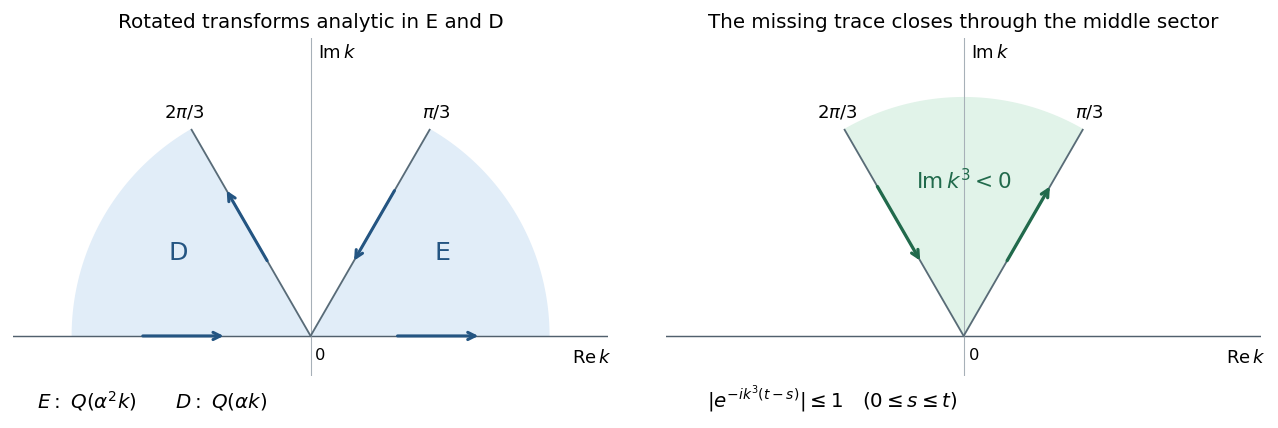
The rotated inversion sectors and the middle sector that eliminates an unknown boundary transform
. Details. 
Define the initial Half-range Fourier transform , and, for each available boundary trace, its finite-time spectral boundary transformTemporarily let also denote the missing trace. Three integrations by parts in giveConsequently the backward-sign Airy half-line global relation isThe spatial transform is holomorphic below the real axis, while each finite-time is an entire function. Moreover, because .
Suppose the missing derivative has order , and put . Its contribution to the right-hand side is , where , , . Apply the inversion from the preceding part at time and selectThe rotated coefficients of that missing trace now equal minus its real-line coefficient. Its entire contribution is thereforeThe real-axis pieces cancel. What remains is the boundary of the middle upper sector, outward on and inward on . In this sector , andis bounded by . The factor decays exponentially throughout the closing arc, overcoming . There are no poles. Thus the Cauchy integral theorem proves the cubic-dispersion elimination of one missing boundary trace and removes every occurrence of the unknown .
For a compact explicit answer, use only the two prescribed traces to form . The three choices areFor each row the solution isAll quantities in this formula are transforms of the given data. On the contour rays is real, so the time exponential is oscillatory; the integrals use the usual limiting interpretation of Fourier inversion. The decay estimate used for elimination belongs to the middle sector, not to or , where can grow.
At , and the preceding inversion recovers . The spectral exponential satisfies the Airy equation with the required minus sign. Differentiating the finite-time amplitudes produces only derivatives of the Dirac delta supported at and zero rotated closed-contour contributions, so the interior equation also holds. Finally, two solutions with the same data have for their difference, so this representation gives zero: each of the three prescribed pairs determines the solution uniquely in the smooth decaying class.
Articles by others on the same topic
There are currently no matching articles.