The principal real arctangent is defined here on , so work on either of the two open half-planes. Put . Direct differentiation givesHence : is harmonic on its domain. The Cauchy-Riemann equations for requireIntegrating these partial derivatives gives the harmonic conjugateThe constants may be chosen independently on the two components. The harmonic angle and logarithmic radius representation supplies the holomorphic functionwhere is the branch of the complex logarithm on the right half-plane. On the left half-plane it is the angle of , rather than the principal angle of , that equals . This distinguishes the literal arctangent from a globally defined argument; no single-valued complex logarithm exists on the whole punctured plane.
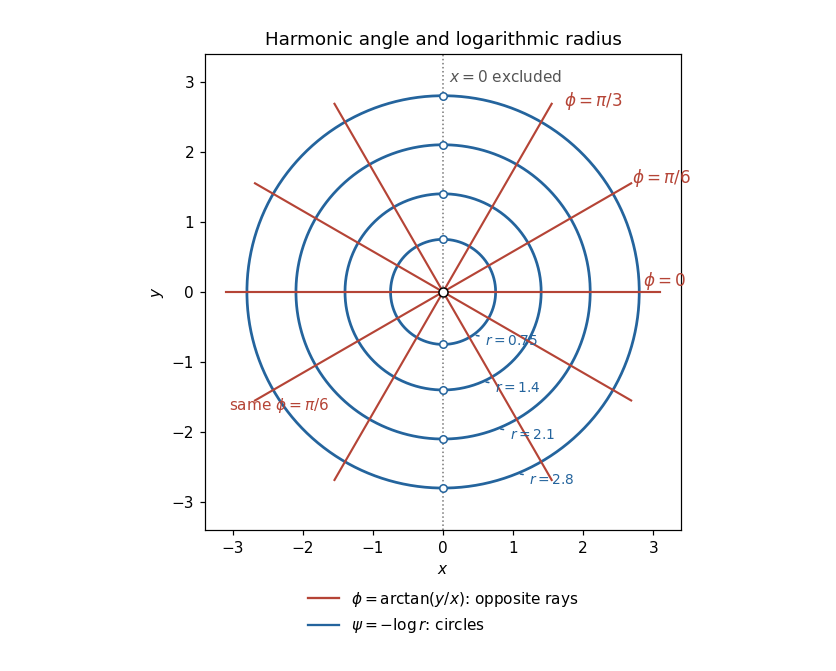
With , the level sets , for , are the two opposite rays of with the origin removed. On each half-plane only one ray remains. The level sets are circles , with their two points on excluded from the literal domain. The rays and circles meet at right angles, as expected for harmonic conjugates.

Articles by others on the same topic
There are currently no matching articles.