An element of the general linear group over a finite field is an invertible matrix. Its columns must form an ordered basis of . There are choices for the first column. Its linear span contains vectors, so there are choices for a second column outside that linear span. Thus the order of a general linear group over a finite field isThe determinant is a surjective group homomorphism : for each , the diagonal matrix has determinant . Its kernel of a group homomorphism is the special linear group over a finite field. The first isomorphism theorem gives , hence
Choose orthonormal coordinates with origin and horizontal axis . The Euclidean reflection and planar rotation have matricesTheir function composition therefore satisfies the composition of a plane rotation and a reflection identityConjugating by a planar rotation transports the horizontal reflection axis to the line at angle . Equivalently, the vector is fixed, whereas its perpendicular is sent to . Consequently the fixed line is the line through obtained by rotating through , and is reflection in that line. Angles of an unoriented line are understood modulo , so this description is independent of the representative chosen for modulo .
A real-valued function on an interval is uniformly continuous whenThe essential point in uniform continuity is that is independent of the locations of and . Uniform continuity on the whole real line does not imply boundedness: is Lipschitz continuous with constant , hence uniformly continuous, but is unbounded.
Take and . Then , whileThe sequential criterion for uniform continuity would force . These pairs contradict it: for example, for all sufficiently large their output separation is greater than , despite arbitrarily small input separation. Thus is not uniformly continuous on .
The derivative is . Its absolute value is continuous and tends to zero as , so it is bounded. More explicitly,obtained by differentiating for . The mean value theorem gives for every . Thus is Lipschitz continuous, and choosing proves is uniformly continuous on .
Every point has arbitrarily small path-connected open neighbourhoods. Indeed, in a coordinate chart homeomorphic to , take the inverse image of a sufficiently small open Euclidean ball. The ball is convex, hence path-connected, and its inverse image is path-connected by the homeomorphism. If the supplied neighbourhood is not itself open, first take an open neighbourhood within it and a ball contained in its chart image. This proves that is a locally path-connected space.
Fix and let consist of the points joined to by a path. For , a path-connected open neighbourhood is contained in : concatenate a path from to with one from to any point of . Hence is open. For , the same kind of neighbourhood cannot meet , since a meeting point would provide a path to . Hence is also open. Since is a connected space and is nonempty, . This proves is path-connected, including the general principle that connected locally path-connected spaces are path-connected. The empty-space case, if allowed, is vacuous.
Every nonempty open set in the given topology contains . Suppose a continuous map took distinct values and . Choose disjoint open intervals containing these respective values. By continuity, and are nonempty open sets in , and therefore both contain . This is impossible because the inverse images of disjoint sets are disjoint. Thus every such continuous map is constant. Conversely, constant maps are continuous. This is the continuous real maps from the initial-segment topology argument, using the Hausdorff separation of distinct real points.
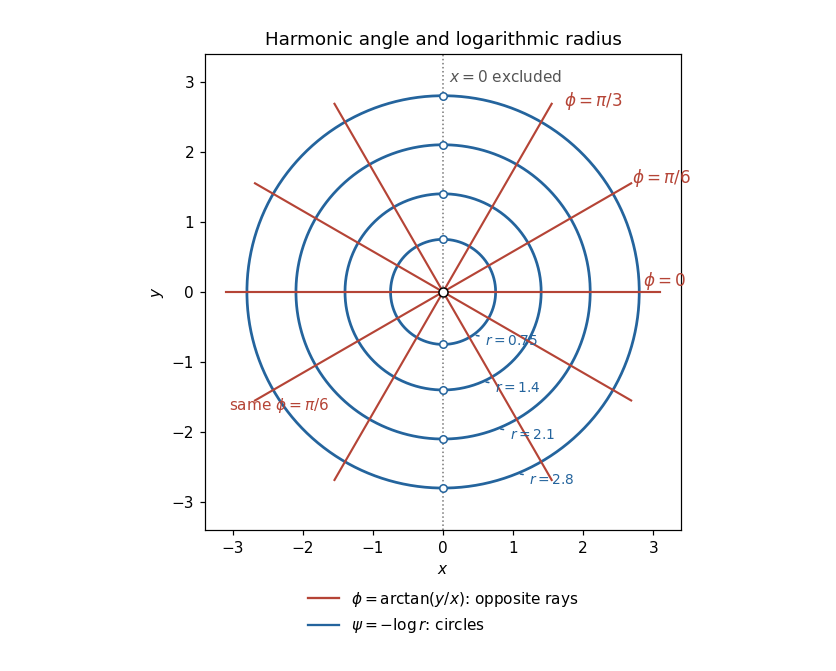
The principal real arctangent is defined here on , so work on either of the two open half-planes. Put . Direct differentiation givesHence : is harmonic on its domain. The Cauchy-Riemann equations for requireIntegrating these partial derivatives gives the harmonic conjugateThe constants may be chosen independently on the two components. The harmonic angle and logarithmic radius representation supplies the holomorphic functionwhere is the branch of the complex logarithm on the right half-plane. On the left half-plane it is the angle of , rather than the principal angle of , that equals . This distinguishes the literal arctangent from a globally defined argument; no single-valued complex logarithm exists on the whole punctured plane.
With , the level sets , for , are the two opposite rays of with the origin removed. On each half-plane only one ray remains. The level sets are circles , with their two points on excluded from the literal domain. The rays and circles meet at right angles, as expected for harmonic conjugates.

For a differentiable equality constraint, the Lagrange multiplier method finds candidate extrema by solvingThe condition requires at the point: every tangent direction to the constraint is perpendicular to , and at a extremum the directional derivative of vanishes in every such direction. Thus is parallel to . One must then classify candidates and check any singular or boundary cases.
For the ellipsoid, its constraint gradient never vanishes on the surface, and its compactness guarantees a maximum and a minimum. The Lagrange multiplier equations becomeIf , then and , giving value . If , then ; neither nor can vanish on this part of the surface. Combining the first two equations gives , and then . The constraint yields and . ThereforeThe maximum occurs at and its negative; the minimum at and its negative. To verify these are the global extrema, useEquality is attained at exactly the points just found. The remaining two candidates have value between the extremal values.
For the quantum harmonic oscillator, split the two expectation values into their variances and squared means:The last two terms are nonnegative, soApply the arithmetic-geometric mean inequality to the two remaining nonnegative terms, then the Heisenberg uncertainty principle:The argument applies to any normalized state with finite oscillator energy; the stated stationary state is a particular case. Equality requires zero position and momentum means, minimum quantum uncertainty, and balanced kinetic and potential contributions, as in the oscillator ground state.
Under the null hypothesis, the defect count in each packet has a binomial distribution with parameters . The likelihood, apart from factors independent of , isThe maximum-likelihood estimate is thereforeThe fitted binomial distribution probabilities for counts are , yielding expected packet counts . The Pearson chi-squared goodness-of-fit test usesFor binomial goodness-of-fit with an estimated parameter, there are statistical degrees of freedom: the category counts have a fixed total, and one parameter was estimated. At the conventional level the chi-squared distribution with two statistical degrees of freedom has upper critical value , so the data do not reject the independent common-defect-probability model. The approximate p-value is ; even at , the critical value exceeds the observed statistic.
This is a goodness-of-fit conclusion rather than proof that individual bulbs are independent. The last expected count is only , so the chi-squared asymptotic approximation is somewhat marginal in that cell. The stated calibration is the usual asymptotic test with all four cells retained; if more accurate small-count inference is required, calibrate the fitted statistic under the binomial distribution model. Pooling cells would require a corresponding treatment of parameter fitting and test calibration.
Write . The Markov property, conditioning on the state at time , givesPut and . Then , so subtraction yields . Iterating this linear recurrence givesFor , read the expression using , or state separately; for , . Since , the result also shows convergence in a metric space to the stationary distribution probability .
The row rank of a matrix is the dimension of the linear span of its row vectors. Its column rank is the dimension of the linear span of its column vectors, equivalently the dimension of the image of the corresponding linear map. The equality of row rank and column rank states that these two numbers are equal for every matrix. Their common value is the rank of a matrix.
Regard as a linear map and as a linear map (the same argument holds over any field). ThenIts dimension cannot exceed either or , since applying a linear map cannot increase dimension. The rank bound for a matrix product is thereforeThe bound is attained whenTheir product has an block and zeros elsewhere, so its rank of a matrix is . Thus the bound depending only on the given matrix sizes is sharp.
Write the cardinality of the finite group as , where is prime and . The Sylow theorems say that a Sylow subgroup of order exists; every p-group is contained in a Sylow subgroup; and all Sylow subgroups are conjugate subgroups. If is their number, thenEquivalently, for a Sylow subgroup , conjugation and the orbit-stabilizer theorem give , where is the normalizer. The containment statement is often included in the conjugacy form: every p-group lies in a conjugate of any fixed Sylow subgroup.
The symmetric group has cardinality , so its Sylow subgroups for have cardinality . One example isEvery nonidentity permutation of order of a group element in is a single permutation cycle of length : two disjoint length-three permutation cycles would require six letters. Choose the three moved letters in ways, then one of their two length-three permutation cycles, giving such elements. Each subgroup of cardinality has exactly two nonidentity elements, and distinct such subgroups have no nonidentity element in common. ConsequentlyThis also satisfies the numerical Sylow theorem restrictions and .
For a regular parametrized surface , the first fundamental form is the induced metricChoose the unit normal . With the convention , the second fundamental form isThe Gaussian curvature, the product of the principal curvatures, isFor a compact smooth embedded surface without boundary, the Gauss-Bonnet theorem giveswhere is the Euler characteristic. The no-boundary condition is needed for this form; a smooth embedded surface with boundary has the additional boundary geodesic curvature integral.
For the surface of revolution, useThe parameters are periodic, with local open parameter rectangles providing the coordinate charts. Put and . Since and , both and are positive. The tangent vectors areTheir inner products are , , and . ThusTheir cross product is , so its normalization gives the outward unit normalNext,Taking their inner products with yields , , and . Hence the fundamental forms of an elliptic ring torus giveChoosing the inward unit normal changes both displayed coefficients of to their negatives and leaves and unchanged. As a consistency check, ; its integral over the torus is zero, since cancels under . This agrees with in the Gauss-Bonnet theorem.
The proposed norm is finite because every continuous function on is bounded and integrable. It is nonnegative. If and at some point, continuity gives a nontrivial interval within on which is bounded below by a positive constant, contradicting the zero integral. Thus implies . The converse is immediate. Absolute homogeneity follows from , and the pointwise inequality integrates to the triangle inequality. These establish all the norm axioms, so is a normed vector space.
To test the Cauchy sequence condition, compare the terms with indices and . Put . The identities and giveBecause , we have . ThereforeIn particular, for all sufficiently large , these arbitrarily late pairs have norm distance greater than . This proves the sine sequence is not Cauchy in the integral norm. Thus the sequence is not Cauchy and does not converge to an element of , since every norm convergent sequence is Cauchy. This direct separation argument does not rely on completeness of .
An entire function that is doubly periodic is bounded: its absolute value has a finite maximum on the compact square , and periodic translations carry every point of into that square. The Liouville theorem therefore proves every such analytic function is constant.
For the zero-pole count, suppose the meromorphic function is not identically zero; otherwise isolated zero multiplicities are not defined. It has only finitely many zeros and poles modulo the lattice , because a compact square can be covered by finitely many local meromorphic neighbourhoods. Choose a translated unit square with no zeros or poles on its boundary. The logarithmic derivative is doubly periodic, so integrals on opposite sides cancel, with their opposite orientations. The argument principle givesBoth counts include multiplicities. Each half-open fundamental parallelogram contains exactly one representative of each lattice orbit, and translation by a lattice vector preserves the multiplicity of a zero or pole. Consequently the counts agree in the prescribed half-open square too, even if that particular square has boundary zeros or poles. Nonzero constants have both counts zero.
For the series, let and write it as the Weierstrass elliptic function . On a compact set avoiding , choose with . For ,There are lattice points with , hence converges by comparison with . The Weierstrass M-test proves absolute locally uniform convergence of the tail, and the finite remaining terms define holomorphic functions off their poles. It follows that is a holomorphic function off . Near each , separate the term ; the remaining terms converge locally uniformly to a holomorphic function. Thus is meromorphic on , with a double pole at each lattice point and no other poles.
It remains to prove the required periods, rather than merely assert them from the lattice. Termwise differentiation, justified by locally uniform convergence of these holomorphic series, givesThis series is absolutely locally uniformly convergent off . For either generator , reindexing proves . Therefore has zero derivative off . Its principal parts at lattice points cancel, so it extends to an entire constant .
The original convergent series is even: reindexing gives . At , which is not a lattice point for either generator, evenness givesHence the series defines a meromorphic function with periods and . This termwise derivative proof of Weierstrass periodicity uses an absolutely convergent derivative sum; splitting the original series into two separate inverse-square sums would not be justified.
Seek a power series in the Legendre differential equation. Equating coefficients of givessoThe even and odd coefficients form separate chains. Choose a nonzero seed of the same parity as and set the other seed to zero. In the chosen chain, none of the factors vanishes before , and the factor vanishes at . Therefore this chain terminates with a nonzero : it gives a polynomial of degree exactly .
To impose the normalization, its value at must be nonzero. Suppose a nonzero polynomial solution were with and . The lowest-order coefficient in would be , whereas has order . This cannot satisfy the equation. Thus divide by to obtain the Legendre polynomial with . Substitution or the coefficient recurrence givesFor an axisymmetric solution of the Laplace equation regular at the two polar axes, the separated modes and their superposition in spherical polar coordinates areThis is the usual separation of variables expansion; the singular angular solutions are excluded by regularity at the axes.
Here , so only degrees and are required. The degree-zero radial function takes the same value at ; since , this forces , . Write the degree-two coefficient as , where and . Multiplying these boundary equations by and subtracting givesConsequentlyEach term is harmonic in the shell, and the radial factor is at both boundaries, so this satisfies both Dirichlet boundary conditions. The maximum principle for harmonic functions, applied to the difference of two solutions, proves uniqueness among solutions continuous on the closed shell.
Expand the initial wavefunction in the complete orthonormal energy eigenstates, with . The unitary time evolution isOn the two-dimensional subspace spanned by , the observable has matrix . Its normalized eigenvectors are the symmetric and antisymmetric combinations. A complete orthonormal eigenbasis is thereforeThe eigenvalues are , with infinitely degenerate. The first two are nondegenerate, regardless of the distinct energies .
The first measurement in quantum mechanics, with outcome , leaves the state up to an irrelevant phase. At time it has becomeIts probability amplitude for outcome isThe Born rule gives the two-level observable transition probability
Neglect end effects, so the electrostatic potential depends only on the cylindrical radius . The radial Laplace equation is , with general solution . Imposing the conductor boundary conditions givesThe radial electric field is . Just inside the middle cylinder it is , directed towards the inner cylinder; just outside it is , directed towards the outer cylinder. By Gauss's law, its charge per unit length isHence the capacitance per unit length isThe two coaxial cylindrical capacitors contribute in parallel because both connect the middle cylinder to the same grounded potential. This is the coaxial capacitor with grounded inner and outer cylinders construction.
For with , while . ThereforeThe inner gap has width and area per unit length approximately . Its parallel-plate capacitor approximation gives exactly the same leading result; the outer gap contributes only a bounded correction.
For the extremum, set , , so . ThenThus the unique stationary point is . Strict convexity and divergence at both endpoints show it is a global minimum:There is no maximum on .
At the initial instant the circulation around every closed curve is zero because the fluid is at rest. A smooth material-flow map carries closed curves bijectively between times. Conservation of circulation around every material curve therefore makes the line integral of the velocity zero around every closed curve at the current time, not just small contractible loops. Fix a reference point in a connected fluid region and defineThe vanishing closed-curve integrals make this independent of the path. Thus : the fluid has a globally defined velocity potential. Its incompressible flow condition is , hence . This argument establishes the global potential without silently assuming the fluid region is simply connected.
Use the laboratory frame, with the sphere instantaneously centred at the origin and moving in the direction. Impermeability equates fluid and sphere normal velocities, while the fluid is at rest at infinity:Choose the additive constant so that at infinity. Substitution of into the Laplace equation in spherical polar coordinates givesThe far-field condition gives , and gives . ThereforeThe radial and polar velocity components areFor fluid density , its kinetic energy isThus with added mass of a sphere , half the mass of displaced fluid.
For the initial acceleration after release, let denote the upward acceleration, , and . At the instant , the velocity-squared term in the Unsteady Bernoulli equation vanishes. The time derivative of the potential at the sphere is ; centre-motion corrections also vanish at this instant. Relative to hydrostatic pressure, the additional pressure is consequentlyIts upward force on the sphere isAdding buoyancy and weight, Newton's second law gives . ThereforeThis is the acceleration of a freely falling sphere with added mass, with upward chosen positive. If , the negative value represents a downward acceleration.
Use the weighted inner productHere the interval is nondegenerate and the indicated integrals are finite, as required for the given orthogonal polynomials. Strict positivity follows because and a nonzero polynomial cannot vanish on an interval. Since each is monic of degree , form a basis of the polynomials of degree at most . Comparing leading coefficients, expandBy orthogonality, . For , symmetry of multiplication by givesbecause has degree at most and is a linear combination of . Only the last two terms remain. Their coefficients areFor the second equality, has degree at most , so its inner product with vanishes. Rearranging proves the three-term recurrence for monic orthogonal polynomials:For this reads because and . The coefficient is therefore immaterial and is not determined by the polynomials. The usual convention is ; if a positive is desired, any positive value gives the identical recurrence. The strictly positive norm-ratio formula is the assertion for , not a division by the norm of .
For the Lagrangian sufficiency theorem, write a maximization problem as subject to . Here may already incorporate simple constraints such as nonnegativity. Define the Lagrangian in optimizationThe theorem states that a feasible point is a global maximizer if there are such multipliers for which globally maximizes on and complementary slackness holds: for every . To prove it, for any feasible observe thatThe first inequality uses feasibility and nonnegative multipliers, the second uses global maximization of the Lagrangian in optimization, and the last uses complementary slackness. Thus is globally optimal. No convexity hypothesis is needed for this implication; concavity is useful when establishing the required global maximization of from its gradient.
For the particular problem, put and . The logarithmic constraint is equivalent to . The objective increases strictly with either variable, so at a maximum the resource constraint is tight: otherwise could be increased. HenceOn this interval the objective becomes , withIt increases up to and decreases thereafter, so the unique feasible maximizer isThe maximum value isThe two expressions agree at . This includes the degenerate feasible set , where and .
To certify the result using the Lagrangian sufficiency theorem, take andwhere . SetSince , and . These choices make both components of vanish at : and . The Lagrangian in optimization is concave on , so the zero gradient proves global maximization there. The resource constraint is tight. When the logarithmic constraint is tight; when , . Thus complementary slackness holds in every case, including both endpoints, and the theorem establishes the claimed optimum.
Articles by others on the same topic
There are currently no matching articles.