For tame or smooth embeddings , ambient isotopy means there is a continuous family , , of homeomorphisms, with and . Equivalently the map is a homeomorphism of preserving the time coordinate. In the smooth category one uses diffeomorphisms and a smooth isotopy. If only unparametrized images are compared, the last condition is ; for oriented knots it must also preserve the strand orientation.
A link is an embedding of a finite disjoint union of circles. Choose a point of outside it and identify the complement of that point with . A generic planar projection gives an immersion with only finitely many transverse double points, no triple points and no singularities of the projected strands. A link diagram is this planar immersed union together with the over/under information at each double point, recording which strand has the larger height. An oriented link diagram also records each component's orientation. The crossing data are indispensable: the planar immersion alone does not specify the link.
Write . Normalize the reduced Kauffman bracket by and . At a positive braid crossing choose the smoothing rule , where is the two parallel strands and joins the adjacent top endpoints and adjacent bottom endpoints. At its mirror crossing the coefficients are interchanged. This convention fixes the two smoothing labels. Equivalently, for a nonempty diagram,where each bracket smoothing state chooses one smoothing at each crossing, count the choices, and counts the resulting circles. It is a Laurent polynomial in and is independent of the order in which crossings are resolved.
We prove the local invariance needed for the Jones polynomial. In the Temperley-Lieb diagram algebra, stacking the smoothing tangles gives , and its reflected version. These identities follow just by following the planar strands; only the first removes an extra circle. The inverse crossing is , andThus the second Reidemeister move preserves the bracket. Expanding three crossings givesso the third Reidemeister move does too; inverse versions follow by multiplying by inverse crossings. A positive curl resolves to times the straight strand, and a negative curl gives . Thus the first move changes the bracket by the indicated factor.
Orient the diagram and let be its writhe, the sum of the signed crossings. DefineThe first move changes by or , exactly cancelling the bracket's curl factor. The other two moves leave writhe unchanged. Planar isotopy leaves both quantities unchanged. The Reidemeister theorem states that diagrams of ambient-isotopic tame oriented links are related by planar isotopy and these three local moves; therefore depends only on the oriented link.
This substitution really lies in . If there are crossings, each state exponent has parity , and also has parity . Expanding each power of adds only even exponents, so every exponent of the normalized bracket has parity . Every even power of is an integral power of . The normalization gives .
Use the standard closed three-strand braid , a four-crossing diagram of the figure-eight knot. The diagram has two positive and two negative crossings, so .
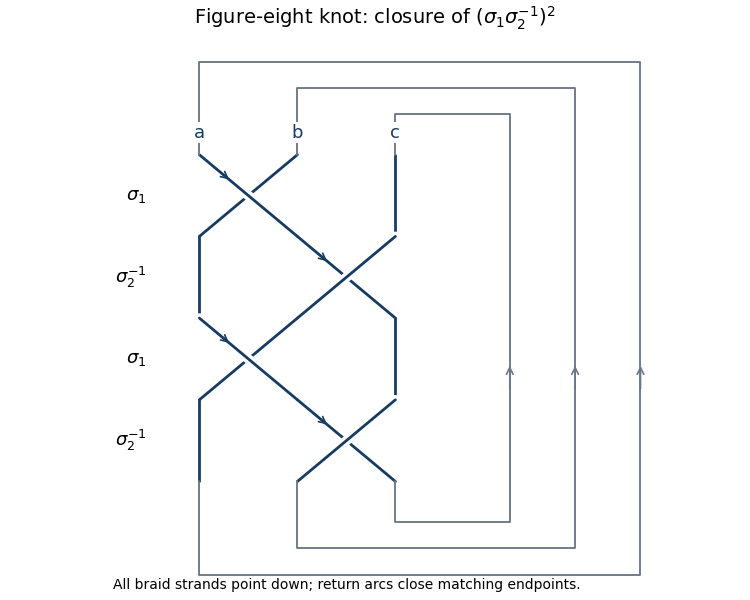
Four-crossing closed braid for the figure-eight knot, with three starting meridians
. Details. 
In the Temperley-Lieb diagram algebra on three strands put , . The relations are , , , . The bracket image of one two-crossing block isClosing planar diagrams gives the bracket trace on the three-strand Temperley-Lieb algebra:These values follow because the closures have respectively three, two and one circles. Expanding and reducing givesTaking its trace and substituting yieldsThere is no writhe correction, soThe equality is immediate from the five displayed coefficients. The same braid model supplies the meridians used in part (d).
Use the braid from part (c). Put meridians around its three strands at one end. At a positive crossing, the Wirtinger presentation relations induce the Artin automorphism of a braidFor the inverse crossing on strands two and three, they giveThe first formula is the usual crossing conjugation, and the second is its inverse on the relevant pair. Following one block gives :The four-crossing braid induces . Closing it identifies each ending meridian with its starting meridian. Applying the Seifert-van Kampen theorem to the crossing regions and the closing arcs therefore giveswhereBoth elementary crossing automorphisms preserve . Hence , and the first two closure relations imply the third: after substitution , so cancellation gives .
The first remaining relation can be solved without adding any relation:Substitute this expression into . Free cancellation and multiplying the two sides by inverse words giveThese are Tietze transformations, eliminating a generator defined by one relation and retaining the other. Thus the figure-eight knot group has the requested one-relator presentation
Articles by others on the same topic
There are currently no matching articles.