The inequalities force , and the reciprocal bounds exclude zero. Thus the whole region lies in the positive quadrant. Introduce ratio-product coordinatesThe region becomes the rectangle , . The inverse map and its Jacobian determinant areThe change of variables formula then gives
Take the usual positive, counterclockwise boundary orientation; the printed question does not specify one, and reversing it negates the answer. Write the successive corner points as , , , . Traverse , keeping the region on the left.
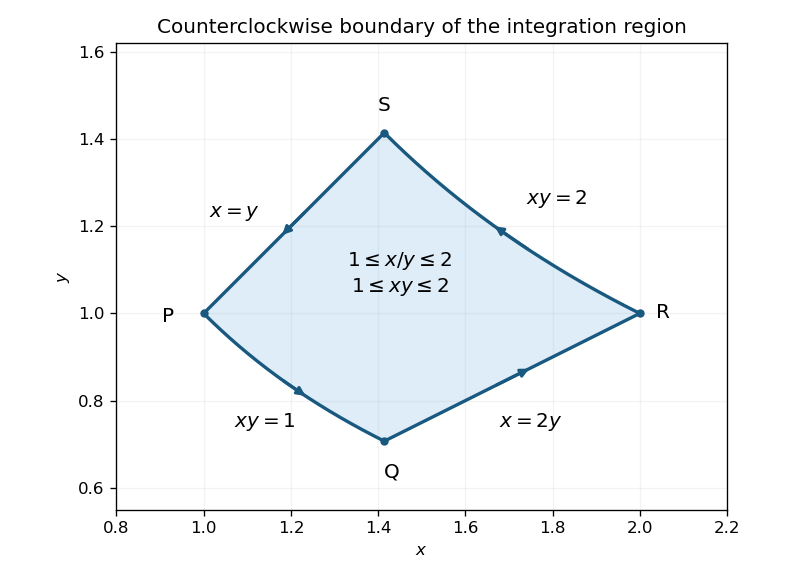
Counterclockwise boundary of the region between two rays and two hyperbolas
. Details. 
On , use with . Here , so the line integral isOn , use with :On , use with decreasing from to :Finally, on , use with decreasing from to :Adding all four line integrals gives for the positive orientation, or for the reverse orientation.
The equality with part (i) follows from Green's theorem. For the coefficients and ,They are smooth on a neighborhood of this region, since . Thus for the positively oriented boundary,The term itself has zero line integral around the closed curve, although it contributes to the four individual edge integrals.
Articles by others on the same topic
There are currently no matching articles.