For a permutation , let be its permutation matrix, defined by . Define the signature of a permutation by . A permutation matrix is orthogonal, so and its permutation sign lies in . A transposition exchanges two columns of the identity and therefore has determinant . Every permutation is a product of transpositions, by decomposing each permutation cycle asHence for any expression as transpositions; the determinant definition proves that this parity of a permutation is independent of the expression. Equivalently the permutation sign is positive for an even permutation and negative for an odd permutation.
Composition is taken rightmost first. Since , we have . Multiplicativity of the determinant therefore proves the sign homomorphism identityThe alternating group consists of the even permutations:It contains the identity. If , their product has permutation sign , and , so their inverses also belong to . This proves it is a subgroup. Finally, for every and ,Thus is a normal subgroup of . This also exhibits directly why a kernel of a group homomorphism is normal.
The real orthogonal group and special orthogonal group are, under matrix multiplication,An orthogonal matrix preserves Euclidean inner products; taking determinants of shows that its determinant is or . Its inverse is , so as well.
For , use . The determinant then satisfiesIt follows that . Thus the real matrix has a nonzero vector in its kernel of a linear map, yieldingThis is the three-dimensional case of odd-dimensional special orthogonal transformation has a fixed vector; geometrically it supplies the fixed rotation axis, unless the transformation is the identity and every direction is fixed.
The claim is false for . The matrix is orthogonal with determinant and has only the eigenvalue . It therefore has no nonzero eigenvector with eigenvalue .
Divide the velocity by the speed calculated above. The unit tangent vector isIts derivative isBecause , the principal normal vector has the direction of , givingThis is a unit vector, and for every real . The curvature of a space curve is , so the principal normal vector is defined everywhere on this curve. The same perpendicularity follows from constant tangent component forces perpendicular principal normals: is constant, and differentiating this identity forces the normal component along to vanish.
For a constant orthogonal Cartesian coordinate change , a Cartesian second-rank tensor has components satisfyingBoth indices transform by the coordinate-change matrix; summation over repeated indices is understood by the Einstein summation convention. A vector would have the one-index rule .
Define . Since , the chain rule gives . The rotation coefficients are constant, soThe identity follows from orthogonality. Hence the contracted derivative transforms as a vector. This proves the divergence of a Cartesian second-rank tensor rule for global Cartesian rotations. In curvilinear coordinates the corresponding construction uses a covariant derivative; ordinary partial derivatives alone would not have the stated tensorial transformation law.
For a normal subgroup , define multiplication of left cosets byTo check that this is well-defined, replace by with . Their product is , and normality puts in . Thus the product coset is independent of the representatives. Associativity follows from multiplication in , the identity is , and the inverse of is . These operations form the quotient group .
For the unheaded finite-index conclusion, let act on the left cosets of its proper subgroup by . This is well-defined even if is not normal: replacing by leaves unchanged. The maps are bijections with inverses supplied by , and their compositions give a group homomorphism . Its kernel of a group homomorphism is normal, by the calculation in part (ii).
The action is not trivial, because some sends the coset to ; hence . If were trivial, would be injective, implying . Under the given strict inequality this is impossible. Thus is a nontrivial proper normal subgroup, andMore precisely, is the subgroup core: fixes every coset if and only if for every . This identifies the normal subgroup produced by the coset action.
Assume is a normal subgroup. Take the quotient group and the natural projection . The well-defined multiplication constructed above gives , so this is a group homomorphism. Its identity is the coset , and exactly when . Thereforewhich proves the implication from normality to being the kernel of a group homomorphism.
Assume for a group homomorphism . For and ,Thus . Apply the same inclusion with to obtain the reverse inclusion, giving . Hence every kernel is a normal subgroup, proving the reverse implication and the required equivalence.
For any permutation , conjugating a permutation cycle relabels its entries:Indeed, the conjugate sends to and fixes the other relabeled entries exactly as the original permutation cycle does. Therefore conjugation preserves the multiset of permutation cycle lengths. Conversely, if two permutations have the same cycle type, pair their permutation cycles of each length and let carry the th entry of each first permutation cycle to the th entry of its partner. Include one-cycles for fixed points. This defines a bijection of all labels, and the displayed relabeling identity makes the permutations conjugate. ThusFor , the alternating conjugacy class splitting criterion says that an even permutation has the same class in and precisely when its type is not a collection of pairwise distinct odd lengths. Equivalently, there is an even-length permutation cycle or a repeated permutation cycle length, counting each fixed point as a length-one permutation cycle. Distinct odd lengths instead give two alternating-group classes. For , and the sole class is the same; the index-two splitting criterion is not applicable.
Squaring an odd-length permutation cycle keeps one permutation cycle of that length, since advancing by two visits all of its entries. Squaring an even-length permutation cycle splits it into two permutation cycles, each of half that length. Thus any even-length permutation cycle strictly increases the total permutation cycle count on squaring, while odd permutation cycles leave that count unchanged. The cycle type can agree with its square exactly when every length is odd. This proves permutation conjugate to its square:The final equivalence follows because the order of a group element that is a permutation is the least common multiple of its permutation cycle lengths.
The possible even types on five labels are the identity, a three-cycle, a product of two disjoint transpositions and a five-cycle. The identity and the double transpositions are their own inverses. For a three-cycle with unused labels , the even permutation conjugates it to its inverse. For a five-cycle , the even permutation reverses its order. Therefore every element of is conjugate to its inverse within . Inverting a five-cycle uses two transpositions, in agreement with inversion of an odd cycle in an alternating group.
A small counterexample elsewhere isThe alternating group is cyclic and therefore abelian. Every conjugacy class in an abelian group is a singleton, while . Thus these two elements are not conjugate in .
If , then and . If , algebraic division givesConsequentlyThe scaling coefficient is nonzero because . Thus translations, nonzero complex scalings and reciprocal inversion generate every Möbius map. The formulas extend over their poles and infinity by the sphere interpretation.
The assertion is true. A Möbius map fixes infinity if and only if : if , its value there is the finite number . For , the decomposition above uses only a nonzero complex scaling and a translation. These maps form the Affine subgroup of the Möbius group.
The assertion is false. Let and . Their relations areMoving each inversion to the right reduces every word to with or . Thus the subgroup generated by complex scalings and reciprocal inversion consists only of and . Of these, only the first form fixes zero.
The Möbius transformationfixes zero but is not a scaling: it sends infinity to instead of infinity. It therefore cannot belong to the subgroup generated by scalings and reciprocal inversion.
The assertion is true over the complex numbers. It suffices to generate every nonzero scaling using translations and , since these together with scalings already generate the Möbius group.
For , compose the maps rightmost first. Away from the intermediate poles, the successive values areHenceFor every , choose a complex square root with . This gives and proves Möbius scaling generated by translations and reciprocal inversion. Equality of the rational maps extends the identity to all points of the Riemann sphere, including the intermediate exceptional values.
Let a finite group act on a set . For , define its stabilizer subgroup and its group orbit . The mapis well-defined, because multiplying on the right by an element fixing does not change its image. It is onto by the definition of the orbit. If , then , so ; hence it is one-to-one. Every coset has elements and the cosets partition . This proves the orbit-stabilizer theorem:For a group element , its cyclic subgroup has elements. Apply the theorem to the action of on its left cosets , whose stabilizer at is . It follows thatThis is the needed case of Lagrange's theorem, obtained directly from the action.
To prove Cauchy's theorem for finite groups, let be a prime divisor of and considerThe first entries are arbitrary and determine the last, so is divisible by . Cyclically rotate the entries. This preserves the product constraint even if is nonabelian, sinceThus a cyclic group of order acts on . By the orbit-stabilizer theorem, its orbits have size one or . Its fixed tuples are exactly with . If is their number, counting the remaining size- orbits gives . The identity provides one fixed tuple, so and a nonidentity with exists. The order of this divides : division of by its order and minimality of that order prove this directly. Since is prime and , the order is exactly . This is the cyclic-tuple proof of Cauchy theorem.
Now suppose every nonidentity element has order two. Then every element equals its inverse, and for any ,Thus group of exponent two is abelian applies. Starting from the identity subgroup, choose an element outside the subgroup already generated. Because the group is abelian and that element squares to the identity, adjoining it doubles the subgroup: it is the disjoint union of the old subgroup and its translate by the new element. Repeating until the finite group is exhausted shows . Conversely the direct product of groups has order and every nonidentity element has order two. ThereforeThe case is the trivial group and satisfies the condition vacuously. These finite examples are elementary abelian groups of exponent two.
An infinite example is the group of all binary sequences, with coordinatewise addition modulo two:Every sequence added to itself is zero, so every nonzero sequence has order exactly two. The sequences having a single in coordinate are all distinct, proving that the group is infinite.
The vector triple product removes the nested cross products:Since is constant, the divergence isThe cube has volume . With the outward unit normal, the divergence theorem therefore gives
The derivative matrixis symmetric in . Contracting it with the antisymmetric Levi-Civita symbol gives the curlDirect differentiation of the scalar potential givesso . To identify the level sets, use the cross product identityIf , write relative to its direction. Then . Thus each negative level is a circular cylinder with axis and radius . The zero level is the axis itself; positive levels are empty. If , the scalar potential is identically zero, so its zero level is all of space and every other level is empty.
Use the right-handed rotation matrix which sends the positive direction to the positive direction:The Cartesian second-rank tensor transformation law givesHere isotropic tensor means invariant under every proper rotation, as is needed for the rank-three assertion involving the Levi-Civita symbol. A passive coordinate rotation through the same angle uses instead; the invariance conclusions are identical.
Setting forces , , and . No symmetry assumption on has been made: it now has the formInvariance under a right-handed quarter-turn about the axis next gives and , hence and . Conversely for every orthogonal matrix. The general isotropic second-rank tensor is therefore .
An isotropic vector must be fixed by the half-turn about the axis, so its first two components vanish. The half-turn about the axis then forces its third component to vanish. Thus the only isotropic vector is zero. The general isotropic third-rank tensor under proper rotations is . If invariance under the whole orthogonal group were required of an ordinary rank-three tensor, inversion would send to , forcing instead.
Both the Levi-Civita symbol and are invariant under proper rotations. Their tensor contractionis consequently an isotropic vector. The introductory proof shows that it must vanish, so .
For the displayed combination of Kronecker deltas, the three terms areIn each term the tensor contraction repeats two indices of the Levi-Civita symbol; each term is zero. This verifies the identity for arbitrary .
The tensor contraction is an isotropic second-rank tensor, because the Kronecker delta and are invariant under rotations. The classification proved above yields for some scalar .
The tensor contraction is an isotropic third-rank tensor under proper rotations. It therefore equals . Cyclically permuting three indices is even, so and .
For the given Kronecker delta expression, the term vanishes by antisymmetry, while the and terms give respectively and . HenceThese computations also illustrate isotropic contractions of a fourth-rank tensor.
The product rule givesApply the divergence theorem, with outward unit normal , and use the vanishing Laplacian of the harmonic function :The boundary value of is one. Another application of the divergence theorem therefore givesThis is the gradient pairing with a boundary-constant function and a harmonic function, obtained directly from Green's first identity. The harmonic function must be regular throughout the volume; an interior singularity can supply an additional boundary flux.
Here , so , while away from the origin. Their inner product is . The spherical coordinates volume element givesThis agrees with the boundary-constant gradient pairing with a boundary-constant function and a harmonic function: has constant boundary value and is a regular harmonic function. For comparison with the boundary value one in part (a), use and multiply back by . Strictly, is not differentiable at the origin. Excising a ball of radius resolves this: the inner boundary term has zero angular integral, so it contributes nothing in the limit. Thus the improper volume integral has the same zero value.
Now and . Since , their inner product is . ConsequentlyAlthough on the boundary, the Laplacian is , so is not a harmonic function. There is no contradiction with part (a). The origin singularity in the derivative of is harmless for this integral: its inner boundary contribution is of order and tends to zero. More explicitly, Green's first identity on the punctured ball gives outer flux and volume term , whose difference is the displayed answer.
Away from the origin the gradients are and . The improper volume integral is thereforeThe function is a harmonic function only off the origin. It is singular inside the integration volume, so it does not meet part (a)'s regularity hypothesis. On the punctured ball, Green's first identity has outer flux and inner flux : the inner outward unit normal is , so . Their sum is , exactly the integral before taking the limit. Equivalently the distributional Laplacian of is , rather than zero throughout the ball. This is boundary flux from a singular harmonic potential; it explains why applying part (a) across the origin would be invalid.
The inequalities force , and the reciprocal bounds exclude zero. Thus the whole region lies in the positive quadrant. Introduce ratio-product coordinatesThe region becomes the rectangle , . The inverse map and its Jacobian determinant areThe change of variables formula then gives
Take the usual positive, counterclockwise boundary orientation; the printed question does not specify one, and reversing it negates the answer. Write the successive corner points as , , , . Traverse , keeping the region on the left.
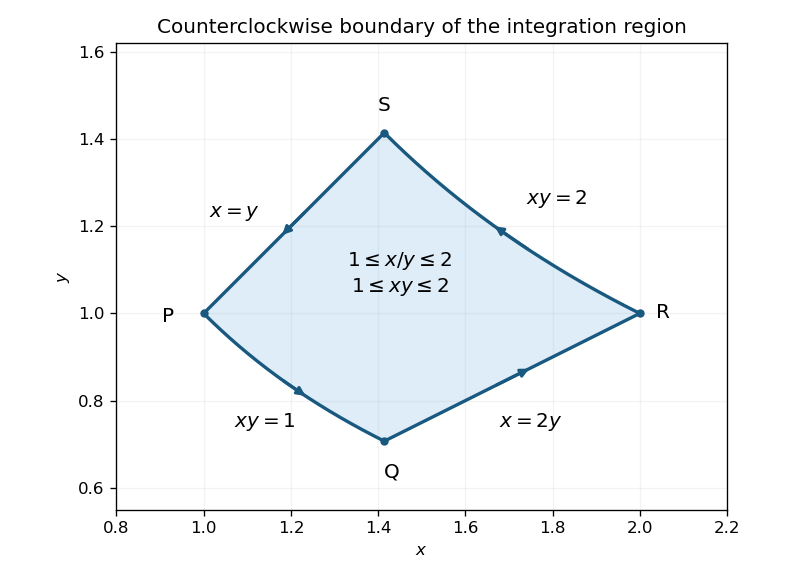
Counterclockwise boundary of the region between two rays and two hyperbolas
. Details. 
On , use with . Here , so the line integral isOn , use with :On , use with decreasing from to :Finally, on , use with decreasing from to :Adding all four line integrals gives for the positive orientation, or for the reverse orientation.
The equality with part (i) follows from Green's theorem. For the coefficients and ,They are smooth on a neighborhood of this region, since . Thus for the positively oriented boundary,The term itself has zero line integral around the closed curve, although it contributes to the four individual edge integrals.
Articles by others on the same topic
There are currently no matching articles.