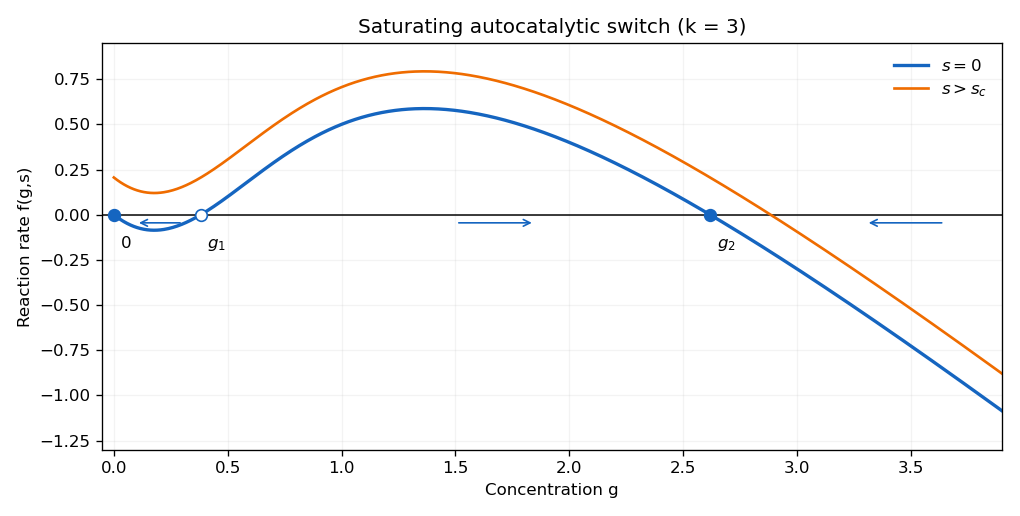
Continue in the bistable regime . At the reaction function factors as . Besides , its positive equilibria areAt zero, , so it is stable. At a positive equilibrium, use to obtain . Therefore is unstable and stable. The sign of is negative on , positive on and negative beyond ; these signs determine the requested reaction-rate sketch.
The stationary points of obey . For its smaller solution is the local minimum, and its larger solution lies above one and is the local maximum. Since increasing translates the whole graph upward, the low and middle equilibria collide whenFor , both stationary values of are positive, while as ; there is exactly one nonnegative equilibrium, on the descending high branch. At equality a double low equilibrium remains, so the uniqueness assertion requires strict exceedance.
For completeness, if the later positive-input request is considered for arbitrary , the derivative is . Its maximum is , attained at . For , the reaction graph is decreasing and every already has a unique steady state, so take . For , the smaller positive stationary point gives the same ; above it the graph crosses zero only on its final descending branch. Persistent robust switching after input is removed uses the previously assumed bistable regime .
Starting near zero, raise past and keep it there long enough for to pass the unstable threshold and approach the high branch. Decrease back to zero slowly, or after ensuring . The trajectory then stays in the basin of the high stable equilibrium and ends at the displayed . The persistent switched state is . This is the saturating autocatalytic switch; the conclusion presupposes and enough forcing duration, not merely an arbitrarily short pulse of large amplitude.

Articles by others on the same topic
There are currently no matching articles.