Use the usual irreducible algebraic variety convention here, and write , . Fix a closed point and an affine neighborhood of it. Noether normalization gives a finite surjective map . Put . Its fibre is a finite set , one of whose members is , because a finite morphism has finite fibres over closed points.
Choose an affine open meeting . Since is irreducible, still has dimension . In , the fibre of over is cut out by the regular functions . Apply the supplied principal hypersurface dimension lemma successively on each irreducible component: if a function vanishes identically the dimension does not drop, if its zero set is empty the component disappears, and otherwise each new component loses exactly one dimension. Hence every surviving component after the cuts has dimension at least .
But that composite fibre is the disjoint union of . Each member is closed, and since there are finitely many members it is also open in the composite fibre. Thus is a nonempty union of its irreducible components, givingThe same argument around a point on any fibre component gives the componentwise bound. This is the closed-fibre lower bound by finite normalization; it avoids assuming that is smooth or that its point ideal has only generators.
Irreducibility matters if “variety” is generalized to arbitrary reduced reducible spaces. For example can map the first component constantly to zero and the second by the identity. It is surjective, but nonzero fibres have dimension zero while . For reducible sources one uses the individual component dimensions instead; the preceding proof establishes the stated theorem under its standard irreducible-variety convention.
Suppose the map were nonconstant. Since projective space is proper, its image is a closed projective subvariety of , of positive dimension . Fix . Regard the map as surjective onto ; the fiber dimension theorem just proved givesChoose a target hyperplane not containing . It meets : the affine cone over has dimension , and the hyperplane equation vanishes at its vertex but not identically. By the principal hypersurface dimension lemma its zero set on the cone has dimension , so it contains a nonzero cone point and hence a point of .
The inverse image is therefore nonempty and proper. Locally the hyperplane equation is a single regular equation, after trivializing the pulled-back line bundle. On the irreducible smooth source it is not identically zero, so the same hypersurface dimension lemma shows that each component of has dimension . Choose one component . Its cone is a codimension-one irreducible closed subset of affine -space, whose prime ideal is principal because the polynomial ring is a unique factorization domain. Thus is a projective hypersurface defined by a homogeneous polynomial of positive degree.
Choose a positive-dimensional irreducible component of . Since , is disjoint from . On the cone over , the equation is consequently nonzero everywhere except at the vertex. This contradicts the hypersurface dimension lemma: the cone has dimension at least two, so its nonempty proper zero set for has dimension at least one and cannot consist just of the vertex. Therefore . The argument proves morphisms from projective space to smaller projective space are constant by combining the fibre bound with the forced intersection of a positive-dimensional projective variety and a hypersurface.
Any isomorphism would permute irreducible components and preserve their intersections. In each configuration, the origin is the unique point lying on all three components, so an isomorphism must take origin to origin.
The coordinate ring of the spatial configuration isThe displayed ideal is indeed the intersection of the three coordinate-axis ideals. Its generators have no linear parts, so at the origin the residue classes of form a basis of . Hence its algebraic cotangent space and Zariski tangent space have dimension three.
For the plane configuration, the coordinate ring is . The three linear factors are distinct in every characteristic, so this principal ideal is radical. It likewise has no linear part, but now has basis and dimension two. An isomorphism of local rings induces an isomorphism of these cotangent spaces, which is impossible:Thus the varieties are not isomorphic. This is embedding dimension distinguishes three-branch curves: matching incidence of branches does not determine their local algebra.
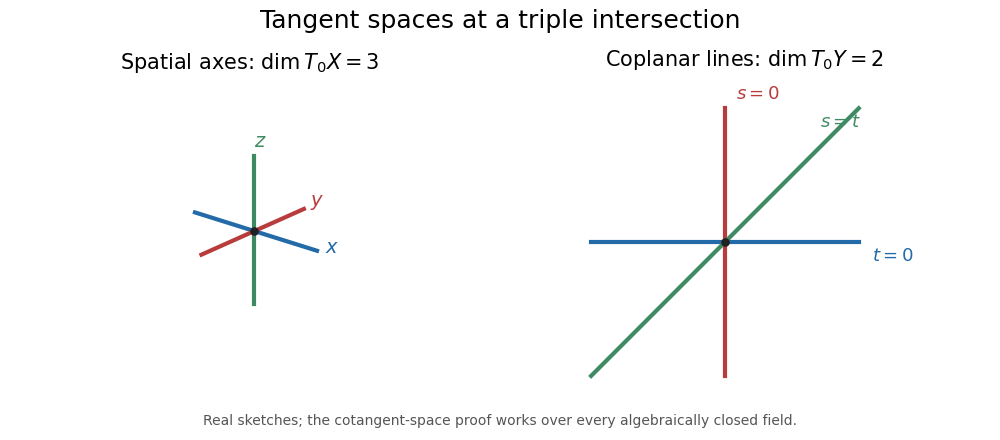
Three spatial axes and three coplanar lines have different tangent-space dimensions at their common point
. Details. 
Parametrize the line as and set , a polynomial of degree at most three. The Jacobian criterion at a singular point of a hypersurface gives vanishing of its equation and all first derivatives. ConsequentlyThus and both divide . They are coprime in every characteristic, so their degree-four product divides a polynomial of degree at most three. It follows that , provingThis is the secant line through singular points of a cubic hypersurface argument. If the given defining polynomial has repeated factors, use its square-free part for the reduced variety's Jacobian criterion: vanishing of that polynomial and its gradient at a singular point implies vanishing of the original polynomial's gradient there as well, by the product rule. The same restriction argument therefore still applies.
We first prove the local algebra fact behind regularity in codimension one. Let be a one-dimensional normal Noetherian local domain. Choose . Its radical is , so some lies in ; take minimal . If , then . Otherwise choose and put in the fraction field. We have but .
If , express multiplication by on a finite generating set of . The determinant trick gives a monic polynomial in annihilating ; as this ideal is nonzero in a domain, the polynomial itself vanishes. Normality would then give , a contradiction. Hence there is with a unit of . Every satisfies , proving . The maximal ideal therefore has one generator in dimension one, so is a regular local ring, indeed a discrete valuation ring. This proves one-dimensional normal local rings are discrete valuation rings directly.
Now a codimension-one point of the normal variety has such a local ring, and a codimension-zero local ring is a field. Both are regular. Since the algebraically closed ground field is perfect, regularity and smoothness agree for this finite-type variety, and the Jacobian criterion makes the singular locus closed. It contains no codimension-zero or codimension-one point. Therefore every irreducible component of the singular locus has codimension at least two, givingFor this means the singular locus is empty. In particular the singular set itself is the required closed subset, not merely a set contained in some larger one.
First suppose . The quadratic form has rank , so it is irreducible: a reducible homogeneous quadratic would be a product of two linear forms, whose associated symmetric matrix has rank at most two. Thusis a domain of dimension . Its gradient is , so the Jacobian criterion shows that the only singular point is the origin. Its codimension is , giving regularity at all codimension-one points, the condition.
At every localization the polynomial ambient ring is regular and hence a Cohen-Macaulay ring. The nonzero quadratic equation is a nonzero divisor; quotienting by it decreases both depth and dimension by one. Hence the hypersurface local rings remain Cohen-Macaulay, so their depth is their dimension and in particular at least . This verifies . The Serre criterion for normality now yields , establishing normality of a quadratic cone with all its hypotheses checked.
In characteristic two, . The reduced zero variety is therefore the hyperplane , isomorphic to affine -space, and its polynomial coordinate ring is integrally closed. Thus the reduced variety is normal in this case too. If one instead keeps the nonreduced hypersurface scheme defined by the squared equation, its coordinate ring has a nonzero square-zero class and is not normal. The variety interpretation in the question requires the reduced zero set.
Put , and . Smoothness makes a regular local ring, with residue field . A list of local parameters is a regular system of parameters: its images form a basis of the cotangent space of a local ring . Set . The basis condition says , so the finitely generated module equals . The Nakayama lemma gives
We now construct the requested formal power series, rather than assert that a local function has a convergent expansion. The associated graded ring of a regular local ring isIndeed these initial forms generate the graded ring, since the generate . The Dimension theorem for Noetherian local rings gives . A nonzero kernel in the surjection from the polynomial ring would make its quotient have dimension at most , so that kernel is zero.
For , choose to be its residue at . Inductively suppose homogeneous polynomials have been chosen such thatThe graded-ring isomorphism gives a unique homogeneous polynomial of degree representing the class of in . Subtracting makes the next remainder lie in . HenceThis equality is interpreted in the adic completion of a module . The same induction applies to every compatible sequence of residues in this inverse limit, so evaluation defines an isomorphism . It is injective because the lowest nonzero homogeneous term of a series has nonzero initial form. The Krull intersection theorem gives , so embeds in its completion and the series determines . This is the formal expansion at a smooth point; it depends on the chosen regular system of parameters, and does not claim that the infinite sum converges inside . If , the local ring is just , and only the constant term is needed.
Choose affine neighborhoods of and of , and orient the given local ring isomorphism asBoth algebras are finitely presented over . Choose finitely many generators of . Their images under are fractions in whose denominators do not vanish at . After inverting the product of those denominators, they define regular functions on an affine open neighborhood of . The finitely many defining relations of vanish as germs at ; each vanishes on a further open neighborhood. Shrinking finitely many times therefore turns those fractions into an actual algebra homomorphism , and hence a morphism of algebraic varieties inducing on the local rings.
A local-ring isomorphism preserves the maximal ideal. Its induced residue-field map is the identity of , because it is a -algebra map. Evaluating every coordinate generator consequently shows . Apply the identical finite-generator and finite-relation construction to to obtain with .
On the composition is defined, and on the composition is defined. Their maps on local rings are the identities. Thus the coordinate differences between and the identity vanish as germs at ; finitely many coordinate generators allow us to shrink to on which actually is the identity. Likewise shrink to on which is the identity. Finally takeThese are open neighborhoods of the specified points. If , then and , so . Conversely, if , then and , so . Therefore the restrictions are mutual inverse regular maps, provingThis proves isomorphic local rings determine isomorphic neighborhoods using actual regular functions and finite presentations. The conclusion concerns neighborhood isomorphisms, rather than just isomorphisms of formal completions.
Let be the elliptic curve, and choose a point to serve as identity. Its geometric genus is one and its canonical divisor has degree zero. For any divisor of degree one, the Riemann-Roch theorem givesSince has degree , its Riemann-Roch space is zero: a nonzero section would produce an effective divisor of negative degree. Hence . Choose a nonzero . The divisor is effective of degree one, so over the algebraically closed field it is a single point . Thus every degree-one divisor class has a point representative.
This representative is unique. If and are linearly equivalent, choose with . Then . That space has dimension one and already contains the constants, so is constant and . Consequentlyis injective. It is also surjective: if represents a degree-zero divisor class, apply the preceding result to to obtain its unique point representative , giving .
The degree-zero Picard group of a curve is a group because divisors add commutatively, principal divisors form a subgroup, and degree passes to the quotient. DefineEquivalently, is the unique point satisfying the linear equivalence of divisors , where the plus signs in this equivalence denote divisor addition. The zero class corresponds to , so is the identity. The inverse of is the unique point with . Associativity follows because both and map to , and is injective; commutativity follows in the same way. Thus this is an abelian group structure on , obtained directly by the elliptic curve group law from Riemann-Roch. The identity choice is part of the construction.
Choose and put . The Riemann-Roch theorem givesAs constants supply only a one-dimensional subspace, the Riemann-Roch space contains a nonconstant rational function . It has no poles except possibly at . It must have a pole, since a global regular function on an irreducible projective variety is constant. Let its pole order at be ; then .
On the open set where is regular, define . At its pole use the other affine chart, . The local ring of a smooth algebraic curve is a discrete valuation ring, and the positive valuation of at makes the latter expression regular there. The two expressions agree on their overlap, so they give a regular map .
This map is nonconstant. It is proper because its source is projective and its target is separated, so its image is closed; a nonconstant image in the projective line must be the whole line. Each finite-value fibre consists of zeros of a nonzero rational function , and the infinity fibre is the finite pole set. Hence every fibre is finite, giving a quasi-finite morphism. The proper quasi-finite criterion therefore makes a finite morphism.
Finally its pullback of the infinity divisor is exactly the pole divisor . The degree of a morphism of curves equals the degree of this pullback, or equivalently the function-field extension degree . ThusThe argument includes inseparable maps: the degree here is the full field-extension degree, not just the separable degree. This proves the gonality bound from Riemann-Roch with an explicitly constructed finite regular map.
Let be the geometric genus of . Choose an integer . For each prescribed point , both and have degree greater than , so their complementary canonical divisors have negative degree and their complementary Riemann-Roch spaces vanish. The Riemann-Roch theorem therefore givesChoose . This is possible because the two dimensions differ by one. Such a rational function has its only pole at , and its pole order there is exactly . Set .
At all terms except are regular. In a local parameter, the term of order in has a nonzero coefficient, and none of the other terms has a negative-power term. Hence that coefficient cannot cancel. Away from the prescribed points every summand is regular. We obtain the stronger conclusionThus is regular on and has a pole at every . This rational functions with prescribed poles construction works in every characteristic and does not require a generic-coefficient choice. If the prescribed list is empty, a constant function meets the vacuous requirements.
Articles by others on the same topic
There are currently no matching articles.