Split the free scalar field into its annihilation part and creation part . Normal ordering moves every creation operator to the left of every annihilation operator, without adding the commutators produced by that rearrangement. For two fields,Its vacuum expectation is zero. Time ordering instead places the field at the later time on the left:The equal-time convention is immaterial away from coincident singularities; these expressions are understood as operator-valued distributions.
The only nonzero vacuum contraction uses . The oscillator commutator therefore gives the Wightman functionPut and . Combining the two time orders, and reversing in the second when necessary, givesTo recover the four-dimensional Fourier transform, use the Feynman i-epsilon prescription in the energy variable:The positive-energy pole lies just below the real axis, and the negative-energy pole just above it. For , close below clockwise: the residue at is , and the clockwise factor after dividing by gives the required positive coefficient. For , close above counterclockwise: the residue at is , and the factor gives the other time order. Equivalently the energy contour passes above the positive-energy pole and below the negative-energy pole. HenceThe limit is distributional. The scalar Feynman propagator pole prescription is essential; omitting it from the denominator must be accompanied by the specified contour.
Finally, moving the annihilation part of past the creation part of givesThe normal-ordered two-field product is symmetric in , because the two creation parts commute and the two annihilation parts commute. Applying the two time orders thus proves the two-field scalar Wick identity
Use the momentum-space Feynman rules with all momenta conserved at each vertex. The free scalar propagator, free Dirac propagator and pseudoscalar Yukawa interaction vertex are respectivelyThe Dirac propagator follows by multiplying the inverse kinetic matrix by , using the Clifford algebra to obtain . The vertex follows by expanding once: there is no factorial because it has one scalar and two distinct spinor field factors. An internal scalar has no spinor indices; an internal fermion line carries the displayed matrix with its momentum directed along fermion flow.
These rules use the coefficient exactly as printed. With the standard Hermitian , the Hermiticity of a pseudoscalar Dirac bilinear gives . A Hermitian physical interaction therefore requires ; writing with real changes the vertex to . This convention issue does not alter the formal rules above, and no unstated real-coupling assumption is needed.
Label the incoming momenta and spin states and the outgoing ones , with . Write and . The Mandelstam variables are , and . At lowest order, each connected Feynman diagram has two pseudoscalar Yukawa interaction vertices and one internal scalar propagator.
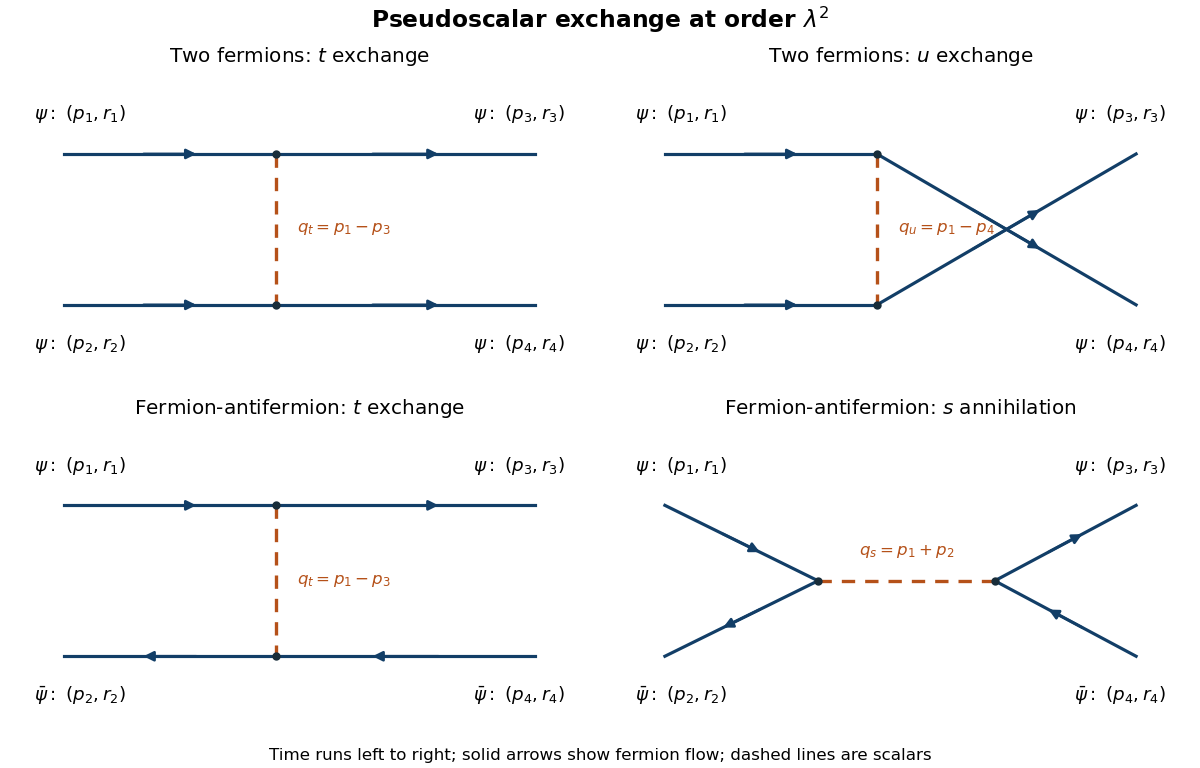
The t and u exchanges for two fermions, and the t exchange and s annihilation for a fermion-antifermion pair, with external momentum and spin labels
. Details. 
Define the scattering amplitude by . Fix the external Fock state ordering as to for the two-fermion process. The exchange connects to and to ; the exchange connects to and to . The two Feynman vertices contribute , and the internal scalar propagator contributes divided by its denominator. Exchanging the two identical final fermions supplies a relative fermionic sign. ThusThis changes sign when the two outgoing labels are exchanged, as identical-fermion antisymmetry requires. There is no annihilation diagram for two incoming fermions: the interaction preserves Dirac fermion number conservation.
For the fermion-antifermion process take initial state and final state . The exchange uses bilinears , and the annihilation uses . To fix the sign without a guess, expand the current in creation and annihilation operators. Its relevant terms have the signsThe antifermion sign of a normal-ordered bilinear makes the exchange contraction negative, whereas the product of annihilation and creation contractions is positive for the specified external ordering. Multiplying by therefore givesA different common phase convention for an external state can reverse the overall amplitude, but never the relative sign of its two contributions. Both results are tree scattering with pseudoscalar exchange and are of order .
Articles by others on the same topic
There are currently no matching articles.