For the whole paper use , natural units and the usual Dirac adjoint . The Lorentz algebra generators below have the real-generator convention of the PDF, with no extra factor of .
Write . The Pauli matrix multiplication law gives . Block multiplication of the Weyl representation of the gamma matrices givesandThus the mixed time-space anticommutators vanish, the time-time anticommutator is , and the spatial anticommutators are . Together these prove the Clifford algebra identityThe negative spatial sign comes from the lower-left block of each spatial gamma matrix.
Construct the Lorentz-spinor generators from a Clifford algebra asThey are antisymmetric in . Reordering a third gamma matrix with the Clifford algebra yieldsUse the commutator derivation identity on the two factors in :This derives every Lorentz algebra commutation relation, so the matrices form its spinor representation. Their finite exponentials describe the connected Spinor representation of the Lorentz group, more precisely the lift to its double cover.
For , choose the corresponding spin liftThe spinor field transforms asThe infinitesimal Clifford algebra identity from part (b) exponentiates to , establishing Lorentz covariance of the Dirac operator. At fixed coordinates the infinitesimal variation also includes the orbital term .
A spatial rotation generator is anti-Hermitian, but a Lorentz boost generator is Hermitian. For example,Its eigenvalues are . A nonzero rapidity gives boost eigenvalues , which are not all on the unit circle. This proves that the finite-dimensional component Spinor representation of the Lorentz group cannot be unitary for a positive-definite component inner product, even after a change of basis. It does not contradict a unitary action on the physical space of quantum states.
Consequently need not equal : it is the time component of the Dirac current, not a Lorentz scalar. The appropriate invariant form is indefinite. From one obtainsThis Dirac spinor pseudo-unitarity gives and hence the Dirac scalar bilinear
Use the PDF's convention in which multiplies , rather than . Its unitarity converts the given gamma matrix identity intoApplying it twice givesFor real infinitesimal Lorentz transformation parameters,Therefore transforms in exactly the same spinor representation as . The coordinate pullback is real and transforms identically as well. This is the antilinear charge-conjugation intertwiner relation; exponentiating also gives for connected transformations.
For real mass, complex conjugation of the free Dirac equation gives . Multiply by and move it through the gamma matrices:ThusAs an explicit check, in the given Weyl representation of the gamma matrices one may take . It is unitary and obeys the required conjugation identity. The free-equation conclusion does not assert that a charge-conjugated field retains the same charge in a fixed electromagnetic background.
Split the free scalar field into its annihilation part and creation part . Normal ordering moves every creation operator to the left of every annihilation operator, without adding the commutators produced by that rearrangement. For two fields,Its vacuum expectation is zero. Time ordering instead places the field at the later time on the left:The equal-time convention is immaterial away from coincident singularities; these expressions are understood as operator-valued distributions.
The only nonzero vacuum contraction uses . The oscillator commutator therefore gives the Wightman functionPut and . Combining the two time orders, and reversing in the second when necessary, givesTo recover the four-dimensional Fourier transform, use the Feynman i-epsilon prescription in the energy variable:The positive-energy pole lies just below the real axis, and the negative-energy pole just above it. For , close below clockwise: the residue at is , and the clockwise factor after dividing by gives the required positive coefficient. For , close above counterclockwise: the residue at is , and the factor gives the other time order. Equivalently the energy contour passes above the positive-energy pole and below the negative-energy pole. HenceThe limit is distributional. The scalar Feynman propagator pole prescription is essential; omitting it from the denominator must be accompanied by the specified contour.
Finally, moving the annihilation part of past the creation part of givesThe normal-ordered two-field product is symmetric in , because the two creation parts commute and the two annihilation parts commute. Applying the two time orders thus proves the two-field scalar Wick identity
Use the momentum-space Feynman rules with all momenta conserved at each vertex. The free scalar propagator, free Dirac propagator and pseudoscalar Yukawa interaction vertex are respectivelyThe Dirac propagator follows by multiplying the inverse kinetic matrix by , using the Clifford algebra to obtain . The vertex follows by expanding once: there is no factorial because it has one scalar and two distinct spinor field factors. An internal scalar has no spinor indices; an internal fermion line carries the displayed matrix with its momentum directed along fermion flow.
These rules use the coefficient exactly as printed. With the standard Hermitian , the Hermiticity of a pseudoscalar Dirac bilinear gives . A Hermitian physical interaction therefore requires ; writing with real changes the vertex to . This convention issue does not alter the formal rules above, and no unstated real-coupling assumption is needed.
Label the incoming momenta and spin states and the outgoing ones , with . Write and . The Mandelstam variables are , and . At lowest order, each connected Feynman diagram has two pseudoscalar Yukawa interaction vertices and one internal scalar propagator.
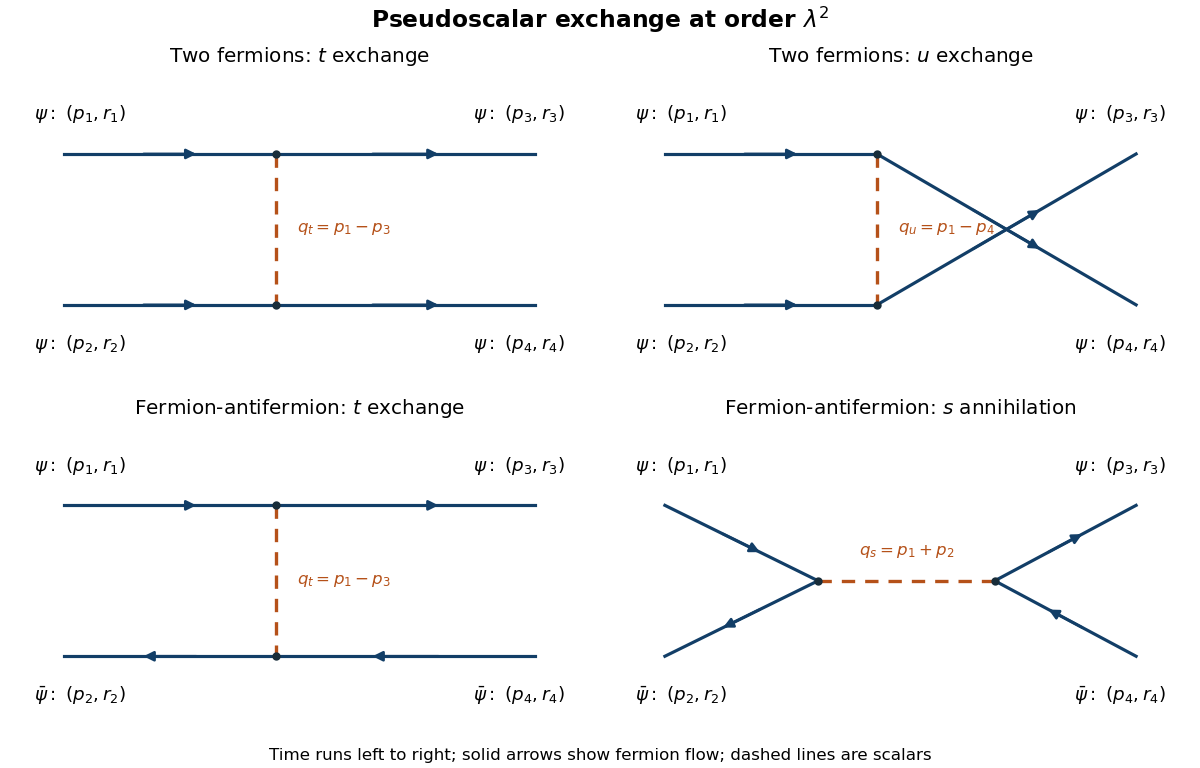
The t and u exchanges for two fermions, and the t exchange and s annihilation for a fermion-antifermion pair, with external momentum and spin labels
. Details. 
Define the scattering amplitude by . Fix the external Fock state ordering as to for the two-fermion process. The exchange connects to and to ; the exchange connects to and to . The two Feynman vertices contribute , and the internal scalar propagator contributes divided by its denominator. Exchanging the two identical final fermions supplies a relative fermionic sign. ThusThis changes sign when the two outgoing labels are exchanged, as identical-fermion antisymmetry requires. There is no annihilation diagram for two incoming fermions: the interaction preserves Dirac fermion number conservation.
For the fermion-antifermion process take initial state and final state . The exchange uses bilinears , and the annihilation uses . To fix the sign without a guess, expand the current in creation and annihilation operators. Its relevant terms have the signsThe antifermion sign of a normal-ordered bilinear makes the exchange contraction negative, whereas the product of annihilation and creation contractions is positive for the specified external ordering. Multiplying by therefore givesA different common phase convention for an external state can reverse the overall amplitude, but never the relative sign of its two contributions. Both results are tree scattering with pseudoscalar exchange and are of order .
The Maxwell field has the gauge symmetry for an arbitrary smooth scalar function . Commuting the two derivatives shows that is unchanged, so the Maxwell Lagrangian is invariant. Vary the action, use antisymmetry of and integrate by parts with variations vanishing on the boundary:The Euler-Lagrange field equations are therefore . Expanding givesIn Lorenz gauge the second term vanishes, leavingThe PDF calls this “Lorentz gauge”; the standard name is Lorenz gauge. A residual gauge symmetry preserves this condition when .
Put . The gauge-fixing variation isAfter integration by parts its contribution to the Euler-Lagrange field equations is . It cancels the from the Maxwell Lagrangian, giving for all four components. This is the Feynman gauge equation; the physical Lorenz gauge condition must still be imposed on states rather than inferred as an additional classical equation from this gauge-fixed density.
Treating the covariant components as coordinates, the derivative of the actual displayed density with respect to gives the canonical momentaIn terms of lower-index spatial coordinates,The gauge fixing has supplied the nonzero momentum of , absent from the ungauge-fixed Maxwell Lagrangian.
There is a boundary-term convention needed for the next part's printed momentum expansion. Direct expansion gives the Feynman-gauge Maxwell kinetic density after a boundary-term subtraction:To verify it, the difference of the densities is ; differentiating gives these two terms, while the remaining second-derivative terms cancel after renaming indices. The subtracted density has , which is exactly the momentum used by the mode expansion in part (c). The literal momenta asked for here are the boxed expression, not . Both densities have the same field equations, and their canonical commutation relations agree through the boundary-induced canonical transformation in Feynman gauge.
Denote the momentum in the printed mode expansion by , as it equals for the boundary-subtracted density discussed in part (b). Take a real complete basis of polarization vectors. Its completeness relation with one index raised isHere raising or lowering the polarization labels uses the same diagonal matrix , so this is just the completeness relation in the PDF. Write . In the mixed field-momentum commutator, the term gives the product of the minus sign in 's creation part and the minus sign in the oscillator commutator. The term gives the same sign. The two mode normalization factors multiply to , and the momentum delta function removes one integral. ConsequentlyFor the field-field commutator, the polarization sum gives insteadbecause the integrand is odd under . Similarly,These are the requested canonical commutation relations, derived by photon oscillator completeness and canonical brackets.
They also hold for the literal momenta of part (b). The shifts areSince the fields commute at equal times, their mixed brackets with the momenta do not change. The only potentially new momentum bracket isAll other momentum brackets vanish separately. Thus both canonical conventions have and vanishing coordinate-coordinate and momentum-momentum brackets, even though the momentum operators differ by spatial derivatives. This resolves the density/expansion mismatch without changing the printed oscillator algebra.
The oscillator commutator givesThe temporal mode has negative norm. More precisely, the nonzero wave packet has norm . The difficulty is an indefinite Hermitian form, not the divergent normalization of an unsmeared momentum eigenstate. The covariant photon Fock space is therefore not a positive physical Hilbert space.
Gupta-Bleuler quantization imposes only the annihilation, or positive-frequency part of a quantum field, of the divergence:A strong operator identity is incompatible with the four unconstrained canonical commutation relations; in the literal momentum convention it would set . The weaker condition instead implies between physical states: the positive-frequency part annihilates the ket, and its adjoint annihilates the bra.
For a nonzero momentum choose upper-index polarization vectorswhere are an orthonormal pair perpendicular to . Labels 1 and 2 have transverse polarization, label 3 has spatial longitudinal polarization, and label 0 has timelike photon polarization. With , the divergence of the annihilation part is proportional to . The physical condition is thereforeFor a one-mode state , the condition reads . ThusThe last direction has zero norm and is orthogonal to every constrained state. Its field wavefunction is proportional to , hence it is a pure gauge symmetry direction. A purely longitudinal creator alone is not physical, despite having positive norm.
For the multiparticle sketch, put and . The commutator allows polynomials in times transverse creator states to obey the constraint. Conversely, on creator polynomials the constraint is , so these are all the constrained polynomials. Every term containing is orthogonal to every constrained bra, since . Quotienting those null vectors and completing the remaining positive space is the Gupta-Bleuler null-state quotient. It givesThe one-particle instance is the transverse one-photon physical quotient.
A symmetry of a classical field theory maps solutions to solutions; for the Noether theorem we require a continuous variational symmetry of the action, allowing its density to change by a total divergence. This is stronger than simply observing an accidental symmetry of one solution. Consider first-derivative fields and defineThe Euler-Lagrange field equations are . For a fixed-coordinate variation , the product rule gives the off-shell identityThis identity is the proof's essential integration-by-parts step.
For a general spacetime symmetry write and . At a fixed point , while the volume-element variation contributes . Suppose action invariance takes the formCombining with the preceding identity provesThis is the Noether current for a spacetime symmetry. It also covers internal symmetries, for which . A constant parameter corresponds to one Noether current; several independent parameters give several currents. Integrating the continuity equation givesThus the Noether charge is conserved when the fields have suitable falloff or no flux through the spatial boundary. These are classical identities; quantum symmetries may additionally require absence of an quantum anomaly.
Translations conserve energy and momentum. If the density has no explicit coordinate dependence, take the active fixed-coordinate variation for translation in direction . Then , and the internal-form proof with gives the canonical energy-momentum tensorIts four spatial integrals are the conserved energy and momentum. For a real scalar field with density this becomes . Direct differentiation gives , which vanishes by the field equation.
Lorentz symmetry conserves angular momentum and boost charges. For that scalar example, is symmetric, so the Lorentz transformation currents can be writtenTheir divergence is . Spatial pairs give angular momentum, and time-space pairs give the conserved boost charges. For a spinor field or a vector field, the intrinsic field variation supplies an additional spin current; equivalently the Belinfante-Rosenfeld stress-energy tensor combines spin and orbital pieces into a symmetric stress tensor. The nonunitarity of the finite component Spinor representation of the Lorentz group does not obstruct conservation of these physical spacetime charges.
Global phase symmetry conserves particle charge. For a complex scalar field with density , the constant transformation leaves the density invariant. Using and gives the Noether currentFor a Dirac field, the corresponding variations , yield instead , the Dirac current. Its divergence vanishes by the Dirac equation and adjoint Dirac equation. The Yukawa interaction of part 2 also preserves this phase symmetry, because each bilinear has one and one . Thus it preserves fermion number and forbids annihilation of two fermions into a single scalar. These currents express charge or particle-minus-antiparticle-number conservation, rather than conservation of total particle count in arbitrary interacting processes.
A global symmetry in field theory uses a spacetime-independent parameter and ordinarily relates physically distinct configurations. A gauge symmetry instead has arbitrary local parameters and represents redundancy in the description. For example, the Maxwell field is unchanged physically by : its electromagnetic field tensor is unchanged. For charged matter use together with . Differentiating shows , so the coupled Dirac action is locally gauge invariant. A local phase applied to free matter alone produces extra derivatives of and is not an invariance; the compensating gauge field is necessary.
Local arbitrariness gives identities among field equations, rather than an independent physical charge for every function . In the pure Maxwell field, action invariance under a compactly supported impliesThus holds off shell, directly because is antisymmetric. This exemplifies the Noether second theorem. Gauge fixing and the Gupta-Bleuler null-state quotient remove redundant photon components; they do not remove a physical global charge. Gauge transformations that are nontrivial at a boundary can carry boundary charges, so the redundancy statement concerns transformations satisfying the chosen boundary conditions. Finally, discrete symmetries such as the sign reversal of a real scalar or parity symmetry in quantum field theory can be important without furnishing a continuous-parameter Noether current.
Articles by others on the same topic
There are currently no matching articles.