Label the incoming momenta and spin states and the outgoing ones , with . Write and . The Mandelstam variables are , and . At lowest order, each connected Feynman diagram has two pseudoscalar Yukawa interaction vertices and one internal scalar propagator.
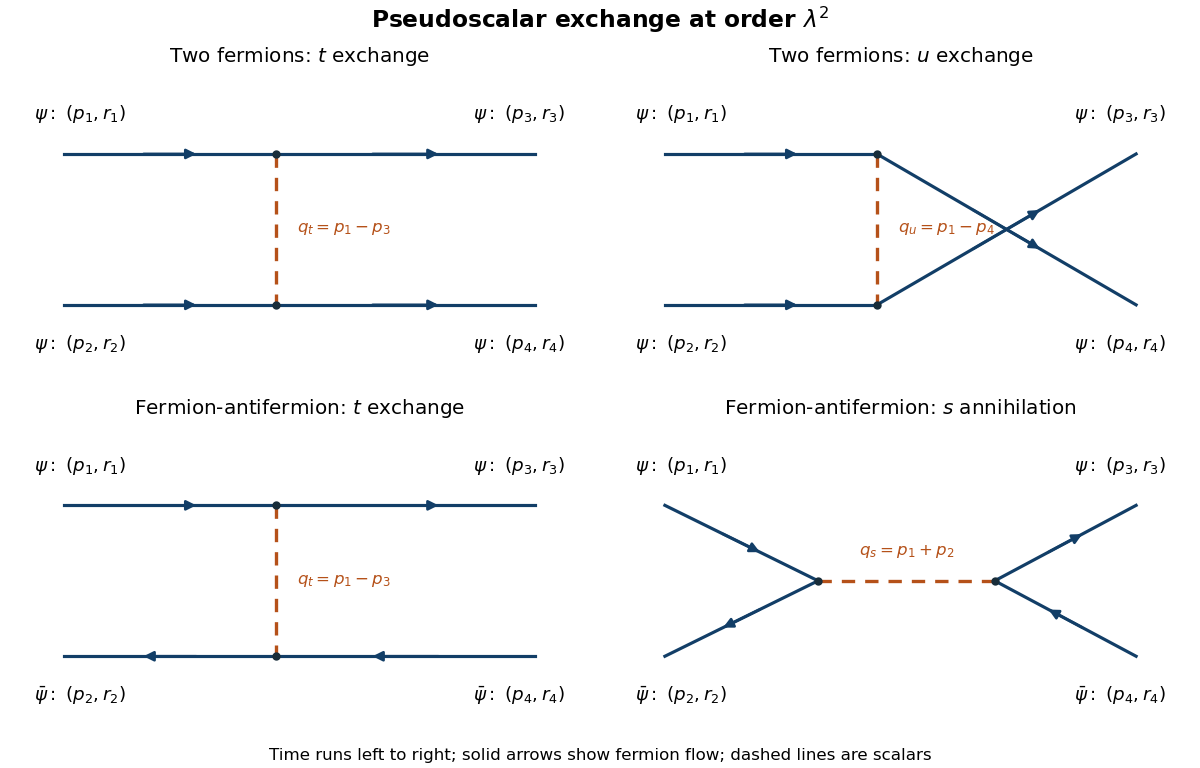
The t and u exchanges for two fermions, and the t exchange and s annihilation for a fermion-antifermion pair, with external momentum and spin labels
. Details. 
Define the scattering amplitude by . Fix the external Fock state ordering as to for the two-fermion process. The exchange connects to and to ; the exchange connects to and to . The two Feynman vertices contribute , and the internal scalar propagator contributes divided by its denominator. Exchanging the two identical final fermions supplies a relative fermionic sign. ThusThis changes sign when the two outgoing labels are exchanged, as identical-fermion antisymmetry requires. There is no annihilation diagram for two incoming fermions: the interaction preserves Dirac fermion number conservation.
For the fermion-antifermion process take initial state and final state . The exchange uses bilinears , and the annihilation uses . To fix the sign without a guess, expand the current in creation and annihilation operators. Its relevant terms have the signsThe antifermion sign of a normal-ordered bilinear makes the exchange contraction negative, whereas the product of annihilation and creation contractions is positive for the specified external ordering. Multiplying by therefore givesA different common phase convention for an external state can reverse the overall amplitude, but never the relative sign of its two contributions. Both results are tree scattering with pseudoscalar exchange and are of order .
Articles by others on the same topic
There are currently no matching articles.