Use the group representation generated by the displayed matrices. The coordinate reflections generate , and the cyclic permutation conjugates to , then to . Thus the group is the semidirect product , of order . The converted TeX's multiplication sign must not be interpreted as a direct product of commuting factors.
To prove absolute irreducibility, complexify to and let be a nonzero complex invariant subspace. It is preserved by the coordinate projections . For a nonzero , at least one coordinate is nonzero, so is a nonzero multiple of a coordinate vector. Applying the cyclic permutation repeatedly shows that all three coordinate vectors belong to . Hence . Therefore the real representation is absolutely irreducible.
Equivalently, a commuting matrix must be diagonal because it commutes with all three reflections; commuting with forces its diagonal entries equal. This also confirms that every equivariant linearization is a scalar multiple of the identity, the condition needed in the branching calculation.
For the Equivariant branching lemma, assume a generic steady-state crossing after parameter normalization, and nonzero leading nonlinear coefficient on each axial line. The lemma gives an equilibrium branch for each axial subgroup with a one-dimensional real fixed-point subspace of a group action.
For , . Conjugation by supplies the other two coordinate axes. For , . Sign reflections supply all the equal-magnitude diagonals. These isotropy types are not conjugate: their subgroup orders are and . Thus there are two distinct primary axial branch types: coordinate-axis states and equal-magnitude diagonal states.
The global sign reversal belongs to the group and makes the restricted scalar equations odd, so generically each has the form , with . Its two nonzero solutions satisfy on the appropriate parameter side. Symmetry-related solutions belong to the same branch type; their existence does not imply stability or that both types lie on the same side of the crossing.
Equivariance under makes the first component odd in ; equivariance under and makes it even in . Up to cubic order its allowed monomials are therefore , , , and . Absolute irreducibility makes the linear coefficient the same in each component. Equivariance under the cyclic permutation then determines the other two components from the first. Write its three independent cubic coefficients as , , and . With , the resulting signed cyclic three-mode amplitude equations areThere are no quadratic terms because each component has its own amplitude as an odd factor and is even in the other amplitudes. Higher-order equivariant terms begin at degree five; the remaining calculation concerns this displayed cubic truncation.
For reference, with , the coordinate-axis states are and their cyclic copies. The equal-magnitude diagonal states havewhen . If that denominator is negative, the generic diagonal branch belongs to the opposite parameter side instead. This makes explicit the two isotropy types from part (b).
Seek an equilibrium in the invariant coordinate plane with . Put and . The two nonzero-component equations areSubtracting gives , so positive require . With , the solutions areThey are actual additional equilibria when has the sign of ; the signs of are independently free, and cyclic permutation supplies the other two coordinate planes. For example, , gives and . Thus additional two-coordinate equilibria do exist for suitable opposite-sign cross-couplings. The inequality is necessary for this type, but without the positivity conditions on the displayed denominator it need not be sufficient for every coefficient choice.
The isotropy of a generic such point is just , whose fixed-point subspace is two-dimensional. The Equivariant branching lemma guarantees axial branches with one-dimensional fixed spaces; it does not rule out these lower-symmetry branches. Their existence therefore gives no contradiction.
At fixed , letting cross zero with sends , : the new pair of opposite- branches meets an axis equilibrium. Its eigenvalue is , so this is a secondary symmetry-forced pitchfork bifurcation. Similarly, as crosses zero with , the branches meet the axis, whose eigenvalue is . The cubic formula gives near the first crossing, and near the second. Reflections force the two signs of the newly nonzero coordinate, while cyclic symmetry gives the corresponding pitchforks on the other axes. The simultaneous case is degenerate and is not a generic single-parameter pitchfork.
Write and . Direct differentiation of the cubic amplitude equations givesWhen , these reduce to and . Therefore, wherever ,This conserved directional quantity is nonconstant in every neighborhood of a nonzero equilibrium. If such an equilibrium were asymptotically stable, all sufficiently nearby initial points would approach it, forcing their conserved values to equal its value. That is impossible. The origin is unstable since its linearization is with . Hence there are no asymptotically stable equilibria when in the displayed cubic system. For the sphere is entirely equilibria, so its individual points still cannot be asymptotically stable.
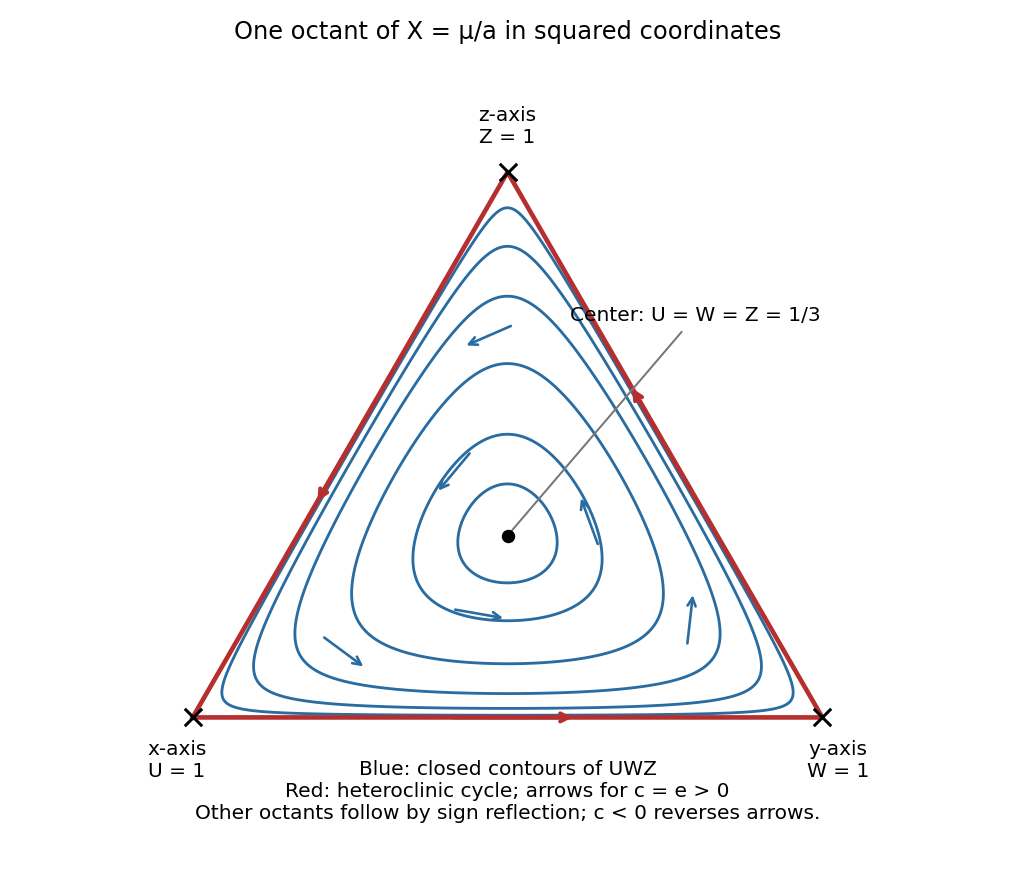
The radial equation attracts every nonzero radius toward . On this invariant sphere, with , the remaining motion isFor , the six coordinate-axis points are saddles on the sphere. The eight equal-magnitude points are centers of the restricted motion. In each open octant the regular level curves of are closed loops around that octant's center. The coordinate planes, where , form heteroclinic orbits joining the axis saddles. In the positive octant, for the boundary orientation is ; for all arrows reverse. Sign reflections give the other octants.
The following sketch uses normalized squared coordinates , , , with . This is a one-to-one coordinate representation of each closed spherical octant, so its triangle depicts the sphere's trajectories without hiding a hemisphere. The center is , and the interior loops are contours of . This is the conserved octant dynamics of a cyclic amplitude system.

Articles by others on the same topic
There are currently no matching articles.