Use signed velocities in Skaro's inertial frame; the returning velocity must be negative. For the first two rockets, the Lorentz transformation of infinitesimal separations is , . Dividing with gives the relativistic velocity-addition formulaFor the third rocket, its signed velocity in the second frame is , so another application givesSince and , the denominator is positive. The third rocket returns from positive to Skaro if and only if , henceEquality leaves it stationary in Skaro's frame, so it never returns from ; a smaller leaves it travelling outward.
Let denote departure, boarding the second rocket, boarding the third, and reunion with Skaro. In coordinates , their positions on the worldline areIndeed, the first two coordinate durations are and , and the returning leg has duration . Equivalently, their coordinates are obtained by multiplying each displayed time by ; these are the coordinates used for the spacetime diagram.
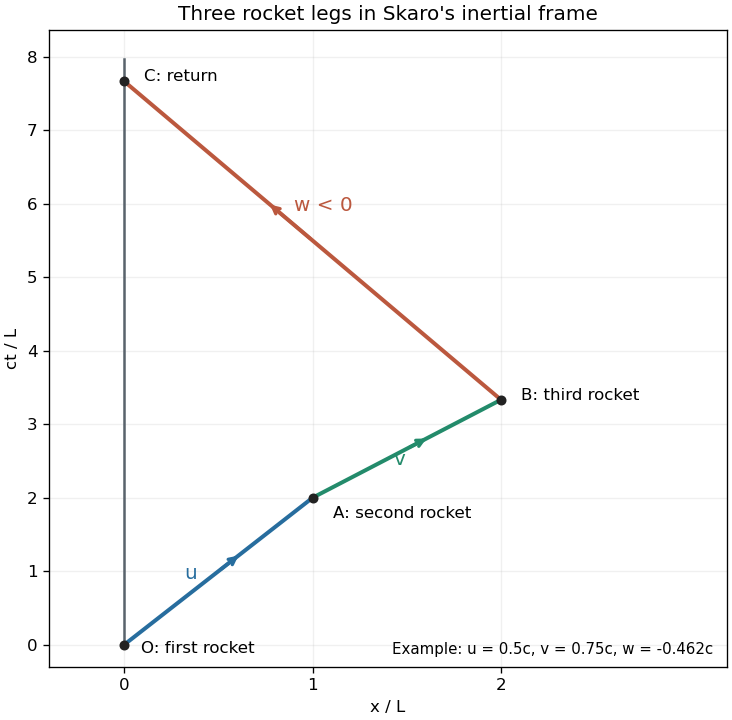

The diagram uses representative velocities satisfying the return condition; its event labels apply to the general formulas above. Skaro's elapsed time isOn a constant-velocity leg the traveller's proper time is , by time dilation. Neglecting the specified brief accelerations, Davros therefore ages byEvery contribution is positive because . Each square-root factor is smaller than one, so : Davros returns younger than a companion who remained on Skaro. The elapsed times compare the same departure and reunion events; they cannot be obtained by applying one time-dilation factor to the whole journey, whose worldline has three different velocities.
Articles by others on the same topic
There are currently no matching articles.