Let be singleton deliveries among treatment cycles. Under a common-probability binomial distribution model, independently across years. The pooled maximum-likelihood estimator isThe Pearson chi-squared test of homogeneity compares singleton and non-singleton counts across all fourteen years, usingAll expected cells are large. One probability has been estimated, so the reference chi-squared distribution has 13 degrees of freedom. Numerically,The constant singleton-per-cycle probability is decisively rejected under the independent-binomial model. The observed proportion rises from to . Dependence between repeated treatments or patient heterogeneity can invalidate literal binomial precision, but they should be addressed by an explicit variance model rather than ignored.
Use grouped-binomial logistic regression, and . Center the year as . Maximizing gives score and information ; these determine the estimates and working covariance matrix.
A straight-line logit fit is , with naive binomial standard errors and . Its yearly odds multiplier is , with naive 95% Wald confidence interval . However, its residual deviance is on 12 degrees of freedom (), so those small standard errors do not describe an adequate independent-binomial fit.
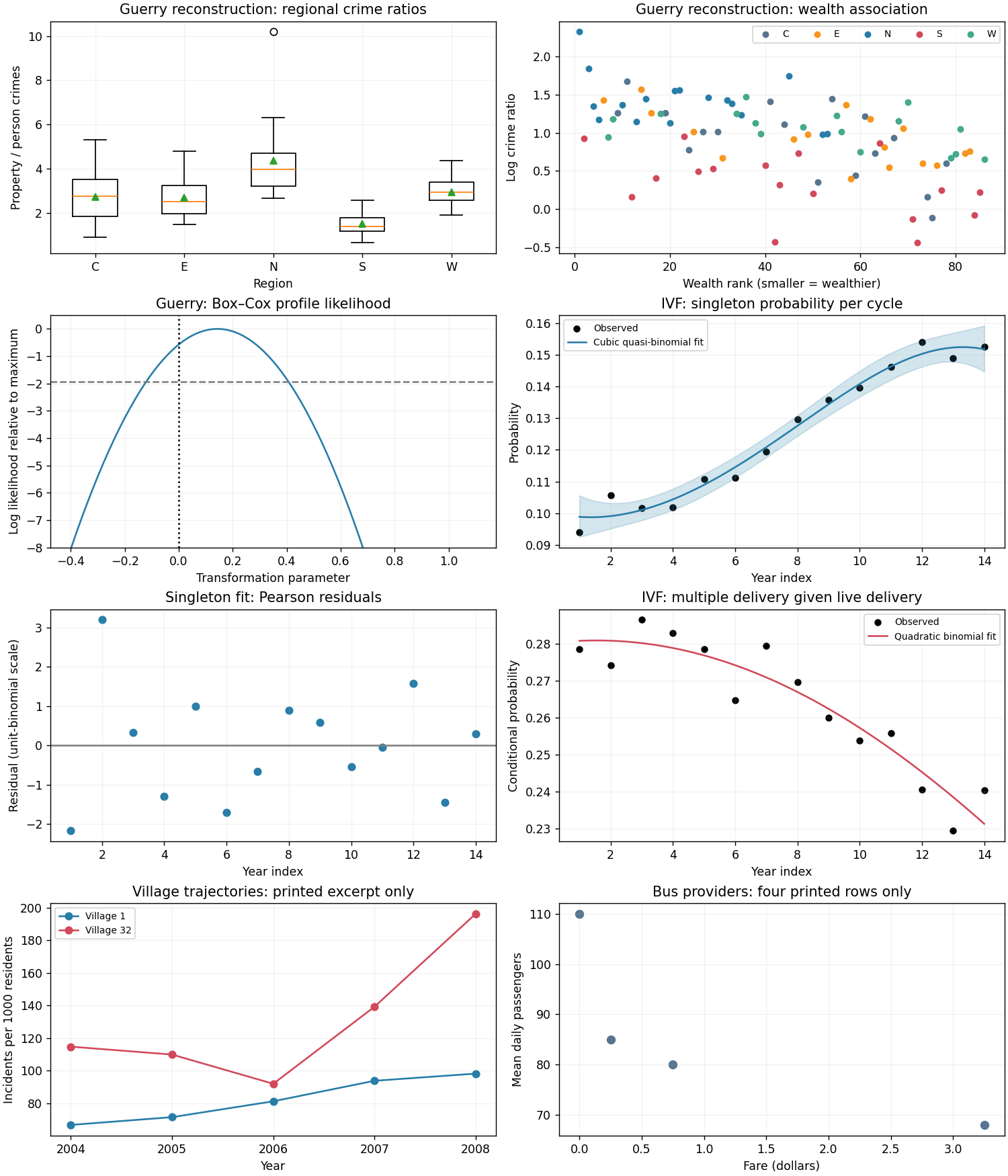
Comparing polynomial mean structures gives residual deviances for degrees zero through three, with respective residual degrees of freedom . A quadratic term alone adds little; the cubic structure captures the middle-period acceleration and later leveling. Even the cubic independent-binomial fit has for its residual deviance goodness-of-fit test. A useful working model is therefore cubic quasibinomial regression, retaining the logistic mean and estimating overdispersion rather than claiming an exact binomial law:The Pearson estimate is . Using standard errors multiplied by and a reference, the approximate 95% coefficient intervals are , , , and . An approximate quasi-deviance comparison of cubic against linear gives and , supporting the added shape while acknowledging that only fourteen annual groups inform dispersion.
In this preferred mean model the odds change is not constant:The fitted annual change is larger around the middle than at the ends; the straight-line 4.6% increase is a useful overall summary, not an exact yearly effect in the cubic model. The fitted curve, uncertainty band and residual plot appear in the figure. Singleton success increased overall, but a constant log-odds trend with unit binomial dispersion fits poorly. Quasibinomial intervals remain working-model intervals: serial dependence, changing patient mix and treatment practices cannot be separated from annual aggregates alone.
The correct denominator is the number of live deliveries , not treatment cycles and not babies. Define and use ; this is the distinction in denominators in grouped birth-outcome models. The observed conditional multiple-delivery proportion is initially and finally.
A constant logit has residual deviance on 13 degrees of freedom. A linear-year fit gives , deviance on 12 degrees of freedom (), and annual odds ratio . A quadratic term improves the deviance by on one degree of freedom (), whereas a further cubic improvement is only (). A supported parsimonious binomial model isIts residual deviance is on 11 degrees of freedom (), and Pearson statistic is , with no detected excess dispersion. The binomial standard errors are ; approximate 95% Wald confidence intervals are , , and . The annual odds multiplier is , describing near-flat early behaviour and a stronger later reduction, rather than a uniform annual decrease.
As a secondary check, modelling the triplet-or-higher share alone among deliveries needs curvature: its quadratic logit has residual deviance on 11 degrees of freedom, compared with for a straight line. Multiple delivery became less likely conditional on a live delivery, especially later in the series; higher-order multiples declined particularly strongly. This conditional probability is separate from the probability of any successful live delivery per cycle.

Articles by others on the same topic
There are currently no matching articles.