The fitted continuous-time multi-state model allows only adjacent fatigue-state jumps. Its four transition intensities, in reciprocal years, are shown here:
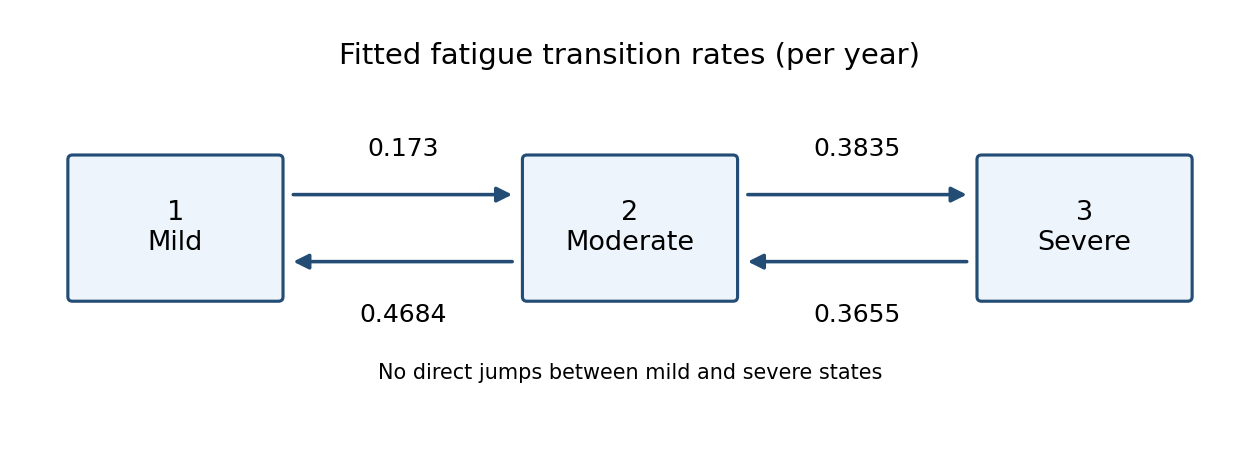
Estimated fatigue transition intensities: mild to moderate 0.173, moderate to mild 0.4684, moderate to severe 0.3835, and severe to moderate 0.3655 per year
. Details. 
In state , the total exit intensity is . By the holding time law for a continuous-time Markov chain, the time until the next jump has an exponential distribution with this rate. ThereforeThe printed interval for gives the interval for . Taking reciprocals reverses the endpoints, so the transformed confidence interval for the mean holding time isFor the next jump's destination, competing outgoing intensities giveIndeed the density of a first jump to at time is ; integrating gives the ratio above. This is a conditional next-jump probability, not a transition probability of being mild at a fixed later visit.
The command uses the model without covariates, starts in mild fatigue at time zero, and calculates expected accumulated years in each state between times and . Let be the fatigue state and its fitted generator matrix. For the occupation time of a continuous-time Markov chain,the expected finite-horizon occupation time isThe first equality follows by interchanging a bounded time integral and expected value, and the second uses the homogeneous continuous-time Markov chain transition matrix. The reported expectations are 7.014800 years mild, 1.724686 years moderate, and 1.260514 years severe. They sum to ten because the person occupies exactly one state at every time. All repeated entries are counted: these are not the lengths of single holding times, the durations until first reaching each state, or the probabilities of occupying the states at year ten. The interpretation of the time limits is also given in the package documentation.
For patient , let be the fatigue state at time years since study entry. Let the covariate vector be , representing the sex indicator, arthritis duration in years, HAQ disability score and haemoglobin measurement. Conditional on these covariates, the continuous-time multi-state model has the Markov property and generator matrixEach allowed transition intensity has its own log-linear transition intensity model, . The zero entries exclude direct instantaneous jumps between mild and severe states, and the diagonals enforce zero row sums.
To express the estimates correctly, the printed intensities are evaluated at the sample covariate means , not at . Order the allowed transitions as . Their estimates arewith rows indexed by that transition order and columns by inEquivalently, the uncentred intercept is . The means are not printed, so the displayed rates cannot be treated as numerical zero-covariate intercepts.
The assumptions are independent patients conditional on their covariates; correctly observed fatigue states; no unmodelled history dependence once current state and covariates are known; positive adjacent-state intensities with the specified exponential covariate dependence and no interaction terms; and a noninformative observation and censoring mechanism for the conditional state-process likelihood. With fixed covariates the rates are homogeneous in time and holding times are exponential. Covariates updated at visits are treated as piecewise constant between observations, so each such interval has a constant generator, a piecewise-constant covariate approximation. In particular this is an approximation if a quantity such as duration changes continuously between visits.
For observations , conditioning on the initial observed state, the panel-observed multi-state likelihood is a product over patients and intervals ofwhere is the covariate value held over that interval. Multiple unobserved jumps within an interval are integrated out by this transition matrix. For example, a mild state followed by a severe state can have positive likelihood despite , because an unobserved moderate state can intervene. The panel observations within a patient are not independent; it is the Markov property that justifies multiplying conditional transition probabilities. The piecewise-constant handling of changing covariates is specified in the msm model documentation.
For the mild-to-moderate transition intensity, an increment in a single covariate, with the others held fixed, gives the multiplicative ratio . Of the four printed effects on this transition, sex and HAQ have confidence intervals excluding zero on the log-intensity scale.
With male coded and female coded , the estimated hazard ratio for males relative to females isThus, conditional on currently being mildly fatigued and on the other covariates, males have an estimated mild-to-moderate transition intensity about lower than females. The conclusion concerns this particular instantaneous transition, rather than a general reduction in fatigue probability.
For a one-point increase in HAQ, indicating greater physical disability, the estimated intensity multiplier isGreater disability is therefore associated with a substantially faster mild-to-moderate transition, after adjustment for sex, arthritis duration and haemoglobin. Both conclusions use the specified log-linear transition intensity model and the nominal individual intervals. Arthritis duration and haemoglobin have intervals including zero for this transition, so their effects here are not statistically significant at ; this says neither that their effects are zero nor that they are insignificant for all other transitions.
Articles by others on the same topic
There are currently no matching articles.