Use position eigenstates normalized by , and the free Hamiltonian operator . The time-sliced path integral is the matrix element of the time-evolution operator:Insert momentum eigenstates, with . The free-particle propagator becomesComplete the square in the exponent:The Fresnel integral, defined by the damping prescription , gives, for ,The square-root branch is ; it is fixed by the regulated Gaussian integral and the short-time Dirac delta distribution limit, rather than an arbitrary phase.
The Euler-Lagrange equation for the free particle is . Its unique classical path satisfying the endpoint boundary conditions is . Therefore its classical action isSubstituting into the operator result yields , with independent of the endpoint positions.
The same independence is transparent directly in the path integral. Write , with . The cross term in the action is , so . The fluctuation integral depends only on . Because the action is quadratic, the factorization is exact; the semiclassical propagator already equals the full answer.
Put and assume . The normalized free Gaussian integral has covariance . Expanding the interaction exponential and using Wick's theorem gives the Feynman rules: a quartic vertex contributes , each internal propagator contributes , and each vacuum diagram is divided by its Feynman-diagram symmetry factor. Multiply the resulting sum by . Because we are expanding , rather than , disconnected vacuum diagrams must also be included.
At order there are two quartic vertices and four internal propagators. Let be the number of edges joining the two vertices. The remaining half-edges must pair at their own vertex, so is even. The possibilities exhaust the vacuum diagrams:
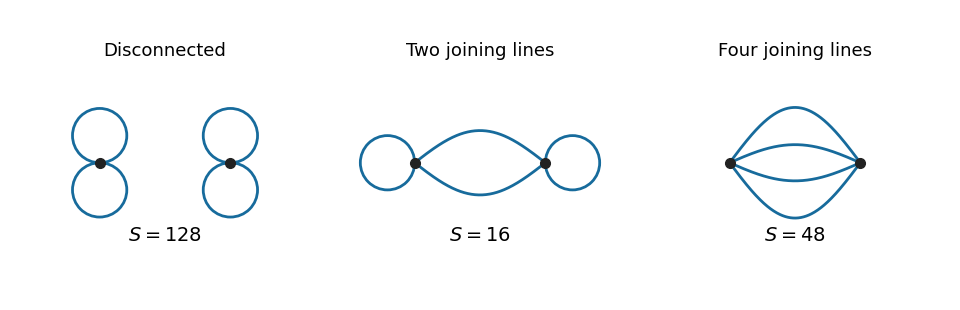

For , each vertex has three possible pairings, giving Wick contractions. For , choose the two half-edges at each vertex, then pair the chosen half-edges across the vertices: . The remaining two half-edges at each vertex form a self-loop. For , all half-edges pair across the vertices, giving . The common denominator from the expansion is , so the Feynman-diagram symmetry factors areEach vacuum diagram has the same factor before division by its Feynman-diagram symmetry factor. Consequently the coefficient of isAs an independent check, the eighth moment obtained from the Gaussian moment pairing theorem is , and . The first terms of the zero-dimensional quartic perturbation series are thereforeStrictly, the printed phrase “Taylor expansion” means a formal expansion or a right-sided asymptotic expansion. The general coefficient has absolute successive ratio , so the power series has zero radius of convergence. Nevertheless, for the remainder after any fixed truncation of is bounded by the next absolute term, and its Gaussian integral is finite. This proves the displayed asymptotic expansion as . For negative real the defining integral diverges.
Articles by others on the same topic
There are currently no matching articles.