For the inverse-square potential , the central force is . The transverse component of acceleration in polar coordinates is therefore zero:Thus ; for unit mass it is the signed angular momentum perpendicular to the orbital plane. The radial component givesConsequentlyThis is the mechanical energy, since the full kinetic energy is and .
For and , the effective potential goes to as and to zero from below as . Its derivative is , so it decreases up to and then increases. Its zero and minimum areFor , is positive and strictly decreasing, with limits at zero and at infinity. It has no minimum at a finite positive radius.
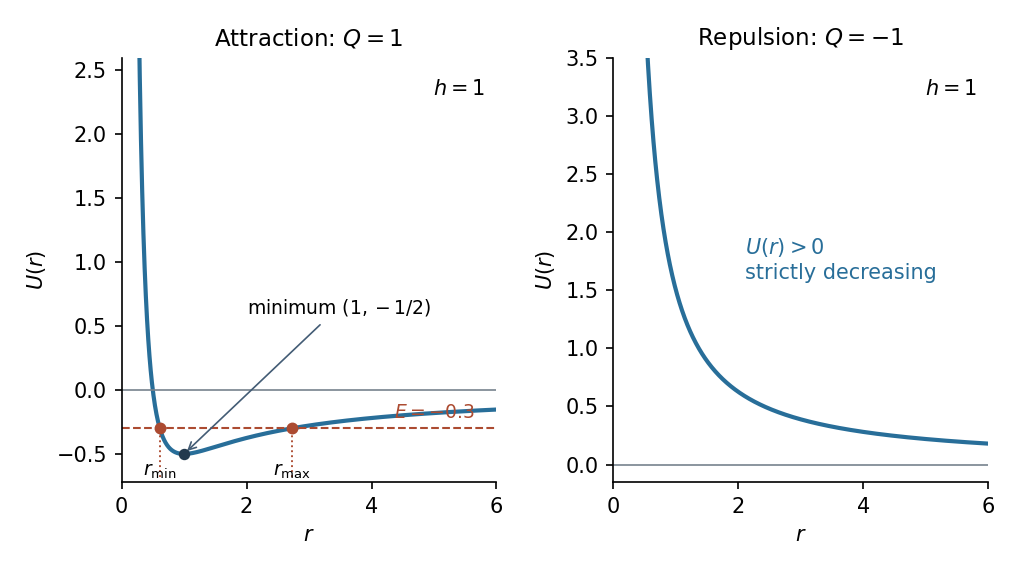

If , the centrifugal term disappears. For the graph is instead , increasing from to without a minimum; for it remains positive and decreasing. The bounded-orbit calculation below uses the stipulated , which excludes this radial collision case.
The radial energy equation is , so motion requires . For and , the effective potential minimum and its limiting value zero at infinity implyAt the lower endpoint the particle stays at , giving a circular orbit. Strictly between that endpoint and zero, two positive turning points confine the radial motion. For below the minimum there is no allowed motion, while does not give a radially bounded orbit.
Write and . At each turning point , soThe smaller and larger roots give the periapsis distance and apoapsis distance:They coincide for the circular orbit. Their sum and product are
The speed satisfies , which decreases strictly with because . Thus its maximum is at the periapsis and its minimum at the apoapsis. At either endpoint the radial velocity vanishes, so . Therefore the apsidal speed sum for an attractive inverse-square orbit isHence . Individually, and , also valid when the orbit is circular.
At infinity the potential energy tends to zero, so the conserved mechanical energy is . The impact parameter is the perpendicular distance from the origin to the incoming asymptotic line. Conservation of angular momentum gives .
For , a turning point of the radial motion satisfiesOnly the positive root is physical, givingFor this reduces to the straight-line closest distance .
For nonzero , put . If , the numerator is , soIf , rationalize the numerator instead:Thus the requested leading distances areRepulsion gives a finite barrier even for zero impact parameter; attraction allows much closer passage. At , the attractive formula has the limiting closest distance zero, corresponding to collision with the singular centre rather than a positive turning point.
Articles by others on the same topic
There are currently no matching articles.