Use the printed unnormalized inverse discrete Fourier transform, with positive exponent: . Its natural domain and codomain are ; the printed real-to-real designation is not literal, as the first example below has complex output. There is no factor in the convention of this question.
Separate even and odd indices, using . ThenThe second identity uses . Each FFT butterfly uses one shared twiddle-factor product and two additions, so assembly costs multiplications and additions.
The radix-two Fast Fourier transform recursively splits the input into even and odd subsequences until length one, then assembles the transforms using the FFT butterfly identities. For , the recursive leaf order is the bit-reversed order . The three assembly stages have block sizes two, four and eight. In a block of size , butterfly number maps to .
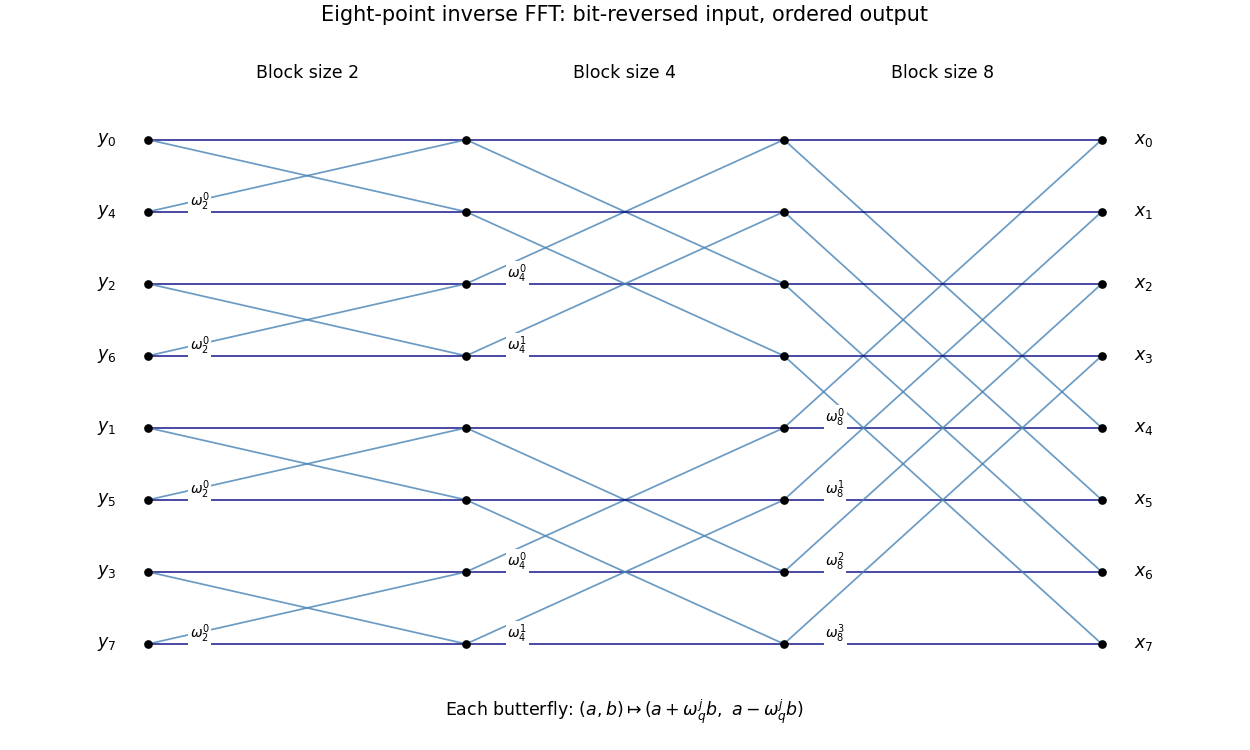

Counting every twiddle-factor product, including multiplication by one, the recurrence is , with . Each of the levels costs products, soIf products by one are omitted, every block saves one product. There are blocks across all stages, giving . The conventional complexity in either convention is ; additional savings are possible by treating multiplication by as component swaps and sign changes.
For , the even and odd subsequences are both and each length-two inverse discrete Fourier transform is . Since , the FFT butterfly givesFor , the even transform is and the odd transform is . The same assembly gives
Articles by others on the same topic
There are currently no matching articles.