For an odd prime number and an integer not divisible by , the Legendre symbol is if is a quadratic residue modulo , and otherwise. One may extend it by when .
Put . The nonzero quadratic residues in the finite field form a subgroup of size : the group homomorphism has kernel . Each square satisfies by Fermat's little theorem. Since a nonzero polynomial of degree has at most roots of a polynomial, these are all the roots of . For any other nonzero , Fermat's theorem gives , so . Thus Euler's criterion follows, and multiplication givesBoth sides are or , which are distinct modulo the odd prime number , so . Taking in Euler's criterion gives , which is for and for .
Euler's criterion gives in this case. There are equally many nonzero quadratic residues and quadratic nonresidues, so . Replacing by and using the multiplicativity of the Legendre symbol givesConsequently .
The Weierstrass approximation theorem says that for every real continuous function on and every , there is a real polynomial with . Equivalently, polynomials are dense in in the uniform norm.
The given moments imply for every polynomial . Choose polynomials converging uniformly to by the Weierstrass approximation theorem. ThenA nonnegative continuous function with zero integral vanishes everywhere. Hence .
This also forces . Indeed, is a continuous function on . Approximate uniformly by polynomials using the Weierstrass approximation theorem. Then uniformly, and the even moments give . The estimate from part (i), with in place of , proves and hence the conclusion.
Again . The change of variables givesApply part (i) to the continuous function . It vanishes on the whole interval, so does .
Let and . The Euclidean isometry fixes the origin and preserves norms. The polarization identity therefore gives . In particular, are an orthonormal basis. The coefficients of in this basis are , so . Thus is a linear map represented by an orthogonal matrix, and . Conversely, every such map preserves distances because .
When , the real eigenvalues of the two-dimensional orthogonal matrix are . Choose corresponding unit eigenvectors , and write . In these coordinates . This is reflection in the line , followed by translation along that line. It is a Euclidean reflection if , and a glide reflection if .
Take the parity-check matrixover . Its columns are all the nonzero vectors of . The Hamming code is . Since has rank three, is a binary linear code of length seven and dimension four. No nonzero codeword has weight one or two, since no column is zero and no two columns coincide. Columns give a codeword of weight three, so has parameters .
For a received vector , its syndrome is . A single error in position gives exactly column of , so the syndrome identifies that position uniquely; zero syndrome means no error under the one-error assumption. The radius-one Hamming balls around the codewords are disjoint and have total size , so this is also a perfect code.
There are weight-three codewords: every pair of columns determines the third, and each triple is counted three times. The all-ones vector is a codeword because the column sum is zero, so complementation gives seven weight-four codewords. Together with zero and the all-ones vector these account for all sixteen. The weight enumerator is therefore
A maximum-likelihood estimator maximizes the likelihood as a function of the parameter for the observed data. Under the usual regularity conditions, a scalar maximum-likelihood estimator satisfies , where is the Fisher information in one observation.
For a Poisson distribution with , the log-likelihood is . Solving gives . Its expectation is and its variance is . If all observations are zero, the maximum over occurs at zero; over this is a boundary supremum. The one-observation score function is , so and the asymptotic variance of is .
For , let . The identitygives , so is another unbiased estimator. However, the total score function has variance . For any regular unbiased estimator , differentiating gives , so the Cauchy-Schwarz inequality yields . The sample mean attains this Cramér-Rao bound exactly. There is no variance advantage in preferring to .
Write , with . Besides zero, the fixed points satisfy . If , they areThe derivative is . At a positive fixed point, , so . Thus zero is attracting, is repelling because , and is attracting because .
Moreover,For the iterates strictly decrease and stay positive. Their limit is a fixed point below , hence zero. For the iterates increase towards ; for they decrease towards . Monotonicity of prevents crossing the limiting fixed point. is the extinction threshold. The cobweb plot illustrates these alternatives.
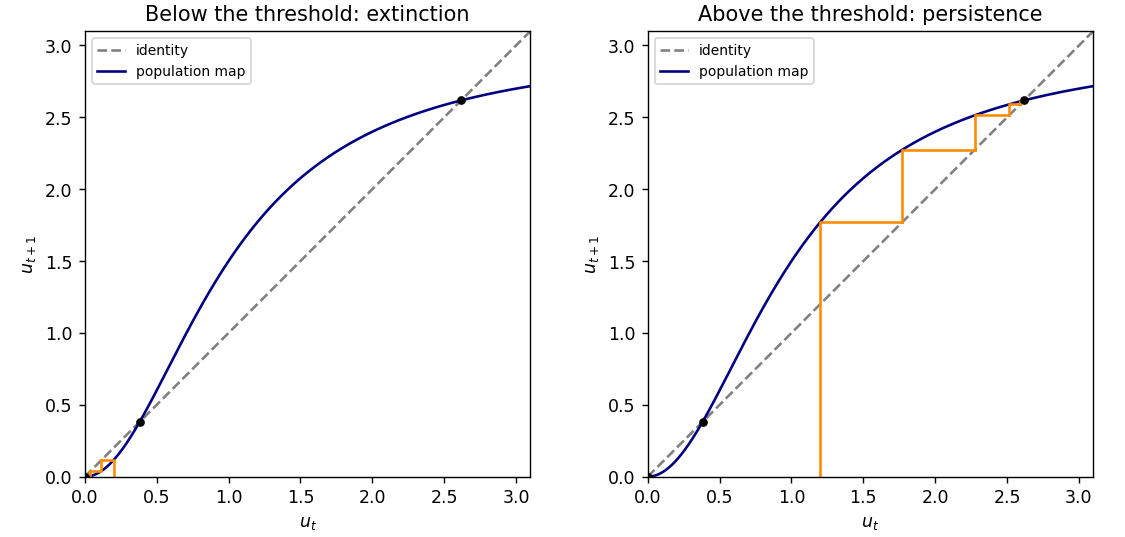
Population cobwebs below and above the unstable extinction threshold
. Details. For there are no positive fixed points, and for every , so all populations tend to zero. At , the positive fixed point is semistable: initial populations below it tend to zero, and those above it decrease towards it. This is a saddle-node bifurcation in the discrete dynamics.
The only equilibrium point is . Its Jacobian matrix is , with characteristic polynomial . For both eigenvalues have negative real parts, so the origin is locally asymptotically stable.
Use the Lyapunov function . Along a solution,A Lyapunov function is positive away from the equilibrium and nonincreasing along trajectories; its sufficiently small sublevel sets prove stability. Asymptotic stability additionally means nearby trajectories converge to the equilibrium. The basin of attraction is the set of initial states whose forward solutions exist for all positive time and converge to it. Every closed disc of radius at most is positively invariant, since there. The LaSalle invariance principle says that a solution in a compact positively invariant set where approaches the largest invariant subset of . Here that subset is only the origin: on , remaining on the line would require ; the isolated points on the outer disc do not remain there because . Hence the closed disc lies in the basin of attraction.
This estimate does not assert that the basin is exactly that disc, or the whole plane. For example, choose so large that and . The region is positively invariant: on one has , and on one has . Within it , which forces finite-time escape. Thus the attraction is genuinely local. The Lyapunov function gives a rigorous sufficient domain for attraction without identifying its entire boundary.
The removable singularities at zero are understood inThese are entire functions, with values and . On the real axis their difference is , including its continuous value at zero. In the complex upper half-plane, , so away from zero; the analogous bound for holds in the lower half-plane. This verifies analyticity, the required jump and the specified decay.
In the Sokhotski–Plemelj formula, the boundary values may also be writtenIndeed the Cauchy principal value of is : split , translate the first integral, and use and the oddness of . The limiting formula at zero follows continuously.
For and , where the matrices are symmetric and constant, the Euler-Lagrange equations give . A normal mode therefore solves .
A string segment of horizontal length has extension . Multiplying by the tension and using and , the quadratic kinetic energy and potential energy areThus and . Taking , , gives the three eigenvalues , . The normal mode frequencies are
The photon number density is obtained by integrating the Planck photon distribution. With ,The integral converges, since its integrand is of order near zero and decays exponentially at infinity. Hence , with independent of temperature.
For equilibrium radiation undergoing adiabatic expansion, the total entropy in a comoving volume is constant. Since the entropy density is , this means is constant. A comoving volume scales as the cube of the scale factor, soThis agrees with the cosmological redshift of each photon frequency. The conclusion uses entropy conservation during the expansion.
The planar Brouwer fixed-point theorem states that every continuous map from a closed disc to itself has a fixed point.
Suppose first that a retraction exists. The continuous map takes to itself, so the Brouwer fixed-point theorem gives . Such lies on , where , contradicting .
Conversely, suppose a continuous map has no fixed point. For each , follow the ray from through to its last intersection with . This defines a retraction. More explicitly, put and setThe positive-root formula is continuous, , and is on the unit circle. If , the last intersection is itself, so . Thus the nonexistence of a retraction rules out a fixed-point-free , proving the equivalence.
Fix with , and let be radial projection to the closed disc. The continuous map has a fixed point by the Brouwer fixed-point theorem. On the boundary, , so its image under is interior and cannot equal the boundary point . Therefore . An interior fixed point of this projection must satisfy , because points outside the disc project to its boundary. Thus . Every belongs to .
No such map exists. If fixed the boundary, it would satisfy the hypothesis of part (iii) for every . Choose . Then part (iii) would give , contradicting the stipulated omission of . Equivalently, radial projection from the omitted point would turn into a forbidden retraction.
The Vandermonde determinant isIndeed, the determinant is an alternating polynomial, hence divisible by every . Both sides have degree , and comparison of the coefficient of gives constant one. This is an identity over the integers, so reducing its coefficients modulo a prime number preserves it. For , two residues coincide and the determinant vanishes. For , choose all elements of once to obtain a nonzero determinant.
For the ordering , this determinant is . If is odd, put . Wilson theorem gives . Pairing the factors with indices and , and leaving unpaired, givesEvery distinct ordering changes the determinant by its permutation sign; repeated residues give zero. Thus the possible values are for odd , and for .
Use Shamir's secret sharing: choose independent uniform , and engrave the shares , where and the are distinct nonzero field elements. We may take ; otherwise use a sufficiently large finite field extension and an agreed integer encoding. Any shares determine by polynomial interpolation and hence . Given any shares and any proposed , their equations in the coefficients have a unique solution: the coefficient matrix has determinant times a nonzero Vandermonde determinant. Since the coefficients were uniform, the observed shares have the same distribution for every . Thus they give no information about the secret.
For the fake, reduce its integers to field elements and first check that its abscissa is distinct and nonzero. Random collisions or a zero abscissa are immediately detectable and have probability ; the following conclusions concern the overwhelmingly likely distinct-abscissa case.
With shares, there is always a unique degree-at-most- interpolating polynomial. If all shares are genuine it gives the correct secret. If one is fake, it normally gives the wrong secret, with probability conditional on a uniform fake ordinate, but the inconsistency is undetectable from those shares. The data do not certify which case has occurred.
With shares, genuine shares are consistent with one such polynomial. A fake is inconsistent with probability , so it is usually detected as an inconsistency. However, omitting each of the shares in turn gives possible polynomials. If the data are inconsistent, their constant terms are distinct: two candidate polynomials with the same constant term agree at zero and at their common abscissae, hence agree identically, which would make all the data consistent. The secret is narrowed to possibilities, but the fake is not identified.
With shares, at least are genuine. There is a unique degree-at-most- polynomial agreeing with at least shares: two candidates would agree on at least abscissae and hence coincide. Find it by deleting each share and checking consistency. The secret is recovered uniquely, and the fake is identified unless it happens to lie on the genuine polynomial, in which case it is harmless.
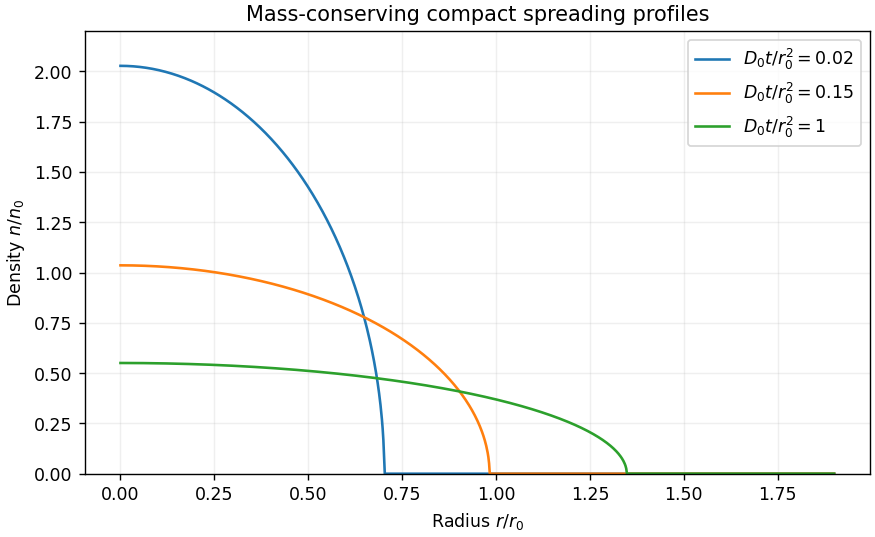
Put and . Direct differentiation givesThus the partial differential equation reduces to an ordinary differential equation precisely when . The profile then satisfies . Regularity and zero radial flux at the origin make the integration constant zero. Wherever , , so using . Requiring the front at selects . Point release requires , givingAlthough diverges at the front, tends to zero, so this compactly supported profile satisfies the equation in the weak solution sense.
The compact radial cubic-diffusion profile conserves the total population:Consequently . The front radius grows as , while the central density decays as . The conserved mass concentrates at the origin as .


Choose with . The cut's upper and lower banks have , , and giveThe small circle about zero vanishes for . On the unit circle put . Since , its contribution isUsing gives the required decomposition.
The only enclosed pole is ; the other root is outside. The residue theorem, including the factor in front of the contour integral, givesHere the positive real logarithm defines the power, so this expression is an entire function of . The finite-interval integral is also entire, by differentiation under the integral on compact sets. Therefore is an analytic continuation valid on the whole complex plane. Outside it is this continuation, rather than the unregularized cut integral, that defines .
Take as the inclination of the symmetry axis to the upward vertical, as its azimuth, and as rotation of the body about that axis relative to the line of nodes. The kinetic energy and potential energy areThe cyclic coordinates and time independence give three conserved quantities:Their meanings are the component of angular momentum along the body axis, the component along the vertical, and the total energy.
For a vanishingly small perturbation of the upright spinning state, , , and . Eliminating gives the limiting effective potentialIts quadratic change near zero is . Thus if , zero is a strict local minimum and a sufficiently small perturbation remains near it.
In the unstable case, the limiting energy equation becomesAt the nonzero turning point the bracket vanishes, yieldingThe approximation is the small-perturbation limit, not an assertion that arbitrary disturbances preserve the upright state's exact conserved quantities.
The map is strictly increasing and continuous at limit ordinals. Also , so the set is nonempty and bounded by . If is a successor, it is already in ; if it is a limit, continuity gives . Thus has a greatest element .
The initial segment of the well-order of order type leaves a tail of some order type , giving . For fixed left summand, ordinal addition is strictly increasing in its right argument, so this is unique.
Maximality gives . Choose the least positive integer such that . Then and . If , monotonicity of ordinal addition would give , a contradiction. Hence . If is not a power of , both and are nonzero and smaller than , proving decomposability.
Conversely, prove by transfinite induction that any two ordinals below have sum below . For the only smaller ordinal is zero. For , choose finite with and . Monotonicity gives . For limit , choose sufficiently large that , and apply the induction hypothesis. Thus the nonzero indecomposable ordinals are exactly the powers of .
A matching in a graph from to chooses one distinct neighbour in for each vertex of . For a finite bipartite graph, the Hall marriage theorem states that such a matching exists if and only if for every . Necessity follows because the matched neighbours of are distinct members of .
For sufficiency use induction on , with the empty and one-vertex cases immediate. If some nonempty proper satisfies , the induced graph on satisfies Hall's condition. The remaining graph on does too: for ,Inductively match both pieces and combine them. If no nonempty proper subset is tight, choose an edge and remove its endpoints. Every nonempty subset of the remaining is proper in the original , so ; removing preserves Hall's condition. Match the remainder inductively and add . This proves the theorem without a flow or disjoint-path theorem.
Fix any edge . After deleting and , every nonempty subset of satisfies , by the strict inequality in the question. The Hall marriage theorem gives a matching in a graph for the remainder; adding gives a matching covering and containing the prescribed edge. The case is immediate.
Suppose a nonempty proper is tight. In every matching in a graph covering , the vertices of use every vertex of . Hence no edge from to could occur in such a matching. The assumption that every edge occurs therefore rules out all such edges. By definition there are also no edges from to . This separates from the rest, which contains the nonempty set , contradicting connectedness. Hall's inequality must therefore be strict on every nonempty proper .
Take a disjoint union of single edges, each joining one vertex of to one of . Its unique matching in a graph covering contains every edge, while any singleton satisfies . For this is nonempty and proper. This illustrates why connectedness was needed in part (ii).
No. In the six-cycle with cyclic vertices , every edge belongs to one of the two alternating perfect matchings. However, the disjoint edges and cannot belong to a common perfect matching: the remaining vertices are not adjacent. Taking and gives the required bipartite graph counterexample.
For the first field, set . Its field extension degree is four, since is real and adjoining doubles its degree. The polynomial is irreducible over : a reducible cubic would have a root in , but every root has degree three over by Eisenstein criterion, impossible by the tower law because . Thus
For the second field, put . The splitting field is and has degree eight, since is Eisenstein and is real. Define automorphisms and . They satisfy and , and give eight distinct automorphisms. Hence .
The Galois correspondence gives all the subfields in the following table. The middle column records generators, not merely their degrees.Each displayed generator is fixed by the indicated subgroup. The two last quartic generators have fourth power , so their degree is four by Eisenstein criterion; the other quartic degrees are immediate. These are all the subgroups of and hence all the subextensions.
If a group representation of has character , its restriction of a representation to has character . For an -representation with character , the induced representation is , with acting on the first factor. Decomposing into coset copies of shows that its character isIndeed only cosets fixed by contribute to the trace, and each coset has representatives.
The Frobenius reciprocity says . Directly, with the usual character inner product,The first equality substitutes in the finite sum, and the second uses conjugacy invariance. This proves the theorem.
In the induced character formula above, there are no with when the conjugacy class of misses . The sum is empty, so .
Each -conjugacy class represented by has elements. For every element of that class, the number of conjugators from to it is . Grouping the induced character formula by these classes therefore gives
In the example, has order four, has order two, and , so . Its five conjugacy classes are , , , and , of sizes . The four one-dimensional irreducible characters are determined by and , each sign independently chosen. The remaining two-dimensional irreducible character comes from the plane action of the square:Their squared degrees sum to eight, so this is the full character table.
In , use class representatives . Their intersections with are respectively , , , the empty set, and . The corresponding centralizer orders are , while the noncentral centralizers have order four. The induced values are consequentlyIn the same class order, all five induced irreducible characters are
Put . The ring of integers is , with discriminant . The Minkowski bound for ideal classes for an imaginary quadratic field says that every ideal class has an integral representative of norm at most . Therefore the ideal class group is generated by primes above two and three: norm-four representatives contribute only products of primes above two.
The prime two ramifies: has norm two and . It is not principal, since an element of norm two would require , which has no integral solution. Thus has order two. Since modulo three, three splits into and its conjugate, whose classes are inverses.
The element has norm . It belongs to but not its conjugate, and its norm has exactly one factor two. Unique prime ideal factorization therefore givesHence . Since all generating classes are powers of , .
Take a CW complex with one vertex, loops labelled , and one two-cell attached along . The Seifert-van Kampen theorem gives the required fundamental group. Connected double covering spaces correspond to index-two subgroups, equivalently kernels of surjective homomorphisms . The relation imposes modulo two, so the unique nonzero possibility sends both to one. Thus there is a unique connected double cover up to covering isomorphism.
Construct it with two vertices; both labelled edges switch sheets, and attach the two lifts of the two-cell. Contract one of the edges to a spanning tree. With coset representatives , the remaining Schreier generators can be taken as , and . Reading the two lifts of the attaching word, starting on the two respective sheets, gives and . ThusFor example, a letter contributes nothing on the first sheet and on the second; a letter contributes on the first and on the second. Both letters then switch sheets, which directly verifies the two relators.
All sequence spaces here are over . Use the supremum norm on and the summable sequence norm on . The dual consists of continuous complex-linear functionals.
The supremum norm satisfies positivity, absolute homogeneity and the triangle inequality coordinatewise. Let be a Cauchy sequence in this norm. Each coordinate is Cauchy in and has a limit . The sequence of norms is bounded, so for all and . Given , choose such that for . Letting in each coordinate gives for . Thus in norm, and is a Banach space.
Suppose converges uniformly to . Choose with , then a tail on which . On this tail , proving . Linearity is coordinatewise, so is a closed subspace.
For , define the bounded linear functional . Absolute convergence gives . For each , take when and , and zero elsewhere. This finitely supported sequence belongs to and has norm at most one, giving . Therefore .
Conversely, for put . The same finite phase vectors give , so . The finite truncations of every converge in the supremum norm, hence continuity gives . This proves the surjective isometric isomorphism of normed spaces .
The finite truncations of lie in and converge in the supremum norm to . Thus is not closed. Every element of is the norm limit of its finite truncations, while is closed and contains . Hence .
A point of the surface is a germ of a branch obtained by analytic continuation of the original function. A representative analytic branch on a small disc gives a neighbourhood of germs, one at each centre in that disc. Projection to the centre is a complex coordinate chart; overlaps have identity transition maps. Complete continuation along every path gives a Riemann surface with an unramified covering map to . Lifting a closed path starting at each germ above analytically continues that branch back to , permuting the fibre. Reverse paths give inverse permutations, and concatenation gives their composition. This is the monodromy action of a covering space.
Write , . There are four branches , which are distinct: neither square root vanishes on , and prevents . Small loops about either or change the sign of only; loops about either or change the sign of only. Label the four branches in the displayed order. The corresponding permutations are and , respectively. Every loop in this punctured plane is generated up to homotopy by these puncture loops, so no other generators arise. The resulting monodromy group of a covering isIt acts transitively and regularly on the four branches.
We use algebraic dimension and tangent spaces, equivalently after extending scalars to an algebraic closure; these are not dimensions of the finite set of rational points when is finite. The condition rank at most is equivalent to the vanishing of all matrix minors. These are polynomials in the entries, so define an affine determinantal variety . The same equations make it a Zariski closed subset of .
For , every line lies in because its matrices have rank at most one. Its tangent direction therefore belongs to the Zariski tangent space at zero. The matrix units span all directions, so . Meanwhile a rank- chart with an invertible block has the formThe free blocks have entries. Rank- matrices are dense in : the factorization parametrizes all rank-at-most- matrices, and the full-rank factor pairs form a dense open subset. This also proves irreducibility, so the local dimension at zero equals the dimension of . Since , zero is singular when .
There is a necessary qualification to the printed claim: for , is a smooth point, with zero-dimensional tangent space. Thus the claim is false if zero is allowed as a rank bound.
Finally, for , the formula gives . Concretely, on a chart where an entry of the first column is nonzero, choose that column freely and make the second an arbitrary scalar multiple of it, giving five plus one parameters.
For a regular simple closed plane curve of length enclosing area , the planar isoperimetric inequality is , with equality precisely for a circle.
The periodic Wirtinger inequality states that an absolutely continuous -periodic function of mean zero with square-integrable derivative satisfieswith equality only for a linear combination of and . Parametrize the curve by arc length and translate its position vector so that both coordinate means vanish. Then , since . Green's theorem and the Cauchy-Schwarz inequality giveEquality requires a first-harmonic parametrization and equality in Cauchy-Schwarz; its radius vector is a constant multiple of the rotated unit tangent. It is therefore a circle. Conversely, a circle attains equality.
The Fenchel theorem states that every closed regular space curve has total curvature at least :Equality holds precisely for a convex plane curve, traversed once.
For the anticlockwise boundary of the region, the inward normal is the left normal, so the signed curvature obeys the turning tangent theorem . Therefore some has . The enclosed area satisfies , and the planar isoperimetric inequality gives . ConsequentlyThis uses the interpretation of the curve as a simple boundary traversed once; the inward normal and enclosed region in the question have that meaning.
A lambda-system contains the whole space and is closed under complements and countable disjoint unions. Let be the smallest lambda-system containing a pi-system . For , the family of with is a lambda-system containing , hence is all of . Fixing and repeating the argument shows is closed under intersections. A lambda-system closed under intersections is a sigma-algebra, so . This proves the pi-lambda theorem. If two probability measures agree on , the sets on which they agree form a lambda-system; thus they agree on .
The nonnegative form of Fubini's theorem, also called Tonelli theorem, states that for a nonnegative product-measurable function on two sigma-finite measure spaces, the product integral equals either iterated integral, allowing the value infinity.
For Lebesgue measure on the plane, a bounded interval rectangle has measure . Its preimage under is , which has the same measure. Under , its vertical slice at is , whose one-dimensional Lebesgue measure is by translation invariance. Tonelli therefore gives . Horizontal slices likewise prove the equality for . The interval rectangles form a generating pi-system. Sigma-finite measure uniqueness, obtained by the finite-measure pi-lambda argument on an increasing rectangular exhaustion, extends these equalities to all Borel sets. Completion extends them to all Lebesgue-measurable sets, since Borel null sets and their subsets remain null.
Writing , matrix multiplication givesThus rotations through angles in preserve measure. Their inverses and compositions do too; every plane rotation is a finite composition of these, including a right angle as two rotations through . Lebesgue measure is invariant under every rotation.
Independence and the moment-generating function of an exponential distribution giveFor each fixed , taking logarithms and using yields . The limiting service time is the constant . Its moment-generating function is exactly this limit.
An M/G/1 queue has Poisson process arrivals of rate , independent identically distributed service times of law , one server, and here infinite waiting capacity. Use first-come-first-served service. Let be the number left just after the th departure. During the next service, let be the number of arrivals. ThenConditional on the next service time , is Poisson with mean . If , the server waits for one arrival to start service; that arrival is the customer being served, and is not counted in . This constructs the embedded Markov chain.
Articles were limited to the first 100 out of 145 total.
Articles by others on the same topic
There are currently no matching articles.