For a nonconstant invasion travelling wave, the relevant end states are and . These fronts do not exist at every nonnegative speed: the phase plane calculation gives the threshold . The constant solutions and are, of course, nonnegative travelling waves for every speed, including zero.
Put and . The travelling-wave reduction of a reaction-diffusion system givesThe equilibrium points in the phase plane are and . At the characteristic equation is , so there is one positive and one negative eigenvalue. Thus it is a saddle equilibrium. Its descending unstable manifold has , and locallyAt the eigenvalues areFor it is a stable node; for it is a stable spiral. The repeated-root case must be included in the existence argument rather than inferred from distinct roots.
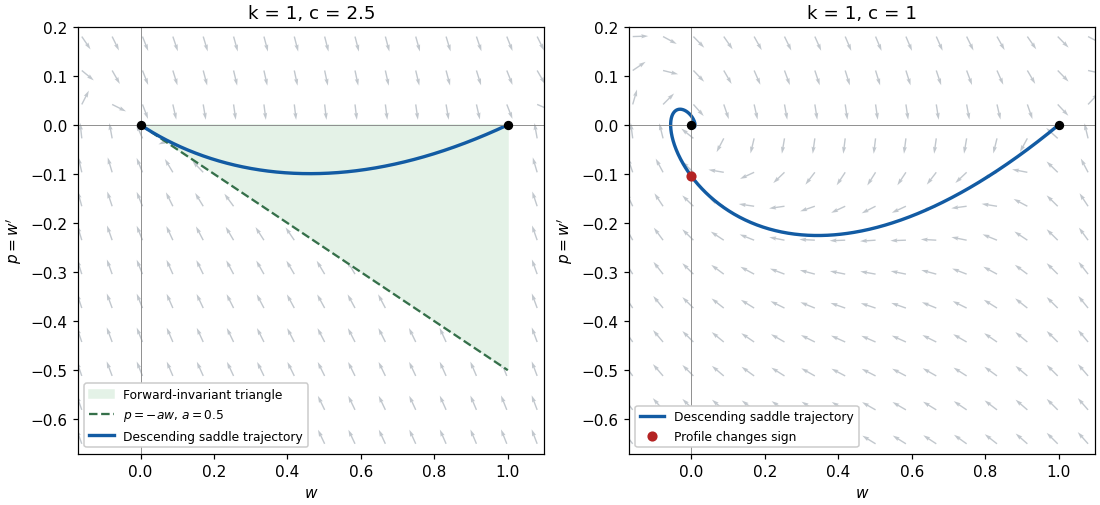
Suppose . Choose with ; for example . Consider the closed triangular regionOn the horizontal side , the vector field has , pointing into . On the vertical side , it has , again pointing inward. For the sloping side use , so that on ,Thus trajectories cannot cross into . The remaining boundary point is an equilibrium point and cannot be crossed in finite time by a nonconstant trajectory, by uniqueness theorem for ordinary differential equations. This proves forward invariance of . The argument works unchanged at with .
The descending unstable manifold of initially enters . Its forward trajectory remains in this compact region, so it exists for all positive . Within the interior, : a first contact with at would have , contrary to arrival from below. Hence decreases strictly and has a limit . To identify the limit, its omega-limit set lies on the line and is invariant. Any trajectory remaining on this line has ; its second equation then forces . Since , it follows that , and the only possible omega-limit set is . Backward in , the unstable manifold tends to by its construction. We have therefore obtained a positive decreasing heteroclinic orbit and hence a nonnegative travelling wave for every .
For completeness, the threshold is necessary for such a front. When , put , , and . Near the zero equilibrium point the system becomesFor a nonzero trajectory its polar angle satisfiesA trajectory approaching zero therefore makes infinitely many rotations and must cross . It cannot be a nonnegative front. At , the first integralis conserved. It has values and at the two desired end states, so no heteroclinic orbit connects them. ConsequentlyThis is the phase-plane construction of a Fisher travelling front, including the critical speed. The statement for all must distinguish these nonconstant fronts from the two constant travelling waves.

Articles by others on the same topic
There are currently no matching articles.