The initial table of content was limited to the first level because it is larger than 1000 articles. There are 1712 articles in total. Expand a branch to load its children.
The defining rule for a derivation of a Lie algebra is linear in the operator, so is a vector subspace of the general linear Lie algebra . Its Lie bracket is the operator commutator. If are derivations of a Lie algebra, expand both compositions:Subtracting cancels the mixed terms and givesThus is again a derivation of a Lie algebra, proving that the derivation Lie algebra is a Lie subalgebra of . This calculation works in every characteristic of a field.
The Jacobi identity states . It first shows that is a derivation of a Lie algebra, and then givesThe map is linear, so this identity proves it is a Lie algebra homomorphism.
Finally, for any derivation of a Lie algebra ,ConsequentlyThis proves that the inner derivations of a Lie algebra form an ideal of a Lie algebra in .
Equip with the inner product defining the root system, so the Weyl group acts by orthogonal transformations. As usual, the root system spans its ambient space . Let be an invariant subspace for the reflection representation of a Weyl group. Its orthogonal complement is also invariant.
For a root , the Weyl reflection satisfiesIf for every , then . Otherwise choose with . Both and belong to , and their difference is a nonzero multiple of , so . HenceThe two sets are mutually orthogonal and individually closed under their root reflections. If both were nonempty, this would decompose into two orthogonal root systems, contradicting that it is an irreducible root system. All roots therefore lie in one of the two subspaces. Because they span , either or , the latter giving . Thus the reflection representation is an irreducible representation.
Use the traceless diagonal Cartan subalgebra of the special linear Lie algebra . Write , so . The standard coordinate vectors are weight vectors of weights , and the tensor product of Lie algebra representations has basisThe weight of this basis vector is . There are two possibilities:The first has basis , with the wedge ordered if necessary. In the second, the tensor's first factor can be any one of the three indicated coordinate vectors. No two different listed coefficient patterns restrict to the same functional on the traceless diagonal Cartan subalgebra: their difference would have to be a multiple of , but its coefficient sum is zero. All unlisted weight spaces are zero. As a check,For , the distinct-index weight is zero and has multiplicity three.
To determine the irreducible summands, take the upper triangular raising operators. The vector is killed by every such operator and has highest weight . The exterior product mapis a Lie algebra representation homomorphism. It has an equivariant right inverseIndeed . The vector is a highest-weight vector of weight .
The Weyl complete reducibility theorem and highest-weight representation theory show that generates an irreducible summand in . To check that it exhausts this kernel, use the Weyl dimension formula with the partition :This equals . The exterior-power Lie algebra representation is irreducible, with highest weight for , and is the one-dimensional trivial representation for . Therefore the tensor product of the standard representation with its exterior square givesEach summand occurs once; their dimensions are and .
Write an element of the symplectic Lie algebra in blocks. Direct multiplication in givesThe diagonal Cartan subalgebra consists of . Define . Under the Adjoint representation, the off-diagonal matrix units in have weights ; the symmetric entries in have weights , including on the diagonal; those in have the negatives of these weights. All nonzero root spaces are one-dimensional, while the zero weight space is the diagonal Cartan subalgebra. Thus the Cn root system isChoose the positive roots and simple roots asTheir highest root and Weyl vector areFor the last identity, each pair contributes before division by two, and the long positive root contributes another afterward. Successive simple roots have equal length except for , whose squared length is twice that of . The Cn Dynkin diagram is a chain with a double last bond, whose arrow points toward , the short root:
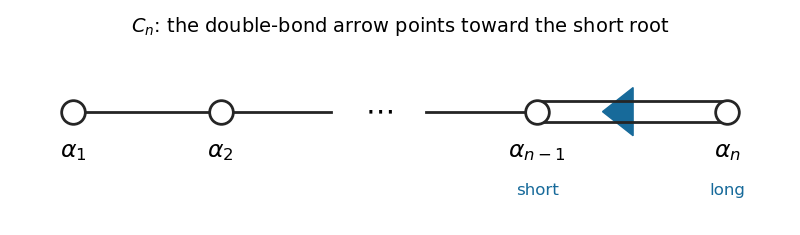

The displayed schematic is for ; omit intermediate nodes for . For the diagram has just the single node .
Let with its nondegenerate alternating bilinear form. Its inverse-form bivector is invariant under the symplectic Lie algebra, and . Choose . The exterior product defines a symmetric bilinear form on byIt is symmetric because two-forms commute under the wedge product. It is nondegenerate because each basis wedge pairs with its complementary basis wedge. Since , the five-dimensional orthogonal complementalso has a nondegenerate symmetric bilinear form. This is the primitive exterior square, equivalently the kernel of symplectic contraction of an exterior square.
Every element of fixes and preserves volume, since its trace is zero. The induced exterior-power Lie algebra representation consequently preserves and satisfies . Thus it gives a Lie algebra homomorphismWe check injectivity explicitly. If acts as zero on , it also kills , and therefore acts as zero on all of . For three distinct indices , the coefficient of in is , so all off-diagonal entries of vanish. Its action on is then . All these sums vanish, which in characteristic zero forces every diagonal entry to vanish. Hence .
Finally,The injective Lie algebra homomorphism is therefore surjective. Over , every nondegenerate symmetric bilinear form admits a basis in which its matrix is the identity, so this constructs the exceptional isomorphism between sp4 and so5:
Identify the diagonal Cartan subalgebra with through its coordinates , and identify real roots with coordinate vectors using the invariant Euclidean inner product. A Weyl reflection is . It does not change when is replaced by . For the Cn root system, its explicit actions areEvery coordinate not displayed stays fixed. Thus each generating Weyl reflection is a signed permutation, so the Weyl group is contained in the signed symmetric group. Conversely, the first row supplies each independent sign change and the second supplies every coordinate transposition; these generate the entire signed symmetric group. This proves the Cn Weyl group identification, including its size:
Suppose that is not a discrete subgroup. The identity is then an accumulation point of nonidentity subgroup elements: translate any failure of isolation to the identity. Choose with , and use a local exponential chart to write , where and in the real Lie algebra .
Choose a norm on this finite-dimensional vector space. By compactness of its unit sphere, pass to a subsequence with , where . For an arbitrary real , choose an integer nearest to . Then andEvery left-hand element belongs to , including for negative . Closedness gives . Since was arbitrary and , the limit directions of a closed subgroup provide a nontrivial one-parameter subgroup in . Its derivative at zero is , so it cannot be the constant subgroup.
For , we prove closure under addition using the Lie product formula in a Lie group. In the local exponential chart, let . Smooth multiplication has differential at the identity, so Taylor's theorem givesFor each fixed real and all sufficiently large positive integers ,Every term belongs to , and is closed, proving . Thus is a real vector subspace. It is also closed: if with , continuity of the Exponential map of a Lie group gives for each .
For the Lie bracket, use the Adjoint representation of a Lie group. Conjugating a one-parameter subgroup givesConsequently . For , linearity puts in . Its limit as is . Closedness of therefore gives , proving that the Lie algebra of a closed subgroup is a Lie subalgebra of .
Choose a real vector subspace complementary to , so . The smooth maphas differential at , an isomorphism. The inverse function theorem makes a diffeomorphism from a sufficiently small product neighborhood onto an open neighborhood of the identity in .
There is a neighborhood of zero in in which implies . Otherwise choose nonzero tending to zero with . A normalized subsequence tends to a unit vector . The limit directions of a closed subgroup from part (a) give , contradicting . Shrink the product neighborhood so that this exclusion holds throughout its first factor.
If , then by the definition of , and hence . The exclusion forces . Conversely, every belongs to . Thus the local product coordinates for a closed subgroup identify near the identity exactly with the smooth coordinate slice .
Left translation by each element of gives the same description around that element, so is an embedded submanifold of in its subspace topology. The multiplication and inversion maps of restrict to smooth maps on this embedded submanifold, making a Lie group and an embedded Lie subgroup. Its tangent space at the identity is , because is the identity on this coordinate slice. It remains closed by hypothesis. This proves the closed-subgroup theorem, with no prior smoothness assumption on .
Write and , its Jacobson radical. First suppose the characteristic is . We prove the counting statement through the cocenter of a finite-dimensional algebrawhere is the linear span of commutators, not an ideal. In a group algebra, this span is exactly the span of differences of conjugate group elements: is such a difference, and . Consequently has one basis vector for each conjugacy class.
There is a well-defined Frobenius map on an algebra cocenterHere is additive and . To prove additivity, expand into words of length . Cyclic rotations of a word are equal modulo commutators. Every nonconstant word has a rotation orbit of length , so its orbit contributes zero; only remain. Alsobecause the two products are cyclic rotations. Additivity then shows that the whole commutator subspace maps to zero, proving well-definedness on the quotient.
Let be the number of simple modules up to isomorphism. The semisimple algebra is : over an algebraically closed field, a finite-dimensional division algebra is the field itself, since the minimal polynomial of any element splits into linear factors and a division algebra has no zero divisors. In a matrix algebra, the commutator subspace is precisely the traceless matrices. Off-diagonal matrix units are commutators, and ; these span that subspace in every characteristic. ThusThe map induced by on each coordinate is , since . This is bijective because is a perfect field.
The natural surjection has kernel . Every kernel class has a representative in . Since is nilpotent, kills that kernel for sufficiently large . On the quotient it remains bijective, so its image has dimension exactly . On the conjugacy-class basis, however,For large , every is a p-regular element; moreover the -power map permutes the p-regular conjugacy classes, because an inverse exponent can be chosen modulo the prime-to- part of the exponent of . The stable image therefore has precisely those conjugacy classes as its basis. Comparing dimensions provesThis argument uses dimensions of semilinear images: a bijective scalar Frobenius map preserves dimension, so the usual rank count applies.
In characteristic zero every group element is relevant. Averaging a linear projection onto a submodule over makes that projection -equivariant, proving Maschke's theorem and semisimplicity of . The same matrix-algebra cocenter calculation now gives , the total number of conjugacy classes.
For the second request, is a relative projective module for when every -equivariant epimorphism onto which splits after restriction to already splits over . Equivalently is a direct summand of , the induced representation of the restriction of a representation to . We can verify the defining splitting property directly: if has an -linear section , choose representatives of the left cosets and setThe sum is independent of representatives by -linearity. Reindexing proves -linearity, while . Hence every is relatively -projective when the index is invertible in .
For completeness the canonical induced-module epimorphism has the explicit -linear sectionIt exhibits the promised direct summand and is the projectivity detected on a subgroup of invertible index construction.
An idempotent gives a projective module , since . It is primitive when it cannot be written as a sum of two nonzero orthogonal idempotents. This is equivalent to indecomposability of : a projection onto a direct summand is an idempotent of , and conversely such an idempotent splits . Starting with , split any nonprimitive summand repeatedly. The process terminates because each splitting increases the number of nonzero vector-space summands in a finite-dimensional algebra. Thuswith orthogonal primitive idempotents and indecomposable projective modules. Each summand is generated by its idempotent.
Let . A Frobenius algebra is a finite-dimensional algebra with as left modules over , where . Equivalently there is a linear functional for which is nondegenerate. A symmetric algebra satisfies the stronger bimodule isomorphism , with ; equivalently the functional can be chosen with . This is the associative-algebra meaning of symmetric, rather than the symmetric algebra of a vector space.
For a finite-dimensional module,The socle is its largest semisimple submodule, and the radical of a module gives its largest semisimple quotient. With one has and : is semisimple, and annihilates every simple module.
Now let for a primitive idempotent, allowing the field to be nonsplit. Symmetry identifies with through the pairingIt is nondegenerate on these corners. If , choose with ; then . The other variable is treated similarly. The pairing respects the left -action, soThe right-module quotient is simple. A primitive idempotent remains primitive modulo the nilpotent radical: idempotents lift through that radical, so a decomposition in the quotient would lift to one in . In the semisimple algebra , the left simple and the dual of the right simple belong to the same matrix block. There is exactly one left simple isomorphism class in that block, even over a nonalgebraically closed field. Hence the head-socle identity for a symmetric algebra isThis is an isomorphism of left modules, and need not be canonical.
For the modular examples put , , so and . The coefficient-of-identity functional on the group algebra is symmetric and nondegenerate, so the identity just proved applies.
In characteristic two, the central idempotents are and . The first block has basis and is . For the second, choose a primitive cube root and useThe two -eigenlines are interchanged by , proving irreducibility. Polynomial interpolation in gives diagonal matrix units, and multiplying by gives the off-diagonal units. Thus the four-dimensional block maps onto and is isomorphic to it:There are two simple modules, the trivial one-dimensional module and the two-dimensional module ; the sign module equals . Their projective covers are , with layers , and . The regular module is , and the Cartan matrix of a group algebra is . Every module is a sum of : the first block is classified by Jordan chains for a nilpotent linear map of lengths one and two, while the matrix block is semisimple. Thus there are exactly three indecomposable isomorphism classes. This describes the 2-modular blocks of S3.
In characteristic three put . The ideal satisfies , and , so . The only simples are the trivial and sign modules . Put . The projectives have dimension three. A convenient radical generator is :The basis gives the radical layersThus and its Cartan matrix of a group algebra isThe elements and give one arrow in each direction between the two simples. All paths of length three vanish, and the six paths of lengths zero, one and two are linearly independent. Hence is the path algebra of that two-vertex oriented cycle modulo the ideal of paths of length three. Its connected quiver also proves there is a single block of S3 in characteristic three.
Any module is a -graded vector space given by the -eigenspaces, with interchanging the grades and . Constructing Jordan chains with homogeneous bases in the kernel and image filtrations and homogeneous lifts decomposes it into graded chains. Each chain has length or and is determined by its top sign. It is a uniserial module and hence indecomposable. Consequently there are exactly six indecomposables, the length- quotients , .
For a finite-dimensional algebra over an algebraically closed field, basic algebra means , so its simple modules are one-dimensional and occur once in the semisimple quotient of the regular module. A hereditary ring has every submodule of a projective module projective; equivalently its global dimension is at most one.
Choose representatives of the simple modules. Our Ext quiver convention gives one vertex for andWith primitive orthogonal idempotents , put and . Applying to givesThe restriction map from is zero since every map to a simple kills , and is projective. Thus the arrow multiplicity is . This specifies the orientation rather than silently replacing the quiver by its opposite.
Because is hereditary, is projective. Its semisimple top has copies of , where is the arrow multiplicity. Its projective cover therefore supplies an epimorphismThis splits by projectivity of . Its kernel is a summand contained in the radical of the source; projection onto that summand and Nakayama lemma force the kernel to be zero. HenceEvery arrow forces , so has no directed cycles.
Choose lifts in of bases of the arrow spaces. Send the vertices and arrows of the path algebra to these idempotents and lifts, multiplying paths in the order for consecutive arrows , . This defines an algebra homomorphism . It is surjective: vertices span , arrows span , and products show that paths of length span . Nilpotence of then gives all of .
Let be the number of directed paths starting at , including the length-zero path. Acyclicity gives the same recursion , with value one at a sink. Induction from sinks gives . ThereforeThe surjective homomorphism is an isomorphism. This proves the basic hereditary algebra path-algebra theorem:
For each connected component of the underlying unoriented graph, is a central idempotent. Paths never connect distinct components, so as a direct sum of two-sided ideals. To prove each is a block, let be any central idempotent. Modulo the arrow ideal it has coordinates . Commuting with an arrow and reducing modulo the square of that ideal gives . Thus these coordinates are constant on each component. If they are zero on a component, the restriction of there is a nilpotent idempotent, hence zero; if they are one, apply that argument to . Consequently
The finite representation type of a quiver condition means there are only finitely many isomorphism classes of indecomposable finite-dimensional -modules. Equivalently, every finite-dimensional module is a direct sum of members of a finite list of indecomposables.
For the case, we give the reflection argument underlying the Gabriel theorem, rather than using its conclusion as the proof. Since the underlying graph is a tree, every orientation is acyclic. At a sink , writefor the sum of the incoming arrow maps. If an indecomposable is not the simple , then is surjective: a nonzero complementary subspace to its image at the sink would be a direct summand supported only at . The Bernstein–Gelfand–Ponomarev reflection functor reverses the arrows and replaces by , with reversed maps the component projections. The source reflection replaces that kernel by the cokernel of its inclusion into , recovering . The inclusion is injective, so the reflected representation has no direct summand at the new source. If it decomposed, applying the inverse would decompose . Thus reflection preserves indecomposability except that it annihilates .
On a dimension vector of a quiver representation, it acts by the integral simple reflectionLet . These reflections preserve the positive-definite quadratic form . Positivity can be checked without a classification theorem: label the graph by the chain and attach vertex to . The leading principal minors are , all positive.
Choose a topological ordering so arrows point from smaller to larger indices. Reflect successively at sinks . This restores the orientation after one full cycle. The transformation of dimension vectors is the Coxeter element . If has diagonal entries one and entry above the diagonal at an arrow, direct multiplication of the reflection matrices givesThus has no fixed vector. It is an integral isometry of a positive definite form, so it has finite order : the image of each lattice basis vector lies in a finite set of vectors of the same norm, giving only finitely many possible isometries. Since and is invertible,If an indecomposable survived all reflection cycles, its dimension vectors would all be nonzero and componentwise nonnegative, contradicting their zero sum. Therefore it reaches a simple at one of the finitely many reflection steps and is then annihilated. Applying the inverse reflections uniquely reconstructs it from that simple. There are at most such stopping positions, provingThis supplies the requested finite-type proof sketch.
Take the quiver with one loop. Its path algebra has basis and multiplication , so it is the polynomial ring . HenceThe algebra generators need not form a spanning vector-space set: products produce the infinitely many independent paths.
Take the Kronecker quiver, with two arrows . There are no paths of length two, so its path algebra has basis and dimension four.
For each , take a quiver representation with one-dimensional spaces at both vertices and arrow maps . An endomorphism consists of scalars with from the first arrow; the second imposes no further condition. Its endomorphism ring is therefore , which has no nontrivial idempotent. Thus the representation is indecomposable. An isomorphism to the representation again requires , and the second arrow then gives . Because an algebraically closed field is infinite, this gives infinitely many pairwise nonisomorphic indecomposables. Hence
For a left -module, group cohomology iswith the trivial module. Equivalently take a projective resolution and the cohomology of . This also describes the right-derived functors of the invariant-module functor .
For an explicit model, the homogeneous bar free resolution has , with diagonal -action and boundary the alternating sum of coordinate deletions. It is free over : each orbit has a unique representative with first coordinate . The augmented complex is exact because inserting as a first coordinate supplies a contracting homotopy of underlying abelian groups; its lack of -equivariance does not affect exactness. The associated inhomogeneous group cochains are functions , withFor group cochains of degree zero, . Adjacent deletions cancel in pairs, giving and hence .
In degree one the cocycle condition is , soThese are crossed homomorphisms modulo principal crossed homomorphisms. For trivial action they reduce to ordinary group homomorphisms, so .
There are two further useful descriptions. If is the augmentation ideal, a crossed homomorphism gives an equivariant map by , because . Applying to therefore givesAlso a section of has the form and is a group homomorphism exactly when is a crossed homomorphism. Conjugation of sections by an element of changes by a principal crossed homomorphism. Thus classifies the -conjugacy classes of such sections, or equivalently of complements to in the semidirect product.
In degree two, a normalized two-cocycle satisfiesDefine multiplication on byThe displayed cocycle identity is precisely associativity; normalization gives the identity and inverses exist. This produces a group extension with the prescribed action on .
Conversely a set-theoretic section , , gives in the additive kernel of a group homomorphism. Associativity gives the cocycle condition. Replacing by changes byThe resulting extensions are equivalent through a change of coordinates in . Conversely any extension equivalence preserving both kernel of a group homomorphism and quotient yields such a change of section. HenceThe zero class corresponds exactly to a split extension. With trivial action these are central group extensions; addition of classes corresponds to the Baer sum. This proves the second group cohomology classifies group extensions interpretation.
For and trivial coefficients , put . The Koszul resolution for a rank-two free abelian group iswhere and . To check exactness at , reduce modulo . Since is not a zero divisor in , write , and cancellation gives . Injectivity of follows because is a domain. The augmentation kernel is generated by , proving the other exactness statement.
Applying makes both differentials zero, since act trivially. ThusDegree-one classes assign arbitrary integers to the two generators. Geometrically these are also the cohomology groups of the torus, a classifying space for ; its cohomology ring is the exterior algebra on the two degree-one classes.
The integer in degree two has an explicit extension representative. On triples , setThe bilinear term is a two-cocycle. With generators , and central ,Every central extension of by has this form: choose lifts of the two generators and the fixed generator of the kernel of a group homomorphism, then their group commutator determines and every element has a unique form . Changing the lifts by central elements leaves that commutator unchanged. Thus distinct integers give inequivalent extensions, and the cocycles add with . The case is ; is the integer Heisenberg group. This realizes the integral central extensions of a rank-two free abelian group concretely.
We first prove the simple Artinian case of the Artin–Wedderburn theorem. This part does not need finite dimension over . Choose a minimal nonzero left ideal , using the descending chain condition. Simplicity gives . Also : otherwise would be zero, since each lies in . Choose for which right multiplication is nonzero. By simplicity of , it is an automorphism. Choose with . Then , and injectivity of gives . Thus .
Right multiplication by splits the left regular module as . Repeat within the remaining left ideal: if it contains a minimal left ideal generated by an idempotent, the map splits off . Each nonzero remaining complement is a strictly smaller left ideal, so the Artinian condition terminates the process. Therefore the regular module is a finite direct sum of minimal left ideals.
All these simple summands are isomorphic. For primitive idempotents , simplicity gives , so ; otherwise would be zero. A nonzero element of defines a nonzero homomorphism , which is an isomorphism between simple modules. Thus as a left module. Put , a division algebra by the Schur lemma. Right multiplication givesTaking opposites, with matrix transposition reversing products, provesThe construction is -linear and embeds into the center of .
A central simple algebra is a finite-dimensional simple -algebra whose center is exactly . The Brauer group consists of such algebras modulo matrix stabilization: represent the same class if for some positive integers . Its operation and inverse areThe tensor product is central simple, and by , explaining the inverse. Both facts can be checked after a splitting field of a central simple algebra extension, where they are matrix-algebra identities, and descended by faithful scalar extension. Every class has a unique central division-algebra representative, by the regular-module description above.
To prove infinitude over explicitly, put and, for , letThis is a quaternion algebra. It is central simple: the center is , and after adjoining its generators have the faithful matrix modelThese generate ; consequently a nonzero proper two-sided ideal over is impossible. The quaternion conjugation givesA nonzero element has an inverse exactly when this norm is nonzero. Thus is a division algebra when is not an norm; if is a norm it has a nonzero zero divisor and is by the classification just proved.
For a prime , every nonzero rational sum has even -adic valuation. Divide out the minimum valuation of ; cancellation modulo is impossible because is not a square modulo . Therefore is not an norm, and is a nontrivial division-algebra Brauer class. This is the quaternion norm obstruction at primes congruent to three modulo four.
We also prove the product rule needed to distinguish classes. In , write the generators as . The commuting subalgebras generated respectively byare and the split quaternion algebra . The latter has the matrix model and . Together the two subalgebras generate the whole tensor product, since they recover and . Dimensions are sixteen on both sides, givingQuaternion conjugation identifies with its opposite, so these classes have order at most two. For distinct primes , the parameter has odd valuation at , so is a division algebra. Thus . There are infinitely many such primes: if their list were , the integer would have a prime factor congruent to three modulo four outside that list. We concludeIndeed the same valuation argument for any nonempty finite product gives independent quaternion classes over rational numbers.
For , we prove the required division-algebra classification. Let be finite-dimensional and central over . If , choose a nonreal element; its irreducible real minimal polynomial is quadratic, so translating and rescaling it gives with . The centralizer of is a finite-dimensional division algebra over , with that field central. Every element has a split minimal polynomial over , hence belongs to , so .
Conjugation by is an involution, giving , where . If , then , contrary to its center being . Choose in . For any , commutes with , so . Also and commutes with , forcing . It cannot be positive, since , or zero, since is a division algebra. Rescale to . ConsequentlyConversely the positive definite quaternion norm makes a division algebra. The two possible central division representatives are therefore and . They are not equivalent, and conjugation identifies with its opposite, soThis uses the finite-dimensional real division-algebra classification directly, not as an unexplained theorem citation.
Finally let be a separable closure and . The cohomological description isHere has the discrete topology and its natural Galois action. For a finite Galois splitting field , identify with a matrix algebra. Its descent action is implemented by matrices , unique up to scalars, soThe inverse convention here agrees with the crossed-product convention below. The semilinear operators commute with the descended algebra ; their crossed product has class by the commuting-factor decomposition of the full endomorphism algebra. Inverting its scalar cocycle therefore gives the class . Associativity gives the two-cocycle identity, and changing the representatives changes by a coboundary. Conversely a two-cocycle defines the crossed-product algebra of a Galois extension, with and . It is central simple and split by . Galois descent identifies coboundaries with split matrix-algebra classes and gives . Every central simple algebra has a finite separable, hence finite Galois, splitting field, yielding the displayed limit.
An Artinian module is an -module satisfying the descending chain condition on submodules: every chain is eventually constant. An Artinian ring is a ring that is Artinian as a module over itself, so its descending chains of ideals stabilize.
We first prove the closure properties needed for finite generation. A submodule of an Artinian module is Artinian, because any descending chain in it is also a chain in the original module. A quotient module is Artinian, because inverse images turn a descending chain in the quotient into one upstairs. Conversely, consider a short exact sequencewith and Artinian. For a descending chain , the chains and both stabilize. Choose beyond both stabilization indices. If and , equality of the images gives with . Thenso . Hence . This proves the extension property of Artinian modules in a short exact sequence.
Apply this property inductively to . Every finite direct sum is Artinian when is an Artinian ring. If generate , the map is a surjection . The quotient property therefore provesThis argument also covers the zero module; it does not require a structure theorem for Artinian rings.
For a counterexample without finite generation, take any field and the moduleThe ring is Artinian, since its only ideals are and . But for every , since . Thus an infinite-dimensional vector space over a field provides the requested non-Artinian module.
Finally, let be an injective endomorphism with Artinian. Its image chain stabilizes, so for some . Given , choose with . Since is injective, . ThereforeThis is precisely the assertion that Artinian modules are co-Hopfian.
The spectrum of a ring is the set of its proper prime ideals. For an ideal , set . These are the closed sets of the Zariski topology. They satisfyThe union identity follows because a prime ideal containing must contain or : otherwise choose and , contradicting . These identities verify the closed-set axioms. The maximal spectrum has the subspace topology, whose closed sets are .
For a finitely generated -algebra, the needed form of the Hilbert Nullstellensatz isHere an empty intersection means . We prove this formula rather than assume the desired correspondence.
First establish the residue-field fact. If a field is a finitely generated algebra over , choose a maximal algebraically independent subset of a finite generating set, with remaining generators . Each is algebraic over . Clearing the finitely many denominators in their monic equations gives a nonzero polynomial such that each is integral overSince is a field, it contains , and is an integral extension of . If a field is integral over a domain, the domain is itself a field: for , an integral equation for , multiplied by , expresses in .
But if , choose for which does not divide . Such a choice exists because a nonzero polynomial has only finitely many distinct factors . The element is a nonunit even after inverting : an inverse would imply that divides a power of . Thus would not be a field, a contradiction. Hence , and is algebraic over the algebraically closed field , forcing . This proves the Zariski lemma in the form used here.
Now if , the localization of a ring is nonzero: vanishing would mean for some . It is still a finitely generated algebra over , since one need only adjoin an inverse of . Choose a maximal ideal of . By the preceding argument, . The composite is surjective because it contains the constant scalars. Its kernel is consequently a maximal ideal of , contains , and does not contain , whose image is invertible. This proves that the displayed intersection is contained in . The reverse inclusion follows because every maximal ideal is prime and contains the radical of an ideal whenever it contains that ideal.
For a closed subset , put . It is a radical ideal. The formulas now showare inverse maps on radical ideals and closed sets. Indeed the first followed by the second gives , while if , the second gives and . Thus the correspondence is a bijection reversing inclusion. This is the relation between radical ideals and closed subsets of the maximal spectrum.
For , the maximal ideals are , for . Every nonzero proper radical ideal is generated by a squarefree polynomial, and hence has the formfor a finite nonempty subset . The associated closed set is . A repeated factor of a polynomial does not change its zero set, but passing to its radical ideal removes that repeated factor. The two endpoint cases areThe empty-product convention makes . Under , the closed sets are exactly the finite subsets and the whole affine line.
An extension is an integral extension when every is an integral element over , meaning thatfor some monic polynomial. The Krull dimension of a ring is the supremum of the lengths of strict chains of prime ideals; the number counted is the number of inclusions.
We prove the prime-chain facts needed for integral extensions preserve Krull dimension. Taking quotients preserves an integral equation. Localizing both rings by the same multiplicative subset of also preserves integrality: for , divide the equation for by , so its new coefficients are . Localizing just at all elements outside one of its primes would not be the same operation.
Two elementary field observations are useful. If a field is integral over a subdomain , then is a field, by the inverse argument given in Question 2. Conversely, if an integral domain is integral over a field , every nonzero has a monic equation with nonzero constant term: cancel a factor of from an equation if necessary. Dividing by and by that constant term expresses as a polynomial in . Thus is a field. In particular, the contraction of a maximal ideal under an integral extension is maximal.
For the Lying-over theorem, fix and localize by . The nonzero domain is integral over the local ring . Choose a maximal ideal of . Its contraction is maximal in , so it is the unique maximal ideal . The prime ideal correspondence for localization now pulls back to a prime ideal of with .
For the going-up theorem, suppose and . The injection is still integral. Apply the just-proved Lying-over theorem to . Pulling the resulting prime back gives with .
For the incomparability theorem for integral extensions, suppose have the same contraction . Write and . The latter is a domain integral over . Localizing both by makes integral over the fraction field of , so is a field. The prime is disjoint from and therefore localizes to a proper prime, which must be zero in this field. Since is a domain and all denominators are nonzero, an element of whose localization is zero was already zero. Hence , proving .
A strict prime chain in therefore contracts to a strict chain in , giving . Conversely, start over the bottom of any finite prime chain in using Lying-over theorem, and successively use going-up theorem to lift the entire chain. Distinct contractions ensure that the lifted inclusions are strict, giving the reverse inequality. Taking suprema, including when arbitrarily long chains exist, proves
For an algebraic extension , its ring of algebraic integers is an integral extension of . The primes of are and the maximal ideals , so the longest strict chains have length one; for example . The preceding argument yieldsThis Krull dimension of rings of algebraic integers argument also covers infinite algebraic extensions. It uses integrality, not an assumption that is a number field or that is Noetherian.
Let be the fraction field of the integral domain . The Picard group of a ring consists of isomorphism classes of finitely generated projective modules that have rank one after localization at every prime ideal. Its product is induced by the tensor product of modules, its identity is , and the inverse of is , where . Evaluation is an isomorphism: after localization it is evaluation on a free rank-one module, and a map whose kernel and cokernel vanish at every prime is an isomorphism.
An invertible fractional ideal is a nonzero finitely generated -submodule admitting another fractional ideal with . The Cartier divisors of can be represented by these ideals. Concretely a Cartier divisor has local nonzero rational equations on a cover by distinguished open sets, with a regular unit on each overlap. We use the convention assigning to it , whose local fractional ideals are . Their unit ratios make these modules agree on overlaps. Thus the Cartier divisor group is realized by invertible fractional ideals with multiplication. The identity is and a principal Cartier divisor of corresponds to .
To check explicitly that local divisor data give an invertible fractional ideal, set . Take a finite distinguished-open cover; this is possible because an affine spectrum is quasi-compact. On an overlap, . For each fixed , clear the powers of in these finitely many expressions: there is with for every . Thus belongs to , and . The finite module has the same localizations, so vanishes on the cover and . Repeating with gives a finitely generated fractional ideal with . Therefore is contained in and equals after localization on the cover, whence . These conclusions use the elementary localization test proved below. Conversely, the next argument constructs precisely such a finite principal cover from an inverse ideal. Thus the local-divisor and ideal descriptions agree, without assuming that is Noetherian.
Here is the algebra underlying that realization and the map to the Picard group. If , write , with and . On the distinguished open where is invertible, : for any , the expressionis in . These open sets cover the spectrum because . The generators on overlaps differ by units. Moreover the maps , , satisfy . Consequently the compositeis the identity. This explicitly makes a direct summand of a finite free module, and hence a projective module, with rank one locally.
Its inverse isThe inclusion follows from . For the other inclusion, gives . Local multiplication is an isomorphism between free rank-one modules, so multiplication is an isomorphism. In particular respects the group laws.
Conversely, suppose is a finitely generated projective module of rank one. It is a direct summand of a finite free module, so it is torsion-free and injects into . The latter is a one-dimensional -space. Choose a basis to identify it with , and let be the image of . Its finitely many generators have a common nonzero denominator, making a fractional ideal. Every -linear map extends to a -linear map , which is multiplication by some . Thus identifies with . Evaluation is an isomorphism locally, so its image ideal localizes to at every prime. A proper ideal would be contained in a maximal ideal, contradicting that localization; hence . This proves that every Picard group class has an invertible fractional ideal representative, and also that locally principal fractional ideals on a finite open cover are invertible.
For completeness, these local tests do detect a zero module without a finite-generation assumption. If , its annihilator is proper; choose a maximal ideal containing it. Then is nonzero in that localization, since any denominator killing would belong to its annihilator. Applying this observation to a kernel and cokernel justifies the local isomorphism tests above.
The natural maps in the Cartier divisor exact sequence for an integral domain are nowThe first map is injective. The ideal is the identity divisor precisely when and lie in , that is, precisely when . Next precisely when some isomorphism sends to an element generating , so . Finally the construction from proves surjectivity onto the Picard group. We have therefore checked exactness at every term:No Noetherian, normality or factoriality hypothesis is required.
Put . The character module has the natural actionAdditivity is immediate, and , using commutativity of . The identity of acts as the identity. We establish the extension and duality tools used in the four implications, so no flatness or injectivity criterion is assumed without proof.
An injective module is one for which every homomorphism from a submodule extends to . The Baer criterion says it suffices to test the inclusions of ideals . Necessity follows directly from the definition. For sufficiency, suppose every extends to . Given , use Zorn's lemma to choose a maximal extension inside ; extensions along a chain have a well-defined union. If , letThis is an ideal and an -linear map. Its extension to has the form for some . Thenis well-defined: if two expressions represent the same element, their coefficient difference lies in , where the two prescribed values agree. It extends to the strictly larger module , a contradiction. Thus , proving the Baer criterion for arbitrary modules and ideals.
The group is divisible. A homomorphism , for , extends to by choosing with equal to its value at ; the zero ideal causes no restriction. The proved Baer criterion over therefore makes injective. It is also a cogenerator: a nonzero element of an abelian group generates either a finite cyclic group of order , which maps to , or an infinite cyclic group, which maps to . Injectivity extends this character to the whole group. Thus every nonzero element is detected by an additive character.
It follows that a group homomorphism is injective exactly whenis surjective. For an injection, extension into the injective group proves surjectivity. Conversely, a character nonzero on an element of cannot be the pullback of a character on . This is the detection property of the injective cogenerator of abelian groups.
Finally, for any -module there is a natural character form of the Tensor-hom adjunction:An -linear map gives the pairing . It is balanced because . Conversely a balanced additive pairing determines by this formula. The universal property of the tensor product of modules makes these constructions mutually inverse, and compatible with restriction maps.
A flat module is one for which tensoring preserves injections. This is equivalent to exactness of the tensor functor, since the tensor product of modules is always right exact: its universal balanced maps identify tensoring a cokernel with the cokernel of the tensored map.
Suppose is flat. For every inclusion , the map is injective. The detection property proved above therefore makes its character-dual map surjective. Under the character Tensor-hom adjunction, this is exactlyEvery map from a submodule into thus extends, proving
Conversely, if the character module is injective, every restriction map in the preceding display is surjective. The character Tensor-hom adjunction then makes the dual of surjective. Since detects injections, that tensor map is injective for every inclusion . Hence is flat, andTogether these two implications prove the Lambek theorem, with both the duality and the injective-cogenerator facts justified.
For an ideal , the canonical multiplication maphas image . Consequently the asserted isomorphism is the natural surjection being injective. This is the flatness criterion using ideals, whose proof follows from the extension criterion above.
Under the character Tensor-hom adjunction, the dual map identifies withIndeed, for , its restriction corresponds to . If is injective, this restriction is surjective, so the cogenerator criterion makes injective. Conversely, if every is injective, every restriction map in this display is surjective. The proved Baer criterion then makes injective. ThusIn particular, (1) also implies (3) directly by tensoring . No finite-generation condition on , and no Noetherian condition on , has been inserted.
To compute the first Tor of a cyclic quotient, start a free resolution of with , take a free module surjecting onto , and take surjecting onto the kernel of . Tensor right exactness identifiesBy definition, the degree-one Tor functor is the kernel of modulo the image from . Quotienting first by that image consequently gives the natural identificationEquivalently the calculation gives the exact sequenceThus its first term vanishes for every ideal exactly when each multiplication map is injective, provingTogether with the preceding implications, all four conditions are equivalent. The proof used explicit extension arguments, character duality and the definition of the Tor functor, rather than an unproved flatness or injectivity criterion.
Write for the cohomological indexing of the right derived functor. For the contravariant construction, assume is additive and left exact, so an exact sequence gives . Module categories have enough projective modules: a free module on a generating set surjects onto any module, and repeating the construction on its kernel produces a projective resolutionContravariance turns it into the cochain complexThe composite of consecutive differentials is zero because is additive and reverses composition. Applying left exactness to gives , so .
Here are the comparison and exactness arguments behind this construction. A map lifts to a chain map between projective resolutions. In degree zero, lift through the surjection by projectivity of . Inductively, the required composite from lands in the cycle module of the target resolution, which is the image of by exactness, so projectivity supplies the next lift. Two such lifts are chain homotopic. Their difference in degree zero lands in , so it lifts to a homotopy map . Subtracting the corresponding homotopy term in degree one gives another map into the next cycle module; continue inductively. Applying additive contravariant turns this chain homotopy into a cochain homotopy, so the maps on cohomology agree. Applying this to lifts of identity maps between two resolutions gives mutually inverse maps on cohomology. Thus the contravariant right derived functor is well-defined, contravariant and natural in .
For , construct compatible projective resolutions by the horseshoe lemma. Its construction is elementary: lift the projective cover of into and add the projective cover of ; their sum surjects onto . The kernels fit into a new short exact sequence of the corresponding kernels, so repeat at each degree. This gives a degreewise split sequenceAn additive contravariant functor takes split sequences to split sequences with their arrows reversed. The resulting short exact sequence of cochain complexes givesThe connecting map is obtained by lifting a cocycle from the quotient complex, taking its differential, and viewing the result in the subcomplex; changing a lift changes the result by a coboundary. This construction proves both exactness and naturality of the long exact sequence.
Positive derived functors vanish on projective modules, since such a module has a resolution concentrated in degree zero. For with projective, the preceding sequence gives for . This is dimension shifting. If is exact, all positive derived functors vanish because applying preserves exactness of the resolution. A natural transformation of additive left-exact contravariant functors induces natural transformations of their derived functors by applying it degreewise. These derived functors form the universal contravariant cohomological delta functor: successive projective surjections, on which the positive functors vanish, and the connecting maps determine any extension of a degree-zero natural transformation uniquely.
The displayed example in the PDF has a genuine variance mismatch. The functor is covariant in , not contravariant. For a map , its induced map sends to , in the same direction. We compute that displayed example with its correct variance, and then explain the contravariant variant.
For an additive covariant left-exact functor, use an injective resolution instead of a projective resolution, and set . Such resolutions exist for arbitrary modules. In fact , with , is injective: the adjunctionsends a map to its value at , and has inverse . Extension on the right was proved in Question 5, so it gives extension on the left. Products of injective modules are injective by extending every component separately. The mapis -linear and injective, because a nonzero is detected by some character at . Applying the same embedding to successive cokernels produces the stated injective resolution. Its comparison and homotopy arguments are dual to the projective ones, and covariant derived functors have the long exact sequence in the original order of .
Let . Evaluation at identifiesa naturally defined -module. It is left exact: a compatible element in the kernel of is exactly an element of killed by .
Because is a non-zero-divisor on , multiplication by is surjective on every injective module . Indeed, for , the map given by is well-defined and -linear. It extends to , and if the extension takes to , then . Thus for an injective resolution we have a short exact sequence of cochain complexesThe cohomology of is in degree zero and zero in higher degrees. Its long exact sequence therefore givesConsequently the Ext from a principal non-zero-divisor quotient computation isAll these groups are naturally -modules. Equivalently they are ; the two-term free resolution gives the same kernel and cokernel after applying .
If one instead wants a genuinely contravariant example, take . Then , obtained by resolving the variable . There is no claim of vanishing above degree one for arbitrary . At , the same two-term resolution has zero differential after applying , and gives , , and zero higher groups. This keeps the printed covariant calculation distinct from the general contravariant construction.
A nilpotent group has a finite central seriesEquivalently the upper central series, defined by , reaches .
We first prove the normalizer condition for nilpotent groups. If , choose the least with . Then , and an element satisfies . Thus normalizes , giving .
Let be a Sylow subgroup of a finite nilpotent , and write . If , the normalizer condition gives some . The subgroups and are both Sylow subgroups of , so Sylow theorem supplies with . But then , forcing , a contradiction. Therefore every Sylow subgroup is a normal subgroup of .
For normal Sylow subgroups at different primes, . They commute, have coprime orders, and their product has order . Multiplication consequently gives an isomorphism from their external direct product of groups onto .
Conversely, a nontrivial finite p-group has nontrivial center of a group: its class equation has every noncentral conjugacy-class size divisible by , so is a positive multiple of . Induction on order, applied to , gives a central series for . Finite direct products of these central series give a central series for the product, padding shorter series by the full factor. Thus the finite nilpotent group decomposition is
For a finite group, define the Frattini subgroup bythe intersection is when there are no maximal subgroups, which for a finite group happens only for . A second definition is the set of non-generators: an element such that always implies .
If and , put in a maximal subgroup . Then , so . Conversely, if , some maximal subgroup omits it; maximality gives , although . This proves equivalence.
Every group automorphism permutes maximal subgroups, so is a characteristic subgroup, in particular a normal subgroup. Alsoa proper would lie in a maximal subgroup containing both factors.
Set and take a Sylow subgroup of . For , normality of makes a Sylow subgroup of . Conjugating inside therefore gives the Frattini argument factorization . The preceding generating property forces . Thus every Sylow subgroup of is normal, and part (i) shows that is a nilpotent group.
Now suppose is a finite p-group. The normalizer condition makes every maximal subgroup normal: and maximality force . The quotient has no proper nontrivial subgroup, hence is cyclic of prime order; its p-power order makes that prime . Consequently every such containswhere the two factors are the commutator subgroup and the subgroup generated by pth powers. Thus .
The quotient is an elementary abelian group, hence a vector space over . If , extend the nonzero vector to a basis and choose a linear functional nonzero on it. Its kernel pulls back to a subgroup of index , a maximal subgroup omitting . Therefore , provingThe two factors in the last formula are multiplied; the superscripted expression in the TeX aid is not the formula printed in the PDF.
For a subset of a finite p-group, its images span the Frattini quotient precisely when . By the generating property proved in part (ii), this is equivalent to .
If is a minimal generating set of a group, its images must be an irredundant spanning set in the vector space . A linear dependence would express one image using the others; those other images would still span, so the other elements would still generate , a contradiction. Thus the images form a basis. Conversely lifts of a basis generate , and deleting a lift destroys spanning and hence generation.
This proves the Burnside basis theorem, including equality of sizes for every inclusion-minimal generating set of a group:Inclusion-minimal generating sets of a group need not have equal sizes in arbitrary finite groups; the elementary-abelian Frattini quotient is the essential p-group feature.
Use rightmost-first composition of permutations, and letFor , direct evaluation gives . Conjugating this transposition by powers of yields the transpositions between consecutive letters around the cycle, including .
Put . For ,Thus the adjacent transpositions generate every transposition, and permutation cycle decomposition shows that transpositions generate the symmetric group. Therefore .
For the final lower bound, associate a graph to a family of transpositions: its vertices are the letters and its edges are the swapped pairs. Every generator preserves every connected component, so generation of requires that graph to be connected. A connected graph on vertices needs at least edges: adding an edge can reduce the number of components by at most one, starting from isolated vertices. The adjacent transpositions supply exactly edges. Equivalently, transpositions on a connected graph generate the symmetric group. Hence
We prove the primitive three-cycle criterion through supports. First, suppose a subgroup contains , the alternating group on a set of at least three letters, and a three-cycle with support meeting .
If adds one letter, it has two letters in . The group is transitive on unordered pairs of : for three letters its cyclic action permutes the three pairs, and for at least four letters one can adjust the parity of a permutation sending one pair to another while preserving its target pair. Conjugating the new cycle, and using inverses, supplies every three-cycle on two old letters and the new letter. Together with , these generate .
If adds two letters, write its cycle as with . Choose and conjugate within to obtain . ThenThe preceding case first adds ; applying it again to adds . This proves connected triple supports generate an alternating group, by successively merging the intersecting triples of a connected support hypergraph. We used that three-cycles generate alternating groups: pairs of transpositions with a common letter are three-cycles, while a pair of disjoint transpositions is a product of two three-cycles.
Now take all conjugates in of the given three-cycle. Their support hypergraph is -invariant, and its connected components form a block system. Transitivity makes their union the whole set. There is an edge, so a component has more than one vertex. A primitive group action forces a single component. The preceding merging argument proves
For the first family of counterexamples, letIts elements are Möbius transformations , modulo nonzero scalar matrices. Any ordered triple of distinct projective points is the image of under exactly one such transformation: representatives of the first two target lines form a basis, and scaling the two columns sends their sum to the third target line. Thus the action is sharply three-transitive, hence two-transitive and primitive. Its degree is and order . It is divisible by , butso it cannot contain .
For the second example takeThe same projective-line construction over is sharply three-transitive. Its order is divisible by 7 and is less than , so it does not contain . For a concrete field one can use .
Use the displayed formula as a right group action: applying and then gives . It is transitive since sends the identity to . An element fixing every must have by evaluating at the identity, and then for every . Its kernel is therefore , which is trivial by the center of a group hypothesis.
The identity stabilizer subgroup is . For every subgroup containing , setConjugation by diagonal elements makes normal in . Multiplying by shows , soConversely each normal subgroup gives such an . Thus the subgroups strictly between and correspond exactly to proper nontrivial normal subgroups of .
For a transitive action, blocks containing a chosen point correspond to subgroups containing its stabilizer subgroup: a block is the orbit of that point under its setwise stabilizer subgroup, and conversely the orbit under an intermediate subgroup gives a block. Therefore the diagonal action on a centerless group is primitive exactly when is simple. A nontrivial centerless simple group cannot be abelian, because an abelian group's center of a group is the whole group. HenceThis uses the usual nontrivial degree convention. If one allows a one-point action to count as primitive, is the additional degenerate exception.
For the requested order example use . Its simplicity follows from its conjugacy-class sizes : a normal subgroup is a union of classes containing the identity, and no proper nontrivial such sum divides 60. Set , a prime. The primitive diagonal action has
Work in the finite-group setting. If is maximal in a nonabelian simple , then : otherwise every nonidentity element would generate , forcing a cyclic group of prime order. Choose a minimal normal subgroup of . Every characteristic subgroup of is normal in , so minimality makes a characteristically simple group. Its normalizer contains . By maximality it is or , and the latter would make a nontrivial normal subgroup of the simple group , impossible because . This proves the maximal subgroup normalizer criterion:
For , stabilizer subgroups have order 12. Stabilizer subgroups of a two-element subset have order , and are isomorphic to ; for example . The normalizer of a Sylow 5-subgroup has order 10: its normalizer in has order , and exactly half its permutations are even, since a multiplier of order four on is an odd four-cycle. This gives a dihedral group of order 10.
To prove completeness, an intransitive subgroup either fixes a point, or its orbits on five letters have sizes two and three. It therefore lies in one of the first two types. A transitive proper subgroup has order divisible by 5. Its number of Sylow 5-subgroups is one or six, since has six and the count is modulo 5. A count of six would make , forcing an index-two subgroup and contradicting Simplicity of the alternating group A5. Therefore normalizes its unique Sylow 5-subgroup and lies in the order-ten normalizer.
Stabilizer subgroups are maximal because their index is prime. The order-ten group is transitive and cannot have a larger proper transitive overgroup by the preceding argument. The order-six group has no fixed point, cannot lie in a stabilizer subgroup, and cannot lie in the order-ten type because 3 does not divide 10. Thus all three types are maximal. is transitive on points and on unordered pairs, while Sylow conjugacy handles the normalizers. Consequently
Now let . Choosing independent columns gives . Its simplicity follows from the elementary projective-transvection proof in part 4(i), which does not use this subgroup classification.
A stabilizer subgroup and a plane stabilizer subgroup each have index seven and order 24. To construct the remaining type, identify with and take the Singer cycle of multiplications by nonzero field elements, of order seven. Any linear map commuting with a primitive multiplication commutes with all of , so its centralizer is precisely . A normalizer sends a primitive element to another root of its minimum polynomial, namely . The Frobenius map realizes those three choices. Hence
If for a proper , its Sylow count is one or eight. Eight would make , hence . Its index-three coset action would inject the simple group into : the kernel is normal and cannot be all of . This is impossible. Thus normalizes a unique Sylow 7-subgroup and lies in the order-21 normalizer.
If , its order divides 24. In its action on seven nonzero vectors, an odd orbit has size one or three. A one-point orbit gives a fixed point. If a three-point orbit is collinear, it is the set of nonzero vectors of an invariant plane. If its three vectors are independent, their nonzero sum is fixed by . Thus lies in a point or plane stabilizer subgroup.
The index-seven stabilizer subgroups are maximal, and any proper overgroup of the order-21 normalizer would again have a unique Sylow 7-subgroup and normalize that same subgroup, so the normalizer is maximal too. The point and plane stabilizer subgroups are not conjugate: a stabilizer subgroup fixes a point, whereas a plane stabilizer subgroup is transitive on its three internal points and its four external points, so fixes no point. Each type is one conjugacy class. We have proved maximal subgroups of GL3 over F2:
The Fano plane has as points the seven nonzero vectors of , because every one-dimensional vector subspace has just one nonzero vector. Its lines are the seven two-dimensional vector subspaces. Every line has three points, every point lies on three lines, two points determine the line , and two lines meet in one point.
The two order-24 classes are therefore stabilizer subgroups of points and of lines. Each is isomorphic to : fixing a vector gives the block group , the full affine group on four points; inverse transpose gives the dual line stabilizer subgroup. Their distinct fixed-point behavior in part (i) distinguishes the two conjugacy classes.
For a point and line , stabilizes the ordered pair . There are incident pairs and nonincident pairs. A change of basis takes any pair to a fixed model of its type, so each type is a single orbit. Orbit-stabilizer theorem gives the Fano point-line stabilizer intersection:Both occur: take and choose or .
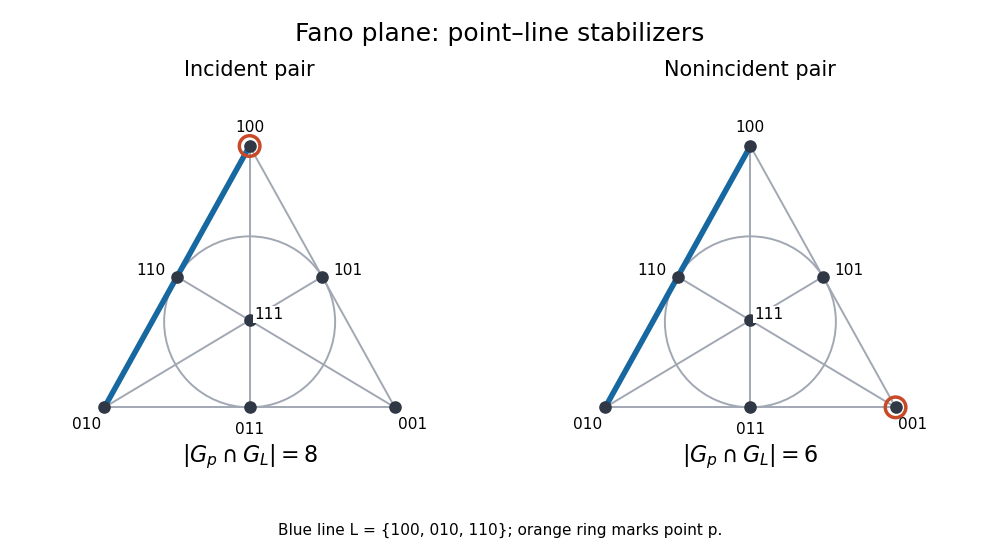
Fano plane with incident and nonincident point-line pairs
. Details. 
For the extension, identify vectors and covectors by the standard pairing. The inverse-transpose automorphism exchanges a point with its orthogonal plane and exchanges the two order-24 classes. Thus it is outer. The Fano plane duality group has order 336 and acts on points and lines, preserving incidence while allowing their types to be swapped.
The stabilizer subgroup of an unordered point-line pair has twice the corresponding ordered-pair stabilizer subgroup: some element outside swaps the pair, since duality produces a pair of the same incidence type and is transitive on such pairs. Hence these stabilizer subgroups have orders 16 and 12. Also every outside conjugate of a Sylow 7-subgroup can be moved back by an element of , giving
We prove these exhaust the maximal subgroups other than . Let be such a maximal subgroup and . Since is not contained in , is normal in and . If , part (i) gives a unique Sylow 7-subgroup of . It is characteristic in , hence normalized by . Therefore maximality forces .
Suppose and . The classification argument in part (i) says fixes a point or a line. Because is normal in , an element outside swaps its fixed-point and fixed-line sets, so it fixes at least one of each. WriteFixed lines are kernels of fixed nonzero covectors, since the only nonzero scalar is one. Duality gives , hence .
If , there is a unique fixed point and unique fixed line; preserves their unordered pair. If , put and . For every , contains the plane and lies in the line . Over there is only one nonzero linear map , so has order two. Invertibility forces : for one needs . Thus and are its unique image point and kernel line. These are canonically swapped by duality, so again preserves their unordered incident pair.
If , then has order two, generated by an involutory duality . For any point , the pair is preserved by . Hence lies in an order-12 or order-16 pair stabilizer subgroup and is not maximal. We have exhausted all cases.
The pair stabilizer subgroups are themselves maximal: a proper maximal overgroup is one of the just-listed types, and divisibility excludes orders 12 inside 16 or 42, and 16 inside 12 or 42. The order-42 normalizer is maximal by the unique-Sylow argument. Incidence types give one conjugacy class each; Sylow conjugacy gives one normalizer class. Thus, apart from the normal index-two subgroup ,
Let . The general linear group over a finite field consists of all invertible linear maps , and the special linear group over a finite field is its determinant-one subgroup. Counting the ordered bases givesThe determinant map is onto , since has determinant . Its kernel is , so
For , commuting with all the elementary transvection matrices forces a matrix to be scalar. Therefore the center of a group of consists of with . The multiplicative group of a finite field is cyclic, so this center of a group has size . The projective special linear group over a finite field consequently has order
Here is a proof of simplicity which isolates all the required ingredients. First we prove the Iwasawa simplicity lemma in the form needed. Suppose a group acts faithfully and primitively, is a perfect group, and has an abelian subgroup normal in a stabilizer subgroup , whose conjugates generate . For a nontrivial normal subgroup , its orbits form a block system. Faithfulness prevents all these orbits from being singletons, so primitivity makes transitive. Thus . Modulo , each conjugate of has exactly the same image as , because we may write its conjugating element as with and . The quotient is generated by this one abelian image and hence is abelian. Since is a perfect group, . Thus every nontrivial normal subgroup is .
Apply this to the action on projective points, that is, one-dimensional vector subspaces of . Any ordered pair of distinct lines can be sent to any other by a linear map obtained by extending representatives to bases. Multiplying one target basis vector by a suitable nonzero scalar adjusts the determinant to one without changing either target line. Thus is two-transitive on these points. A linear map fixing every line is scalar: it is diagonal on a fixed basis, and fixing the lines spanned by makes all diagonal entries equal. The projective quotient therefore acts faithfully, two-transitively, and primitively.
For the line , useThese matrices multiply by addition of , so is abelian. Conjugating by a matrix preserving preserves , so it is normal in that stabilizer subgroup. Its conjugates include every elementary transvection matrix .
These elementary transvection matrices generate by row elimination. For completeness, row addition is elementary, signed row interchange is elementary, and compensating diagonal scalings are elementary because, in a two-dimensional coordinate block,Elimination using these operations reduces a determinant-one matrix to the identity.
It remains to show that these groups are perfect groups. In the following matrix identities use ; the alternative group commutator convention generates the same commutator subgroup. If , distinct indices give the group commutator identityEvery elementary generator is therefore a group commutator. For and , choose with , and let . ThenAs varies this supplies all upper elementary transvection matrices, and conjugation supplies the lower ones. Thus , and its projective quotient, are perfect in the asserted cases. The preceding simplicity argument now applies.
The two exceptions are genuine: the projective actions identify with and with , of orders 6 and 12 respectively. The first contains its normal subgroup of order 3; the second contains the normal Klein four group. We have proved
Replace the determinant condition by preservation of a nondegenerate alternating bilinear form on . In a symplectic basis the symplectic group over a finite field isTo count symplectic bases, choose the first vector in ways, then choose with in ways. Their span is nondegenerate; its symplectic orthogonal complement has dimension and supplies the rest of the basis. The resulting recurrence gives the finite symplectic group order
The elementary replacements are symplectic transvectionsExpanding shows that the two cross terms cancel and the last term vanishes because . Thus these maps preserve ; their inverses are .
We need both generation and primitivity to use the argument from part (i). For nonzero vectors with , the symplectic transvection with direction and parameter sends to . When , choose nonorthogonal to both and use two such steps. Such exists because two proper hyperplanes cannot cover a vector space: if the two linear forms are independent prescribe both values to be one, and if dependent prescribe either a nonzero value. Hence symplectic transvections act transitively on nonzero vectors.
They generate the whole symplectic group over a finite field. Indeed first use them to make a given symplectic transformation fix . Its image of still satisfies . A symplectic transvection with direction fixes and sends to if the pairing is nonzero. If that pairing is zero, pass through for any : it has nonzero pairing with both partners, and both required directions lie in . We have now fixed the first hyperbolic pair, and induction applies in its nondegenerate orthogonal complement. The final two-dimensional case is exactly the elementary generation of proved in part (i).
For a fixed projective point , the symplectic transvections form an abelian subgroup normal in its stabilizer subgroup; conjugation scales by the square of the scalar multiplying . Their conjugates supply all symplectic transvections. A central element commutes with every symplectic transvection, so it preserves every direction line and must be scalar. Conversely scalars commute with the whole group. The kernel of the projective action consists of scalar matrices, and preservation of restricts the scalar to . Thus the center of a group has size and the projective symplectic group over a finite field acts faithfully.
For the stabilizer subgroup has precisely three orbits: its fixed point, the other points in , and the points outside . Transitivity on each follows by extending, respectively, an independent isotropic pair or a hyperbolic pair to a symplectic basis. WriteA nontrivial proper block through the fixed point would be a union of these stabilizer subgroup orbits, hence would have size either or . A block size divides . But , so cannot divide , and , excluding the other size. This proves primitivity. For the projective action is the two-transitive action of .
Here is a direct check of perfectness of finite symplectic groups, including the small fields where the diagonal group commutator needs replacement. If , every symplectic transvection lies in an embedded on a hyperbolic plane containing its direction, and that subgroup is perfect by part (i). Since the symplectic transvections generate, the whole symplectic group over a finite field is perfect.
For and , all are conjugate, so their common image generates the abelianization and satisfies . Choose independent perpendicular vectors . The four commuting symplectic transvections with directions and parameter one multiply to the identity: the sum of their rank-one matrices is zero in characteristic 3. Thus also , giving .
For and , use the seven nonzero vectors of a three-dimensional isotropic subspace of a symplectic vector space. Their symplectic transvections commute, and their product is the identity. To see this explicitly, write a vector in three isotropic basis coordinates: in the sum of the outer products each diagonal coefficient occurs four times and each off-diagonal coefficient twice, all zero in characteristic 2. The common abelianization image therefore satisfies . Again the group is perfect.
The simplicity argument from part (i) now applies to the projective symplectic group over a finite field. The remaining exceptional group besides and is . It is not simple: it is isomorphic to . One can verify this identification without assuming it. On setThese are all 16 quadratic forms with polar form ; the Arf invariant of a quadratic form gives . There are six with invariant one. The symplectic group over a finite field permutes these six forms. Differences of their parameter vectors span : writing for the symplectic basis, the six parameters areTheir pairwise differences include each of . An element fixing all six forms therefore fixes all linear forms , hence is the identity. This gives a faithful action on six objects; the group order is 720, so its image is all of . Consequently
Choose a complement to the fixed -dimensional vector subspace . With column vectors and the decomposition , its parabolic stabilizer of a subspace isThe arbitrary upper-right block forms a normal elementary abelian group. The block-diagonal matrices form a complement, acting on it by . ThusWith row vectors the off-diagonal block is transposed; the subgroup description is the same after the convention change.
The rank of a transitive permutation group is the number of orbits of a stabilizer subgroup, not the rank of a matrix. For , the invariant of its -orbit is . This invariant is complete. Choose a basis of , extend it to a basis of , then add a basis of a complement of in , and extend the resulting independent vectors to a basis of . For with the same intersection dimension , do the same. The map between these adapted bases preserves and sends to .
The Grassmann graph is connected, and its distance can be determined directly. Put , , and . Choose vectors so thatThe vectors of a basis of , followed by all the and , are independent: a relation would identify a vector in the two chosen complements modulo , contradicting . For defineEach successive pair has an intersection of dimension . Thus and are joined by a path of length .
For the lower bound, if two vertices are adjacent, their common vector subspace has codimension one in each. Both and lie between and . Thus one edge can change the dimension of the intersection with by at most one. It must change from to along a path from to , requiring at least edges. Therefore
If two ordered pairs have equal distance, their intersections have equal dimension. Construct adapted bases for each pair as above and extend both to bases of the ambient vector space. The invertible linear map between them sends the first ordered pair to the second. It preserves intersection dimensions, so it is a graph automorphism. This proves that the Grassmann graph is distance-transitive, with the required simultaneous images. Its diameter is , because permits two disjoint -dimensional vector subspaces.
A finite two-transitive group action is transitive on ordered pairs of distinct points. Equivalently, the action is transitive and a point stabilizer subgroup is transitive on the remaining points. Its rank of a transitive permutation group is two, and the orbit-stabilizer theorem gives for degree . Such an action is primitive: a block containing a point and another point must, by the transitivity of the stabilizer subgroup, contain every point.
These groups illustrate two quite different sources of symmetry. The structural theorem for finite two-transitive groups says that they have either a regular elementary-abelian normal subgroup, giving the affine case, or a nonabelian simple normal subgroup, giving the almost simple case. The full classification of the second case depends on the classification of finite simple groups; the useful point here is to describe the constructions, actions, and representative families rather than treat two-transitivity as an abstract property of a group without a specified action.
In the affine case let be a finite vector space over and let act transitively on . The affine two-transitive groupis transitive by translations, and the stabilizer subgroup of zero is exactly , so it is two-transitive. Conversely, if a two-transitive group has an abelian minimal normal subgroup , normal-subgroup orbits and primitivity make transitive. An abelian transitive faithful permutation subgroup is regular: an element fixing one point commutes with every element moving that point and hence fixes them all. Minimal normality makes elementary abelian, since its prime-primary subgroups and its subgroup of pth powers are characteristic. Conjugation by the stabilizer subgroup acts faithfully as linear automorphisms of , and regularity gives . This recovers precisely the construction above.
Many examples follow at once. The group acts on the vectors of ; sends any nonzero vector to any other by a basis map. For , the subgroup also gives a two-transitive action, since the determinant of a basis map can be adjusted on a second basis vector while retaining the prescribed first vector. The affine group with linear part gives another family: the nonzero-vector transitivity was proved using symplectic transvections in part 4(ii). Here the additive group of , for , is an elementary abelian p-group of rank .
In particular consists of with . Given distinct and distinct , the equations , have the unique solution , . Thus this action is sharply two-transitive, of degree and order . Adding field automorphisms gives , still two-transitive, with elements .
An almost simple group lies between a nonabelian simple group and its automorphism group. One must still specify an action: a group can have several permutation representations with different degrees or different transitivity properties. The natural actions of for and for are the most familiar examples of a two-transitive group action. For , the simple group , a normal subgroup, places these groups in the almost simple case; the smaller two-transitive examples belong to the affine case. The symmetric group sends any ordered distinct pair to any other; for the alternating group one can adjust an odd map by swapping two letters outside the target pair. Thus both are two-transitive in the indicated ranges.
The projective linear examples are just as concrete. The groups and act two-transitively onpoints, by the basis and determinant adjustment argument of part 4(i). Their field-automorphism extensions are also two-transitive. On the projective line, is sharply three-transitive: three distinct points determine a unique Möbius transformation. Its degree is and its order is . For even , ; for odd the special projective group has half that order and remains two-transitive, but cannot be three-transitive. In projective dimension at least two, triples of distinct points may be collinear or noncollinear, so the natural action is not three-transitive.
The projective special unitary group over a finite field , for , acts on the isotropic points of a space with a nondegenerate Hermitian form of dimension three over . Its degree and order areFor two distinct isotropic lines the Hermitian form pairing is nonzero, since a three-dimensional nondegenerate Hermitian space has maximal totally isotropic dimension one. Scale their representatives to form a hyperbolic pair and extend to a basis adapted to the Hermitian form. The corresponding isometry sends one ordered pair to another, and a norm-one scalar on the orthogonal one-dimensional complement adjusts its determinant without moving the two lines. Thus the special projective unitary action is two-transitive.
Two further families of simple groups have analogous rank-two actions:The Suzuki group of Lie type and the Ree group of type G2 have stabilizer subgroups containing subgroups acting regularly on all the other points in these actions; this gives two-transitivity. For example has degree 65 and order 29120. These are exceptional Lie-type families, distinct from the preceding linear and unitary constructions.
The symplectic group over a finite field in characteristic two has a particularly illuminating pair of two-transitive actions which are not their projective-vector actions. For , acts on the two classes of quadratic forms whose polar form is the given alternating bilinear form, distinguished by the Arf invariant of a quadratic form. Their degrees areTransitivity on each class follows by choosing symplectic bases giving the standard quadratic-form normal forms. Fix a form . Every other form with the same polar form is , and has the same Arf invariant of a quadratic form exactly when . The stabilizer subgroup of , an orthogonal group over a finite field, is transitive on its nonzero isotropic vectors: extend such a vector to a hyperbolic pair and map adapted quadratic-form bases. It is therefore transitive on the other forms of the same type. This proves two-transitivity of both actions. In particular has actions of degrees 28 and 36. The degree-six action of in part 4(ii) is the smaller-dimensional precursor.
Finally the Mathieu groups supply exceptional examples with even higher transitivity:In particular all five natural actions are two-transitive. Together these examples exhibit affine spaces, projective and Hermitian geometries, symplectic quadratic forms, and exceptional finite simple groups as different sources of the same pair symmetry.
The organizing distinction is affine versus almost simple; the action, its degree, and its stabilizer subgroup are essential data. The explicitly verified affine, symmetric, alternating, projective, unitary, and symplectic actions already give many infinite families, while the exceptional families show why no single matrix construction covers every example.
Use the bilinear pairing , so the map is complex linear. With the sesquilinear convention the representing map would instead be conjugate linear. For conjugate exponents , Hölder's inequality gives . If , take , defined as zero where . ThenConsequently . This also proves injectivity of the representation.
For surjectivity, let be a nonzero element of the continuous dual space of and choose with . Its kernel is a closed linear subspace. Use the allowed best-approximation fact to choose and put . Thus andFor each , the vector belongs to . Therefore , givingMembership follows from ; the zero functional is represented by zero. This proves the isometric isomorphism without using a representation theorem as a substitute for the proof. It is the closed-hyperplane proof of Lp duality.
The relevant Banach-Alaoglu theorem says that for the closed bounded balls of are compact in the weak topology. In particular, every bounded sequence has a weakly convergent subsequence whose limit has norm no larger than the common bound. Applying the preceding duality of Lp spaces also identifies this as weak-star compactness of ; its weak and weak-star test spaces are both .
Here is a direct proof of both compactness and the subsequence assertion. Let and choose a countable dense set in the separable Lp space . Each scalar sequence is bounded. Successive subsequence selection followed by the diagonal subsequence argument gives for which these pairings converge for every . For arbitrary ,First approximate by and then take large. This proves convergence of every pairing, and the limit is linear with . Apply the already proved duality of Lp spaces with in place of : for an with . ThusTo obtain compactness rather than only a sequential statement, on the radius- ball defineDensity and Hölder's inequality show that this is a metric space distance and that its topology is exactly the weak topology on this ball: every remaining test pairing is uniformly approximated there by a dense-set pairing. The subsequence argument proves sequential compactness for this metric. A sequentially compact metric space is compact: otherwise either an infinite separated sequence contradicts total boundedness or a Cauchy sequence without a limit contradicts sequential compactness; completeness and total boundedness give compactness by successive finite coverings. This completes the proof. The same argument is the Sequential Banach-Alaoglu theorem for a separable predual.
The assertion that fails is weak compactness of the unit ball; the abstract Banach-Alaoglu theorem for dual balls never fails. Consider the concentration prevents weak compactness in L1 exampleSuppose a subsequence converged weakly in to . For each , all sufficiently late supports lie inside . Testing against every bounded measurable function supported outside that ball shows that almost everywhere there. Taking the countable union over proves almost everywhere on . But testing against the bounded constant function one gives , a contradiction.
The same argument applies to every subnet whose indices tend to infinity, so the sequence has no weak cluster point in the ball and the ball is not weakly compact. It converges against smooth compactly supported tests to a point mass, which is not an density. Thus boundedness in does not imply the weak compactness proved in part (b); concentration is the obstruction.
Articles were limited to the first 100 out of 1712 total.
Articles by others on the same topic
There are currently no matching articles.