A sufficient set of assumptions is that is a densely defined closed operator on the Hilbert space , generating an analytic semigroup , and that for some . For an operator criterion, one may assume that is a sectorial operator of angle less than , with dense domain. The analytic semigroup then satisfies, on a fixed finite time interval,The Hölder continuity assumption means . It supplies time regularity of the forcing, not spatial membership of in .
With initial datum , a classical solution of an abstract Cauchy problem meanswith the evolution identity holding in at positive times and in . Equivalently, the positive-time domain continuity is in the graph norm. If the definition requires differentiability also at zero, assume additionally ; the proof below then gives .
The variation-of-constants formula gives the candidateThe integral is a Bochner integral. Boundedness of and continuity of make the expression continuous into , and its integral term tends to zero with . Thus it is a mild solution of an abstract Cauchy problem with the correct initial value. The issue is showing that its integral term lies in the domain of the unbounded linear operator .
Write . For , the truncated integral lies in . Subtract the current forcing before applying :Here the last term follows by integrating away from zero; it does not assume that . The first integrand satisfiesSince in and the displayed images also converge, the closed operator property givesThis is the reason for the Hölder continuity assumption: the unsplit estimate would have the nonintegrable factor . Merely knowing that is continuous does not provide the integrable bound needed here. More generally, a modulus of continuity satisfying suffices for this argument; a positive Hölder exponent is a convenient sufficient hypothesis.
The formula also proves continuity of at positive times. On compact positive-time intervals, split the integral at a small : its short part is uniformly bounded by , while the remaining part is continuous by the strongly continuous semigroup property and ordinary dominated convergence. Together with analytic smoothing of , this makes continuous at positive times. The semigroup property givesBecause , division of this identity by after subtracting gives the continuous right derivative . The left derivative agrees by the same identity and continuity of . Thus , proving existence of the classical solution of an abstract Cauchy problem on the entire given finite interval, and in particular local existence.
For uniqueness, the difference of two such classical solutions of an abstract Cauchy problem satisfies and . For , differentiation of on gives zero, so . Letting yields . Finally, if , then , and the expression for tends to zero. Hence and the stronger time-zero regularity follows. The solution is unique; the forcing regularity controls the singularity in the differentiated integral.
Use the usual fractional Dirichlet domain scale: on , and . Its Sobolev embedding theorem givesSuch a positive exists precisely because the assumed is greater than . Consequently is continuous in time with values in this Hölder space on every compact positive-time interval. This embedding alone gives no two spatial derivatives for ; those must come from the equation.
First establish a bound that will also justify the nonlinear regularity steps. Put andThe constants and enclose both the initial data and the zero Dirichlet boundary data. Moreover and , so they are a supersolution and a subsolution for the parabolic comparison principle. A direct energy proof avoids assuming pointwise continuity at time zero. Let . This truncation has zero trace under the Sobolev trace operator; testing the evolution with and using integration by parts givesFor , the mean value theorem and imply . ThereforeThe Gronwall inequality gives , since its initial L2 norm vanishes. For the initially rough datum, apply the inequality from and let , using in L2 space. The same argument for , which satisfies the same equation because is odd, provesThis is the invariant interval for a cubic reaction-diffusion equation; the energy calculation is valid by the Sobolev chain rule and approximation even before the stronger pointwise regularity is established.
Now fix and, if necessary, reduce the positive Hölder exponent . Rearranging the evolution gives the elliptic identityIts right side is bounded on , because and . Boundary elliptic regularity first gives for every finite , uniformly on this time interval. For , the Sobolev embedding theorem makes spatially continuously differentiable, with a positive Hölder exponent. Thus lies in after reducing if necessary. The global Schauder estimate then gives .
These are continuous-in-time, not just separate-time, regularity statements. Since , the identity , initially an identity in L2 space, holds in once is known to belong to that space. Hence is locally Lipschitz in time into . Apply the global Schauder estimate to the difference of the two elliptic identities. Continuity of and of into proves .
To gain the spatial regularity of the time derivative itself, take time difference quotients of the evolution. If , their equations arewhereThe coefficients have uniformly bounded spatial Hölder norms and temporal Hölder norms on compact positive-time cylinders: this follows from the spatial regularity just proved and the local time Lipschitz bound in . Also is uniformly bounded and tends to in . Positive-time parabolic Schauder estimates, applied away from the lower time edge, give uniform bounds for , with a slightly smaller exponent if needed. Passing to the limit proves that is continuous into and satisfiesThe Dirichlet boundary condition for follows also by differentiating the identically zero boundary value in . Since was arbitrary, this proves the requested, genuinely stronger regularity:This is positive-time smoothing for a semilinear heat equation; it is the extra parabolic step for , not just the Sobolev embedding theorem, that gives the topology asserted here.
Finally, a uniform bound excludes a finite maximal existence time for this semilinear partial differential equation. Restart at any positive time , using the heat semigroup on the Banach space with the supremum norm. Its variation-of-constants formula isThe heat semigroup is a contraction semigroup on . On the ball of radius , is Lipschitz with constant at most , and bounded by . Choose a time length so that the integral is at most and its Lipschitz constant is less than . The Banach fixed-point theorem then gives a local solution on , with independent of , because . If a finite maximal time existed, choosing less than before it would extend the same solution past it, a contradiction. Uniqueness identifies this continuation with the original solution, and positive-time smoothing restores the classical solution on each extended interval. The solution is globally defined and remains between and .
For a nonconstant invasion travelling wave, the relevant end states are and . These fronts do not exist at every nonnegative speed: the phase plane calculation gives the threshold . The constant solutions and are, of course, nonnegative travelling waves for every speed, including zero.
Put and . The travelling-wave reduction of a reaction-diffusion system givesThe equilibrium points in the phase plane are and . At the characteristic equation is , so there is one positive and one negative eigenvalue. Thus it is a saddle equilibrium. Its descending unstable manifold has , and locallyAt the eigenvalues areFor it is a stable node; for it is a stable spiral. The repeated-root case must be included in the existence argument rather than inferred from distinct roots.
Suppose . Choose with ; for example . Consider the closed triangular regionOn the horizontal side , the vector field has , pointing into . On the vertical side , it has , again pointing inward. For the sloping side use , so that on ,Thus trajectories cannot cross into . The remaining boundary point is an equilibrium point and cannot be crossed in finite time by a nonconstant trajectory, by uniqueness theorem for ordinary differential equations. This proves forward invariance of . The argument works unchanged at with .
The descending unstable manifold of initially enters . Its forward trajectory remains in this compact region, so it exists for all positive . Within the interior, : a first contact with at would have , contrary to arrival from below. Hence decreases strictly and has a limit . To identify the limit, its omega-limit set lies on the line and is invariant. Any trajectory remaining on this line has ; its second equation then forces . Since , it follows that , and the only possible omega-limit set is . Backward in , the unstable manifold tends to by its construction. We have therefore obtained a positive decreasing heteroclinic orbit and hence a nonnegative travelling wave for every .
For completeness, the threshold is necessary for such a front. When , put , , and . Near the zero equilibrium point the system becomesFor a nonzero trajectory its polar angle satisfiesA trajectory approaching zero therefore makes infinitely many rotations and must cross . It cannot be a nonnegative front. At , the first integralis conserved. It has values and at the two desired end states, so no heteroclinic orbit connects them. ConsequentlyThis is the phase-plane construction of a Fisher travelling front, including the critical speed. The statement for all must distinguish these nonconstant fronts from the two constant travelling waves.
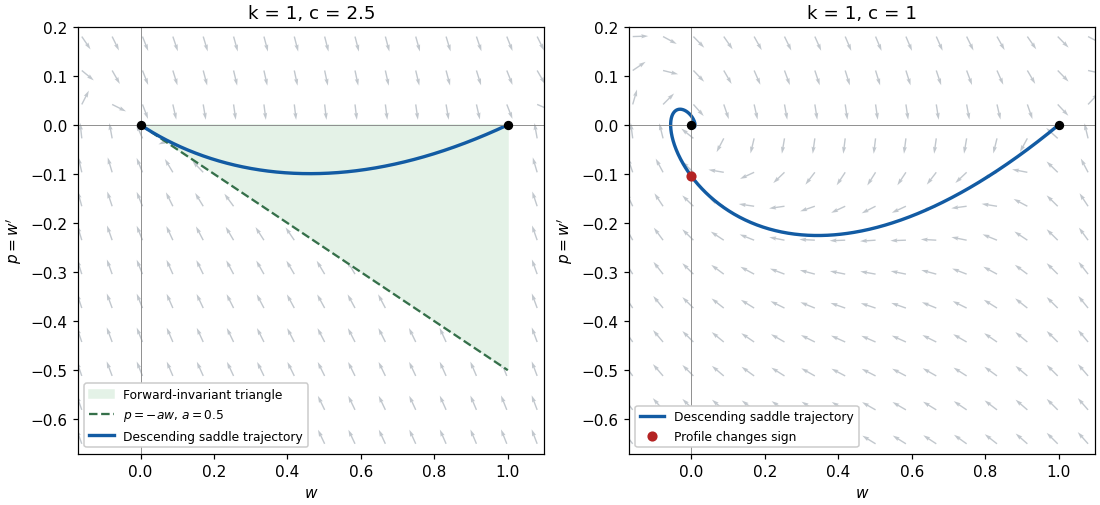
Invariant triangle and descending Fisher-front trajectory at a supercritical speed, compared with sign-changing motion at a subcritical speed
. Details. 
The natural expectation is orbital stability, since a spatial translation of a travelling wave is another travelling wave. Thus convergence for ordinary perturbations, when it holds, is to a suitably translated front. It also matters which perturbations are allowed in the leading edge: the zero state ahead of this front is linearly unstable, and a sufficiently shallow positive tail can select a different speed. One should not assert asymptotic stability for arbitrary disturbances without a norm and a class of initial data. The requested essential spectrum calculation is a necessary part of such an analysis, not by itself a complete nonlinear stability proof.
In the moving coordinate , write . Expansion of the reaction term givesThe first equation to study is its linearization,and the associated eigenvalue equation . Differentiating the front equation gives , the neutral translation mode whenever it belongs to the chosen function space. Ahead of the front the limiting coefficient is , so in unweighted L2 space the limiting dispersion relation is : its rightmost real part is positive. An exponential weight penalizes precisely these disturbances ahead of the front.
There is a small functional-analytic correction to the printed definition. Use the complete exponentially weighted L2 spaceThe additional requirement of unweighted L2 space membership in the printed set makes that set incomplete under its stated weighted norm. Indeed belongs to the intersection and is a weighted Cauchy sequence, but its weighted limit does not belong to unweighted L2 space. The usual Hilbert space for this spectral argument is the completion . We use that completion explicitly, rather than treating the intersection as a complete space.
Multiplication is a unitary map from onto L2 space. Take the domain for . The transformed closed operator isThis follows from . The two limiting constant-coefficient dispersion relations, obtained by the Fourier transform, areIn particular the necessary strict leading-edge condition is . For this meansA particularly convenient choice isWith this choice there is no first derivative, and is a self-adjoint differential operator on . This also avoids possible ambiguities between definitions of essential spectrum for nonnormal operators.
The relevant perturbation theorem is essential-spectrum invariance under relatively compact perturbations: if is a closed operator, is compact with respect to the graph norm, and is closed on the same domain, their Fredholm essential spectrum is the same. For self-adjoint operators this is the usual essential spectrum after removing isolated finite-multiplicity eigenvalues. To see why the theorem applies, regard and as bounded maps from the graph norm domain to , and use compact perturbation invariance of Fredholm operators for each .
Define a step-potential comparison operatorBoth and are self-adjoint on . Their difference is multiplication byIt is relatively compact, not necessarily compact as a multiplication map on all of L2 space. To prove the needed compactness, take a sequence bounded in . On each bounded interval the Rellich-Kondrachov compactness theorem gives a subsequence converging in L2 space. A diagonal subsequence makes the products by converge locally. Outside a sufficiently large interval, is arbitrarily small and the sequence has a uniform L2 norm bound, so those tails are uniformly small. Thus the products converge globally in L2 space, proving graph-domain compactness.
Finally,Here is a direct verification. Its quadratic form is at most , so no spectrum lies above this endpoint. For every , choose with . Normalized, increasingly long cutoffs of , translated far to the right, have disjoint supports and satisfy : differentiating the cutoff gives errors of orders and . They converge weakly to zero. This is a singular sequence in the Weyl criterion, proving that every such belongs to the essential spectrum. The relatively compact perturbation theorem therefore givesThis proves the weighted essential spectrum of a Fisher travelling front is strictly stable when . In fact here the quadratic form gives more:Since , the full transformed spectrum lies below , and the evolution given by its linearization decays at least as in this weighted norm. This does not contradict translation invariance: the nonzero translation mode cannot lie in this weighted operator domain, since otherwise it would be a zero eigenfunction, contradicting the strictly negative quadratic-form bound. The weight restricts the permitted perturbations and excludes these neutral translations. Nor does a weighted L2 norm alone control the nonlinear remainder at ; a nonlinear theorem needs further boundedness or regularity assumptions.
At the minimal speed , the best choice is . Now , andThe essential spectrum has no positive part but touches zero; no positive exponential weight makes it strictly negative. Thus the critical front has no spectral gap and this argument gives no exponential decay rate there. Strict weighted spectral stability holds above the minimal speed; at the minimal speed it is marginal.
Articles by others on the same topic
There are currently no matching articles.