For a nonzero complex number, write with and principal complex argument . The principal complex logarithm and corresponding complex exponentiation are
The value at zero is not defined by this formula. The choice of complex argument matters: these are single-valued principal powers, rather than all values of a multivalued complex logarithm.
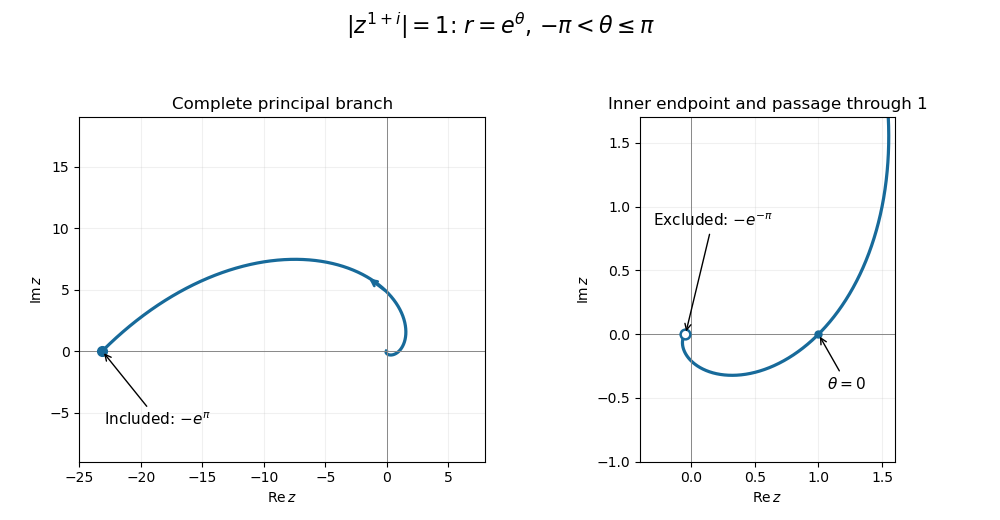
For the requested sketch, . Its complex exponential has complex modulus , so
This is one turn of a logarithmic spiral, with increasing radius as the polar angle increases. It passes through at , approaches the excluded endpoint from below the negative real axis, and ends at the included endpoint from above that axis. The endpoint distinction follows from the chosen principal complex argument.
Figure 1.
One turn of the principal-power logarithmic spiral, with open inner and closed outer endpoints
. Details.
The principal complex exponentiation gives . Equality to one requires its complex modulus to be one, hence , and then its complex argument requires . Thus all solutions are positive real, namely
Substitution verifies every value, and the modulus condition excludes every nonreal value.
Away from the negative real axis, the complex conjugate has principal complex argument . Consequently
Taking the complex modulus gives , hence . The remaining equation is , so
On the negative real axis, both and have principal complex argument , so the left-hand side has modulus , not two. There are no additional solutions there. The printed second term is the principal power of , not the complex conjugate of .

Articles by others on the same topic (0)

There are currently no matching articles.