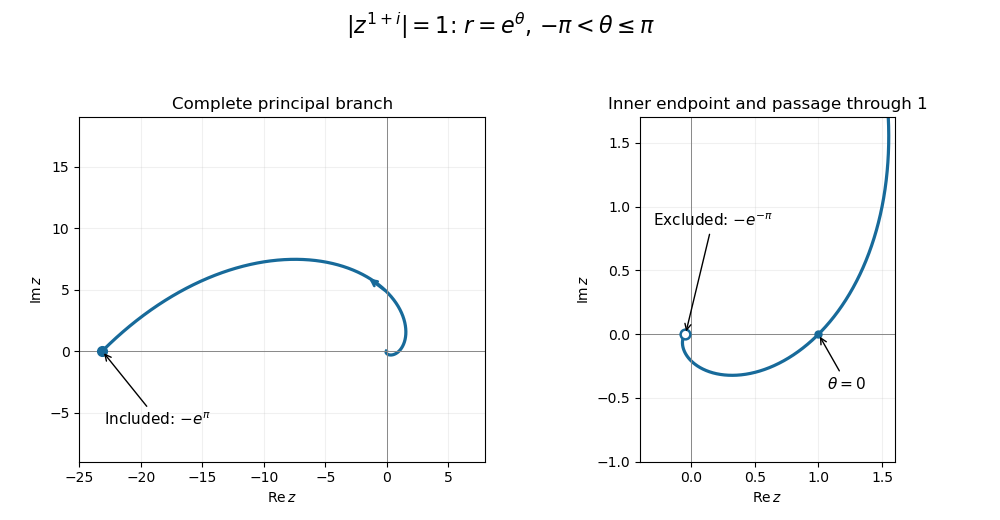
This is one turn of a logarithmic spiral, with increasing radiusas the polar angle increases. It passes through 1 at θ=0, approaches the excluded endpoint −e−π from below the negative real axis, and ends at the included endpoint −eπ from above that axis. The endpoint distinction follows from the chosen principal complex argument.
The principal complex exponentiation gives zi=e−θeilogr. Equality to one requires its complex modulus to be one, hence θ=0, and then its complex argument requires logr∈2πZ. Thus all solutions are positive real, namely
On the negative real axis, both z and z have principal complex argumentπ, so the left-hand side has modulus 2e−π, not two. There are no additional solutions there. The printed second term is the principal power of z, not the complex conjugate of zi.
The coordinate relation is [Φ(x)]C=A[x]B. Therefore the standard-coordinate matrix of a linear map is T=SCASB−1, and the new coordinate matrix is A′=SC′−1TSB′. Multiplying gives
Define a2k=0 and a2k−1=k. The odd-indexed terms are unbounded, while the even-indexed subsequence is identically zero and hence converges to zero. This gives an unbounded sequence with a convergent subsequence.
The floor function has even value on indices congruent to zero or one modulo four, and odd value on indices congruent to two or three. Accordingly the displayed sequence has terms 2+1/n in the first two residue classes and −1/n in the other two. In particular,
Every term is within 1/n of the set {0,2}. If a subsequence converged to c∈/{0,2}, its eventual distance from that set would be bounded below by a positive constant, contradicting this bound. The complete set of subsequential limits is {0,2}.
Thus the radius of convergence is R=1. The power series converges absolutely for ∣z∣<1 and diverges for ∣z∣>1. On ∣z∣=1 its terms have modulus n2, so they do not tend to zero and the series diverges there as well.
Thus the perpendicularity assumption is sufficient, and the solutions form a straight line parallel to c. When d=0, the vectord is perpendicular both to c and to every position vector on the line; it is the normal to the plane through the origin containing that line. The point a=c×d/∣c∣2 is the perpendicular foot from the origin. Its distance from the origin is ∣d∣/∣c∣, since c⋅d=0.
For the two planes, put s=m⋅n and c=m×n. Nonparallel unit normals give ∣s∣<1 and ∣c∣2=1−s2. Seek the perpendicular foot in their span, a=um+vn. Its two dot products impose u+sv=μ and su+v=ν. Solving gives both requested descriptions of the intersection:
Expanding the formula from part (a) in components gives yi=xi+(α−1)ninjxj, with repeated indices summed. Hence the matrix of a linear map and its inverse, when α=0, have entries
Geometrically, CTC=I, detC=1 and Cn=n, so C is a rotation matrix about the n axis. Its matrix trace is two, giving cosθ=(trC−1)/2=1/2; its skew part selects angle −π/3 about the oriented axis n. It has no fixed nonzero perpendicular vector. Meanwhile A preserves perpendicular components and scales the axial component by α. Comparing these components firstforces x⊥=0, and then (α−1)x∥=0, exactly matching the determinantcalculation, including the noninvertible case α=0.
The equation is solvable exactly when b∈imA, the image of a linear map, equivalently when the rank of a matrix satisfies rankA=rank[A∣b]. If it is solvable and x0 is one solution, every solution is precisely
Indeed differences of solutions lie in the kernel of a linear map, and adding a kernel vector preserves the equation. Hence there are no solutions when b∈/imA; one solution when A is invertible; and infinitely many solutions when b∈imA and A is singular. In the last case the rank-nullity theorem gives a nonzero kernel vectorv, and x0+tv gives distinct solutions for every real t. This proves that a finite number greater than one is impossible.
Use the eigenvectorbasisv1=(−1,0,1)T, v2=(1,1,0)T, v3=(1,1,1)T. The forcing has decomposition b=−v1+3v3. If x=c1v1+c2v2+c3v3, the linear system reduces to
For a positive-term series, the ratio test says that if an+1/an→L<1, the series converges; if the ratio tends to L>1, including positive infinity, it diverges. More generally limsupan+1/an<1 suffices for convergence and liminfan+1/an>1 for divergence. A limiting ratio of one gives no conclusion.
The P-series∑n−2 converges and the harmonic series∑n−1 diverges. Both have strictly decreasing positive terms, and their successive ratios, (n/(n+1))2 and n/(n+1), tend to one. These supply the two requested possibilities.
The set is nonempty and bounded above. Continuity at a puts points to the right of a in S, while continuity at b excludes an entire interval to the left of b, so a<c<b. If f(c)<y, continuity puts some point larger than c in S, contradicting its supremum. If f(c)>y, continuity excludes S in a neighborhood of c, contradicting the existence of points of S arbitrarily close to its supremum from below. Therefore f(c)=y, proving the theorem.
No. The continuous functionf(x)=(x+1)/2maps (0,1) into (0,1), but f(x)−x=(1−x)/2>0 throughout the domain. Its only possible fixed point is the excluded endpoint one.
No.Define f(x)=1 for 0≤x<1 and f(1)=0. This self-map of [0,1] is discontinuous at one. Every point smaller than one is sent to a different point, and one is sent to zero, so it has no fixed point.
Adjacent formulas agree at each junction. Their endpoint values lie in [0,1], so linear interpolation proves that the whole image lies in [0,1]; also f(0)=1 and f(1)=0. On the four pieces, f(x)−x is respectively 1−3x, 3x/2−1/2, 1−3x/2, and 2−3x. Their only zeros on their respective intervals are 1/3 and 2/3. Thus the complete fixed pointset is {1/3,2/3}. Continuity forces at least one zero, but does not force every zero to change sign.
In particular G′(0)=−∑n=2∞2−n=−1/2. The accumulation of cusp locations at zero does not destroy the derivative, because their weights are summable.
At x=1/m, the same tail argument applies to both one-sided derivatives. Every term except the mth has the same derivative from both sides; the mth has derivatives −2−m and 2−m. Consequently
Indeed (Q−H)′=0, so the mean value theorem makes Q−H constant, and evaluating at the endpoints proves the formula. Auseful stronger version only requires Q′ to be Riemann integrable. For a partition a=x0<⋯<xN=b, the mean value theorem on each subinterval provides ξj∈(xj−1,xj) such that
These three constants give arbitrary initial values y0,y1,y2, hence the full third-order solution. If μ=0, the recurrence instead reduces to yn+3=0: the first three values are arbitrary and every subsequent value is zero. The nonzero-rootformula must not be used to discard those initial values.
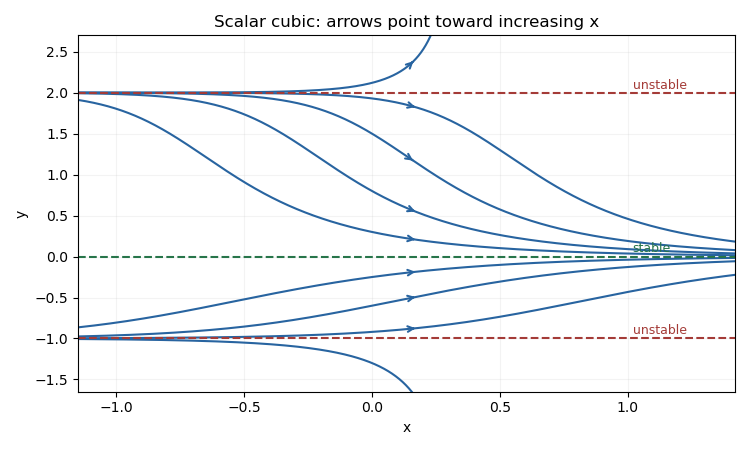
Thus the linear perturbation is proportional to ef′(y∗)x. More directly, continuity of f′ makes f(y) point toward y∗ on both sides when f′(y∗)<0, and away from it when f′(y∗)>0. Hence
The sign refers to evolution toward increasing x. If f′(y∗)=0, linear stability analysis is inconclusive: the leading nonzero nonlinear term or the signs of f on either side are needed. For example η′=−η3 is attracting whereas η′=η3 is repelling, despite the same zero linear coefficient.
Construct independent copies Y1,Y2,… of Y, also independent of X, and define the random sumZ=∑j=1XYj, taking the empty sum to be zero. Independence gives, conditional on X=n,
The summands are nonnegative, so this equality is valid also as an extended-valued expectation. Where the right-hand side is finite, it is the ordinary moment-generating function of the constructed random sum. The construction does not assert a finite moment-generating function near zero for arbitrary X,Y: heavy tails can prevent this. For example a nonnegative Y with no positive exponential moments and X≡1 already shows the necessary qualification.
for every nonempty subset I of the indices. For three events this includes the triple intersection, not just the three pairwise intersections.
Write Ai=Bi∪C. Disjointness gives P(Ai)=p+q, while every intersection of two or three distinct Ai is exactly C. Thus pairwise independence is equivalent to q=(p+q)2. Since p+q≥0,
For 0≤q≤1/16, this is an admissible nonnegative p: putting u=q∈[0,1/4] gives 3p+q=3u−2u2≤5/8<1. The four disjoint events can therefore have the stated probabilities, with the remaining probability assigned to their complement. This also covers q=0.
Full independence would additionally require q=(p+q)3. Together with q=(p+q)2, this forces p+q to be zero or one. The first case gives p=q=0; the second gives q=1,p=0. Neither allows positive p,q. There are no such mutually independent events with p>0 and q>0.