An equilibrium of an autonomous differential equation is a constant with . Put . For differentiable , the linear stability analysis givesThus the linear perturbation is proportional to . More directly, continuity of makes point toward on both sides when , and away from it when . HenceThe sign refers to evolution toward increasing . If , linear stability analysis is inconclusive: the leading nonzero nonlinear term or the signs of on either side are needed. For example is attracting whereas is repelling, despite the same zero linear coefficient.
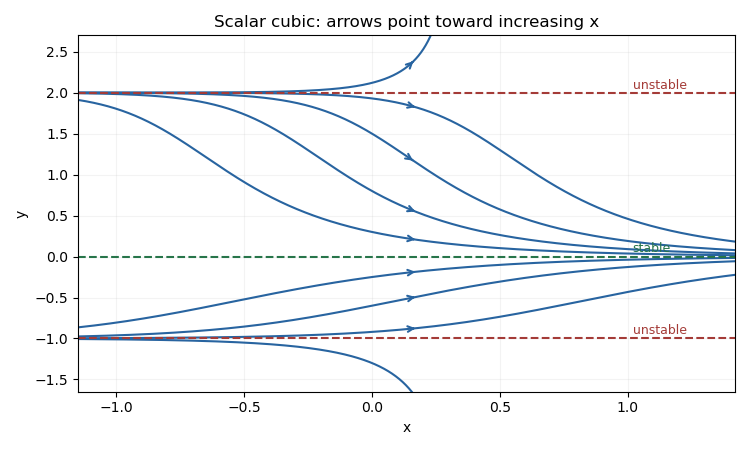
Factor the right-hand side as . Its equilibrium points are , and givesIndeed , and . The phase line has downward motion for , upward motion for , downward motion for , and upward motion for . The uniqueness of a smooth autonomous differential equation prevents trajectories from crossing an equilibrium point. Consequently trajectories starting between and approach zero as , while those outside that interval move away from the three equilibrium points. The constant trajectories and representative nonconstant trajectories are shown below.

Articles by others on the same topic
There are currently no matching articles.