Substitution of into the linear recurrence relation gives . Since , division by proves the sequence is a solution exactly when .
For a nonzero triple root of a polynomial , the repeated characteristic root of a linear recurrence rule gives the three independent solutions . One way to see the polynomial factors is to write : the recurrence becomes the third forward difference operator applied to equal to zero, so is a quadratic polynomial. ThusThese three constants give arbitrary initial values , hence the full third-order solution. If , the recurrence instead reduces to : the first three values are arbitrary and every subsequent value is zero. The nonzero-root formula must not be used to discard those initial values.
Eliminate the free constant by comparing consecutive values:Therefore an appropriate inhomogeneous linear recurrence isIts homogeneous part has solution , and is a particular solution. A first-order linear recurrence relation has one arbitrary initial value, so this gives exactly the desired general solution.
An equilibrium of an autonomous differential equation is a constant with . Put . For differentiable , the linear stability analysis givesThus the linear perturbation is proportional to . More directly, continuity of makes point toward on both sides when , and away from it when . HenceThe sign refers to evolution toward increasing . If , linear stability analysis is inconclusive: the leading nonzero nonlinear term or the signs of on either side are needed. For example is attracting whereas is repelling, despite the same zero linear coefficient.
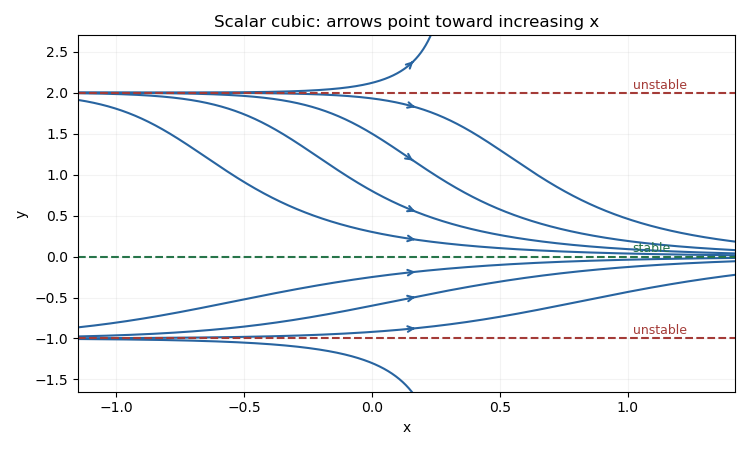
Factor the right-hand side as . Its equilibrium points are , and givesIndeed , and . The phase line has downward motion for , upward motion for , downward motion for , and upward motion for . The uniqueness of a smooth autonomous differential equation prevents trajectories from crossing an equilibrium point. Consequently trajectories starting between and approach zero as , while those outside that interval move away from the three equilibrium points. The constant trajectories and representative nonconstant trajectories are shown below.

For a nonnegative integer-valued random variable, the probability generating function isinitially for , with . For the Poisson distribution, insert its probability mass function and sum the exponential series:Thus
The moment-generating function is for real where this expectation is finite; a finite neighborhood of zero is usually required when speaking of an existing moment-generating function. For a standard normal distribution, completing the square givesThe translated Gaussian density integrates to one, so
Construct independent copies of , also independent of , and define the random sum , taking the empty sum to be zero. Independence gives, conditional on ,The law of total expectation gives the transform composition for an independent random sumThe summands are nonnegative, so this equality is valid also as an extended-valued expectation. Where the right-hand side is finite, it is the ordinary moment-generating function of the constructed random sum. The construction does not assert a finite moment-generating function near zero for arbitrary : heavy tails can prevent this. For example a nonnegative with no positive exponential moments and already shows the necessary qualification.
Pairwise independent events satisfy for every distinct pair. Independent events satisfyfor every nonempty subset of the indices. For three events this includes the triple intersection, not just the three pairwise intersections.
Write . Disjointness gives , while every intersection of two or three distinct is exactly . Thus pairwise independence is equivalent to . Since ,For , this is an admissible nonnegative : putting gives . The four disjoint events can therefore have the stated probabilities, with the remaining probability assigned to their complement. This also covers .
Full independence would additionally require . Together with , this forces to be zero or one. The first case gives ; the second gives . Neither allows positive . There are no such mutually independent events with and .
Articles by others on the same topic
There are currently no matching articles.