A survivor function is . For a nonnegative event time it is nonincreasing and right-continuous, with values between zero and one; a proper finite event time has as . Here , , , and for . Extending it by one for supplies a valid continuous survivor function.
The density is , so the hazard function isIn particular and . The survivor is a mixture of rate-one and rate-two exponential distributions with weights and . Among long-term survivors the rate-one component dominates, explaining the limiting hazard. More generally the hazard derivative for a mixture of exponential distributions is minus the variance of the component rate among survivors; the decreasing hazard is selection, not an individual component's changing hazard.
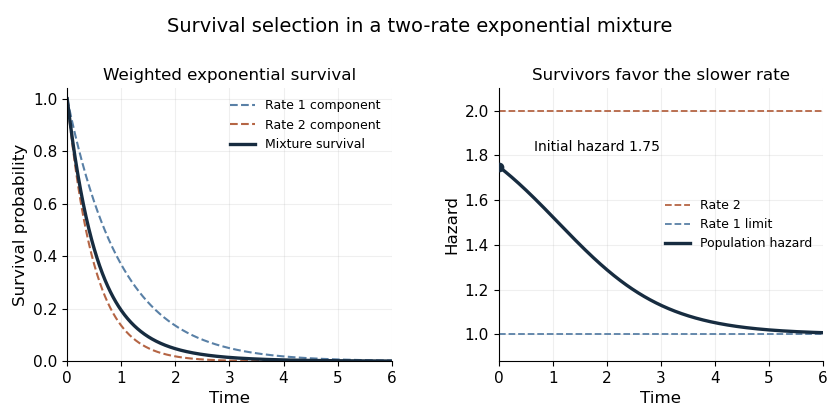

A frailty model uses an unobserved nonnegative random hazard multiplier to represent variation in individual risk. In a proportional frailty model, conditional on the cumulative hazard function is , giving survivor . Averaging over the frailty random variable by the law of total probability yieldsthe Laplace transform of the frailty distribution evaluated at the baseline integrated hazard. This also applies to atoms by integration against the probability measure; the printed Dirac expression is not an ordinary continuous density.
In the given two-atom case, the Dirac delta function notation assigns probabilities and to and . These have mean one, fixing the frailty scale relative to the baseline hazard. With , the two conditional integrated hazards are and . ThereforeThe frailty distribution among survivors shifts toward the smaller multiplier over time, reproducing the declining population hazard and limit one without changing either individual's constant conditional hazard.
Articles by others on the same topic
There are currently no matching articles.