The initial table of content was limited to the first level because it is larger than 1000 articles. There are 1856 articles in total. Expand a branch to load its children.
For the Adjoint representation of a Lie algebra, the operator associated with isThe Jacobi identity gives , so this really is a Lie algebra representation. Define the lower central series of a Lie algebra by and . A nilpotent Lie algebra is one for which for some integer . If this holds, carries into , and consequently . This proves one implication without any condition on the field.
For the converse, we prove the linear form of the Engel theorem: if is a finite-dimensional Lie algebra consisting entirely of nilpotent linear maps, with finite-dimensional, then there is a nonzero vector annihilated by all of . This argument works over any field.
Induct on . The assertion is immediate when . First observe that if , then its commutator action on is nilpotent, becauseLet be a proper Lie subalgebra of . The commutator action of on therefore consists of nilpotent linear maps. Its image has dimension at most , so induction supplies a nonzero coset annihilated by . Thus , and the normalizer strictly contains . This is the Engel normalizer lemma.
Choose maximal among proper Lie subalgebras. Its normalizer must be , so is a Lie algebra ideal. Moreover : otherwise the inverse image of a one-dimensional subalgebra of would lie strictly between and . By induction,Since is an ideal, is -invariant: . Take . Its restriction to is nilpotent and hence has a nonzero kernel. A nonzero vector in that kernel is annihilated by and , and therefore by all of . This completes the induction.
Apply this result successively to , then its quotient by a common annihilated line, and so on. We obtain a complete flag with . Equivalently every element of is strictly upper triangular in one common basis; any product of such operators is zero.
Now take and . The hypothesis supplies exactly the nilpotence needed above. Every iterated bracket of length , where , is an application of adjoint operators and vanishes. These brackets span , giving . The zero algebra is already nilpotent. Thus is nilpotent if and only if every is nilpotent. The common flag is essential: separate nilpotence of unrelated operators would not imply that their mixed products vanish.
Use the derived series of a Lie algebraA solvable Lie algebra has for some . For a two-dimensional algebra with basis , alternating bilinearity shows that is contained in the line spanned by . A one-dimensional Lie algebra is abelian, so . Every two-dimensional complex Lie algebra is solvable, with derived length at most two. This dimension argument actually works over any field with the alternating definition of a Lie bracket.
There is a genuine qualification in the last request: the assertion about all Irreducible Lie algebra representations is true for finite-dimensional representations. Without that restriction, the infinite-dimensional simple module for the two-dimensional affine Lie algebra is a counterexample. Take , with , and let it act on byThen , so this is a Lie algebra representation. Any nonzero submodule is stable under multiplication by , hence is an ideal . Stability under implies . The two polynomials have the same degree; their leading coefficients also agree, so . In characteristic zero this forces to be constant. Thus is infinite-dimensional and irreducible, while is solvable. The literal unrestricted assertion is false.
Here is a proof of the intended finite-dimensional assertion, including the essential Lie theorem argument. We prove that a nonzero finite-dimensional representation of a complex solvable algebra has a common eigenvector, by induction on . If , any nonzero vector works. Otherwise ; choose a hyperplane containing . It is a solvable ideal, and . Induction gives and with for all . Write and suppress on elements of .
Let and let be the first index for which lies in the span of . The space is -invariant. Repeatedly using and proves inductively thatThus is -invariant, and every has constant diagonal in this basis. The trace of a commutator is zero, soSince we work over , for all . Therefore the nonzero simultaneous eigenspaceis -invariant: . A complex linear operator on a nonzero finite-dimensional space has an eigenvector. An eigenvector of is consequently a common eigenvector for .
Its span is a one-dimensional submodule. If is irreducible, that span must be all of . Hence every finite-dimensional irreducible representation of a finite-dimensional complex solvable Lie algebra has dimension one. Conversely a one-dimensional representation is given by a linear functional on , because every commutator acts by zero. Passing repeatedly to quotients also gives the simultaneous triangularization of a Lie algebra representation. Neither the eigenvector step nor the trace argument extends to the infinite-dimensional counterexample above.
A finite-dimensional complex Lie algebra is a semisimple Lie algebra when its solvable radical is zero, equivalently when it has no nonzero solvable ideals. Its Killing form is the symmetric bilinear formThe cyclic trace identity and giveThus the Killing form is an invariant bilinear form on a Lie algebra. In particular its radical is an ideal.
We supply the trace argument needed for nondegeneracy rather than assuming the Cartan criterion for semisimplicity. The matrix form of the Cartan solvability criterion says: if and for every , , then is solvable. To prove this direction, fix . Let be its generalized eigenspace decomposition, and define to act on by the scalar . On , the semisimple part of has eigenvalue , whereas acts by . Polynomial interpolation on the finitely many eigenvalues, with all derivatives through the sizes of the nilpotent blocks set to zero, therefore givesHere the same difference always has the same conjugate, so the interpolation is consistent; the prescribed zero derivatives remove every nilpotent block. Since , it follows that .
Write . By cyclicity and the trace hypothesis,On the other hand, . Thus all eigenvalues of vanish, and every element of is nilpotent. The Engel theorem makes nilpotent as a Lie algebra, hence solvable; is abelian, so is solvable. This is the Conjugate-spectrum proof of Cartan solvability.
Apply this to the Killing radical . For , the adjoint actions preserve and act as zero on , because is an ideal. Computing traces in a basis adapted to givesThe matrix Lie algebra consequently satisfies the trace criterion and is solvable. Its kernel is , an abelian ideal; a central extension of a solvable algebra is solvable. Thus is solvable. This proves the reusable assertion that the Killing radical is a solvable ideal. Semisimplicity forces , and hence is nondegenerate.
A Cartan subalgebra is a nilpotent subalgebra which is self-normalizing:For a complex semisimple algebra this is equivalently a maximal toral subalgebra. The nilpotent, self-normalizing definition permits a proof of the restricted nondegeneracy without first assuming the toral characterization.
Use the generalized-weight decomposition for a nilpotent Lie algebra for the adjoint action of :For completeness, the stability underlying this decomposition follows directly from nilpotence of . For fixed , every on is nilpotent. If and in a finite-dimensional representation, then for sufficiently large . The identityshows that preserves each generalized eigenspace of . Starting with a basis of , refine these primary decompositions successively; all summands remain -invariant. Each resulting summand has only one eigenvalue for each basis element. The Lie theorem triangularizes the action on that summand, so those eigenvalues extend to a single linear character on all of . This proves the displayed decomposition and nilpotence of all shifted operators there.
Since is nilpotent, . The space is a subalgebra: repeated use of the derivation rule for shows that the bracket of two generalized zero-eigenvectors is another such vector. If , the adjoint action of on this quotient consists entirely of nilpotent maps. The Engel theorem supplies a nonzero coset with , contradicting self-normalization. Therefore the zero generalized weight space of a Cartan subalgebra is exactly .
Finally, when . Choose with and put . On , a power vanishes. On , is invertible. For and , write ; invariance givesIf is orthogonal to , it is now orthogonal to every summand of , so nondegeneracy of implies . The restriction is nondegenerate. This establishes the nondegeneracy of the Killing form on a Cartan subalgebra for every Cartan subalgebra, without requiring a chosen root basis.
A Lie algebra representation is completely reducible when it is a direct sum of irreducible submodules. In finite dimension this is equivalent to saying that every submodule has an invariant complementary subspace. Indeed, one may split off a minimal nonzero submodule and induct on dimension; conversely, if is a finite sum of simple submodules, choose a maximal sum of these with . If , some simple summand is not contained in . Then by simplicity, so is a larger sum disjoint from , a contradiction. Thus .
We prove the required splitting by Haar averaging produces invariant complements. The structural input is the compact real form of a complex semisimple Lie algebra: there is a real semisimple algebra with , whose simply connected integrating Lie group is compact. This structural fact is independent of the complete-reducibility assertion. One standard construction uses root vectors normalized so that , with real structure constants compatible with the involution and . The real spanis closed under brackets, complexifies to , and has negative-definite Killing form. The compactness criterion for real semisimple Lie algebras then gives a compact simply connected . Thus this route uses root structure and compact integration, not the theorem being proved.
Restrict to . The integration of a Lie-algebra representation gives a representation , since is simply connected. Choose any positive-definite Hermitian inner product and average using normalized Haar measure:The integral exists by compactness. It is positive-definite because for , and it is -invariant by translation invariance of Haar measure. Equivalently, every with is skew-Hermitian for this inner product.
Let be an -submodule. It is invariant under , hence under the exponentials generating the connected group . For , and ,Consequently the orthogonal complement is -invariant, and differentiation makes it -invariant. It is a complex vector subspace, so it is also invariant under and hence under . Therefore as -modules.
Induction on now expresses as a finite direct sum of irreducible submodules. Every finite-dimensional representation of a finite-dimensional complex semisimple Lie algebra is completely reducible. The compact real form need not be the real form originally used to present ; in particular the averaging argument does not require the given presentation to be unitary.
Here root systems are finite, reduced and crystallographic, as for complex semisimple Lie algebras. For a base of a root system , the Dynkin diagram has one vertex for each simple root. Two distinct vertices have bonds, with the arrow on a multiple bond pointing toward the shorter root. The classification of finite crystallographic Dynkin diagrams consists of the following connected diagrams; the integers describing arms count vertices away from the unique branching vertex.
- (): a chain with only single bonds.
- (): a chain with one double bond at an end; that end is short.
- (): the same bond pattern, but that end is long. The rank-two system is ; .
- (): a simply laced tree with three arms of lengths .
- : simply laced trees with three arms respectively of lengths , and .
- : a four-vertex chain, with single, double, single bonds in order, and two long roots adjacent on one side of the middle bond and two short roots on the other.
- : two vertices joined by a triple bond, one long and one short.
This is classification up to diagram isomorphism and overall rescaling of the root system. It includes the conventional identifications and when those low-rank notations are used. The weighting here encodes root lengths and bonds; it is not the separate theory of vertex labels attached to nilpotent orbits. Dropping the crystallographic or reduced hypothesis changes the classification.
Precisely, a base of a root system is a vector-space basis such that each root has a unique expansion , with integer coefficients all nonnegative or all nonpositive. This defines the positive and negative roots. We use the column-coroot convention for the Cartan matrix:Some conventions transpose this matrix; specifying which index labels the coroot resolves that difference. The Weyl group is the subgroup of orthogonal transformations generated by the Weyl reflections
For the C3 root system, take an orthonormal basis of andThere are six long roots of squared length and twelve short roots of squared length . A base is , , . The Cartan matrix convention for C3 above givesThus the double bond connects to , with its arrow directed toward .
An explicit complex Lie algebra realizing this root system is the symplectic Lie algebraIt is closed under commutators, since the two identities , imply . Equivalently,so its dimension is . A Cartan subalgebra isWith denoting a matrix unit, the root spaces have generators for (), for (), and for ; the analogous lower-left generators give the negative roots. These are all eighteen root spaces, each one-dimensional, and together with they exhaust the algebra.
For an explicit semisimplicity check, let be an ideal. Simultaneous diagonalization of makes a sum of its intersections with and these root spaces. If it contains a nonzero , some root has , and supplies a root vector in . Thus always contains a root vector. Bracket it with its opposite root vector to obtain a nonzero coroot . Whenever , bracketing with either or puts both root spaces into . The graph of the roots with edges for nonzero inner products is connected: connects to , which connects to , and every short root connects to an axis root. Repeating the argument yields all root spaces and then all of from their brackets. Hence : the constructed algebra is simple, and therefore semisimple.
The reflections in and exchange adjacent coordinates, while reflection in changes the sign of the third coordinate. They generate every signed permutation. Conversely reflection in any displayed root is a signed permutation. ThusThe reflecting hyperplanes are and . A fundamental open Weyl chamber is . Every regular point has three nonzero coordinates of distinct absolute values; its signs and the ordering of those absolute values specify exactly one of the chambers. The closure of this chamber is generated by the rays through , and . This is the Weyl chamber geometry of C3.
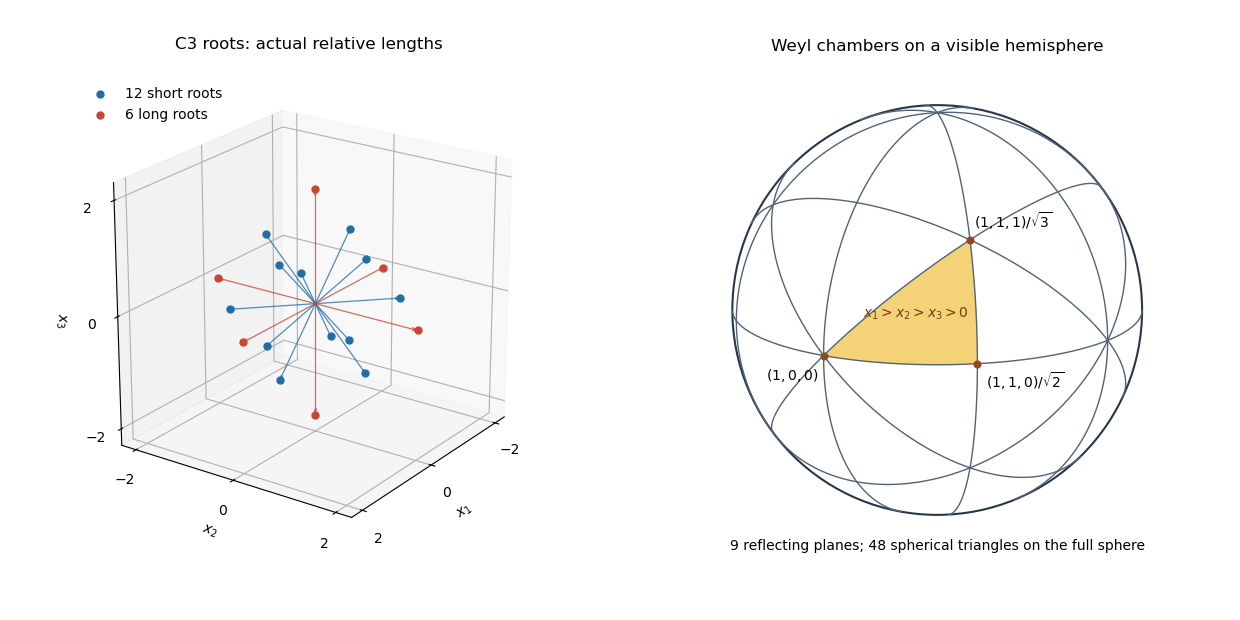
C3 roots and the spherical tessellation into 48 Weyl chambers
. Details. 
The left panel retains the actual long and short root lengths. The right panel radially projects a hemisphere of the unit sphere, draws every visible reflecting great-circle arc, and highlights the chamber . Each spherical triangle is the section of a three-dimensional chamber by the sphere; opposite triangles on the rear hemisphere supply the remaining chambers. Roots of a root system are normal to the chamber walls, rather than generally lying along their edges.
Choose a base of a root system and its positive roots, so that the triangular decomposition of a Lie algebra is . A primitive element of a Lie algebra representation of weight is a nonzero vector such thatEquivalently it is a highest-weight vector. Being primitive depends on the chosen positive system; no integrality condition is part of this definition.
Construct the Verma module for an arbitrary . The subalgebra has a one-dimensional module on which acts by and acts by zero. This is a representation because . Setwhere denotes the universal enveloping algebra. The Poincaré-Birkhoff-Witt theorem, applied with negative-root vectors first, then Cartan vectors and positive-root vectors, givesas vector spaces. In particular is nonzero, generates , and is primitive of weight .
The same ordered monomials show that is a direct sum of weight spaces, with weights of the formand that its weight- space is exactly . Each vector has only finitely many weight components. If a submodule contains a vector with nonzero weight- component, choose that separates from the finitely many other weights of that vector. Polynomial interpolation in the action of extracts a nonzero multiple of . Such a submodule is all of , because generates it. Consequently every proper submodule has zero component in weight .
Let be the sum of all proper submodules. Every finite sum still has zero weight- component, so is proper; it contains every proper submodule and is therefore the unique maximal proper submodule. Its quotientis irreducible, and the nonzero image of is primitive of weight . This proves existence for every and gives the irreducible quotient of a Verma module. It also proves uniqueness up to isomorphism among irreducible modules generated by a primitive vector of that weight: the defining relations induce a surjection from , whose proper kernel must be .
These modules are not generally finite-dimensional. For example, in an root subalgebra, a primitive vector with satisfiesIf its irreducible highest-weight module is finite-dimensional, the weight-lowering sequence eventually stops. For the first with and , the identity forces . In general a finite-dimensional highest-weight module therefore requires nonnegative integral values on all simple coroots; arbitrary in the request must allow infinite-dimensional representations. This is consistent with the finite-dimensional qualification made in Question 2.
For simple coroots forming a basis of , the fundamental weights are the dual basis :For the special linear Lie algebra , take the diagonal trace-zero Cartan subalgebra and positive roots corresponding to upper triangular matrix units. Write . The simple roots are , , and the simple coroots areThe fundamental weights of sl3 are thereforeChecking these on gives the two coordinate vectors and . In the Euclidean trace-zero plane they can also be writtenThe Fundamental representations of sl3 make these weights concrete: has primitive vector of weight , and has primitive vector of weight . Every finite-dimensional irreducible highest weight is with nonnegative integers .
A partition of an integer is a finite sequence with sum ; append zeros when comparing lengths. Its Young diagram has cells with . A Young tableau is a bijective filling of these cells by . Write for its row and column stabilizers, and fix the conventionPermutations act on entries on the left, with the rightmost factor acting first. This defines the Young symmetrizer used throughout. In the dictionary order on integer partitions, means that at the first differing part ; equality is allowed in .
Suppose there is no row-column collision between of shape and of shape . Each column of contains at most one entry from each row of . The first rows of therefore contain at mostentries, where is a column length. Thus for every : dominates in dominance order on partitions. If in dictionary order on integer partitions, a first strictly larger part would contradict the corresponding prefix inequality. Hence .
All the bounds must now be equalities. Every column of contains exactly one entry from row of whenever . Choose sending that entry to the entry of in cell . These prescriptions are bijections within the rows. The columns of then have exactly the same sets of entries as the columns of , so for some . ConsequentlyIf a collision was present instead, its two entries supply the first alternative. This proves the row-column collision lemma, including the prescribed order of the two stabilizer factors.
We next prove the Specht module classification. By Maschke's theorem, the group algebra is a semisimple algebra. Use the permitted basic quasi-idempotence of a Young symmetrizer,and put . The coefficient of in is one, because , so .
For , consider . A collision between the rows of and the columns of gives a transposition . Row symmetrization fixes , whereas column antisymmetrization changes its sign, so . If there is no collision, the proved lemma gives with , andIt follows that is zero or . Since permutations span , . In a semisimple algebra this means that is a primitive idempotent, so is an irreducible left module.
If in dictionary order on integer partitions, the collision lemma applied to every gives , and therefore . Sincethe two simple modules cannot be isomorphic. Conversely, Young tableaux of the same shape are related by a permutation, which conjugates their Young symmetrizers and gives isomorphic left ideals. Finally, the center of has the conjugacy-class sums as a basis. Conjugacy classes are indexed by cycle-type partitions, so its dimension is the number of partitions of . The Artin–Wedderburn theorem gives exactly that many simple-module isomorphism classes. We have already produced one for each partition. Thus the form a complete set of pairwise nonisomorphic irreducible modules.
A standard Young tableau has its entries increasing from left to right in each row and from top to bottom in each column. For the convention , use column-reading order of standard Young tableaux: read columns from left to right, each from top to bottom, and compare the resulting words lexicographically. This makes the requested product direction explicit. The order and the symmetrizer multiplication convention must be chosen together.
We prove the vanishing claim. Suppose the rows of and the columns of have no collision. The argument in Question 1 shows that every column of contains one entry from each eligible row of . Its first column thus selects one entry from every row. Each selected entry is at least the first entry of that row in . Sorting the selected entries, as the standard tableau does, gives a column componentwise at least the first column of : increasing individual entries cannot decrease any order statistic. If the columns are equal, equality of their sums forces every selected entry to be that row's first entry. Delete this common column and repeat. At the first differing column, its first differing entry in is therefore larger; otherwise . Thus absence of a collision implies in column-reading order of standard Young tableaux.
If , there must instead be a transposition in . It fixes and negates , giving . HenceThis is triangular vanishing of Young-symmetrizer products; it does not assert vanishing in the opposite order.
Normalize to . List all standard tableaux in increasing shape dictionary order on integer partitions, and within each shape in increasing column-reading order of standard Young tableaux. Then for , using Question 1 between different shapes and the result above within a shape. The left ideals have an internal direct sum: if with , multiply on the right by to get , since and every later . Repeat with . This proves directness without incorrectly treating all the idempotents as mutually orthogonal.
Let count the standard tableaux of shape and let . In the regular representation a simple module of dimension occurs times, by the Artin–Wedderburn theorem. The direct sum just constructed contains copies of , so for every shape. We supply the needed counting identity independently of the dimension conclusion.
The Robinson–Schensted correspondence bijects permutations with pairs of standard tableaux of the same shape. Here is its row insertion construction and inverse. Insert the successive permutation entries into an increasing row by replacing its first entry larger than the incoming entry, bumping that replaced entry into the next row; if no entry is larger, append at the row end. Continue until a new cell is created. Record the insertion time in that cell of a second tableau. For completeness, the successive bumped entries strictly increase, and their column indices weakly decrease: an entry below a bumped entry was originally larger, so the next replacement occurs no farther right. The entry newly placed in each row is smaller than the entry removed and larger than the entry above it. At a strictly earlier column, that last inequality follows from row increase in the preceding row; at the same column, it follows from the preceding bump. Hence the insertion tableau keeps increasing rows and columns. If a new cell is appended below the first row, the preceding bump guarantees that the row above reaches that column, so the shape stays a Young diagram. Recording times also increase in rows and columns, since every new cell is an outer corner of the current diagram. Thus both tableaux are standard at the end. Conversely, remove the cell with the largest recording label. Reverse its bumping path upward, replacing in each preceding row the rightmost entry smaller than the moving entry and moving the displaced entry upward. This recovers the last inserted letter; iterating recovers the entire permutation. The two rules undo one another at each row. ThusSemisimplicity also gives . Since termwise, equality of these sums forces for every shape. The internal direct sum has dimension and hence fills :There is also a useful numerical form. Right multiplication by is an idempotent with image . In the permutation basis of , each diagonal coefficient is the coefficient of in , namely . Its trace equals its rank, so . Together with the count just obtained this recovers the hook-length formula.
On , define the permutation and diagonal actions byThe inverse in the first formula gives a left action. Applying to every tensor factor and then reordering produces the same tensor as reordering and then applying . Thus the two actions commute. The Schur algebra isIt is the commutant of an operator algebra of the permutation action.
To identify this commutant, use the multilinear isomorphismConjugation by a permutation reorders the factors on the right. Therefore the invariant subspace is the space of symmetric tensors of degree in . It is spanned by . Indeed, the polarization identityexpresses every symmetrized elementary tensor as a linear combination of pure powers. Those symmetrized elementary tensors span the invariant subspace in characteristic zero.
One may restrict to invertible endomorphisms without changing the span. For fixed , the vector-valued polynomial has degree at most . Choose distinct values of away from the finitely many roots of . Polynomial interpolation expresses its constant term as a linear combination of those invertible tensor powers. ConsequentlyThe span is an algebra, since products are .
The image of is semisimple, as a quotient of a semisimple algebra. The double-centralizer theorem for semisimple operator algebras gives . Since the preceding computation says that is the span of the general linear action, the two actions are mutual commutants. More explicitly, semisimple module decomposition givesHere is the multiplicity space, with its natural general linear action. The commutant algebra is the product of the full endomorphism algebras of these multiplicity spaces. Hence each nonzero is irreducible, and distinct spaces have nonisomorphic general linear representations, because the operators span that commutant. A primitive picks a one-dimensional factor from , so is an equivalent realization of as a Schur module.
The range of shapes is exact. If has more than rows, a column antisymmetrizes more than vectors and its action vanishes by . Conversely, for at most rows place the th basis vector in every tensor position belonging to row of . Row symmetrization multiplies this tensor by . Column antisymmetrization is nonzero, because all vectors within each column are distinct, and its different permutations give distinct basis tensors. Thus . This proves the length bound for a Schur module and the stated Schur–Weyl duality. For , the empty partition and give the trivial version.
For a partition with at most parts, let be the Schur module constructed in Question 3, equivalently the image of a Young symmetrizer on . For a weakly decreasing integer tuple , put and . Define the rational Schur module byHere is the one-dimensional representation . This is rational, and it is irreducible under the permitted irreducibility assumption; for nonnegative it is the original polynomial Schur module. Larger shifts give the same module, as will also follow from the character formula below.
Write and . For a permutation of the given cycle type, the trace of a permuted tensor power isIn a tensor basis, the trace contracts the matrix entries of around each cycle of ; a cycle of length contributes . This proof applies to nondiagonalizable endomorphisms as well. The eigenvalues give .
The Schur–Weyl duality decomposition, on which and act on the two respective factors, gives the same trace asFor a partition, the character extends polynomially to all endomorphisms because the tensor-power action does. This extension is not asserted for determinant-twisted modules at singular matrices.
We now derive the alternant character formula for the general linear group. Put andUse the permitted symmetric-group character result, the Frobenius alternant character formula:It concerns characters of , rather than assuming the character formula we seek for the general linear group. Substitute the proved trace identity and setThen for every conjugacy class. Independence of the irreducible symmetric-group characters forces .
Each character on diagonal matrices is a symmetric homogeneous polynomial of degree , since conjugation by permutation matrices permutes its arguments. Thus is alternating of degree . Every alternating polynomial of this degree has a unique expansion in alternants : a monomial with repeated exponents has zero coefficient, while each strictly decreasing nonnegative exponent vector is uniquely for a partition of with at most parts. Its coefficient at is the coefficient of that alternant. The identities for therefore give . We have derived the Weyl character formulaFor partitions the quotient is the Schur polynomial, with removable apparent singularities when eigenvalues coincide. For arbitrary dominant integer tuples, multiply the formula for by ; this shifts every numerator exponent by and yields the same boxed formula. The variables must then be nonzero. The expression also shows independence of the shift used to define the determinant twist. Equality of characters identifies these irreducible modules: the group-algebra image on a direct sum of two irreducibles is finite-dimensional and semisimple, and its span of group operators detects the traces on every simple block.
Finally, the character of a dual representation evaluates the original character at . Reverse the numerator's columns after making this substitution. The exponents become . Factoring converts these into for . The denominator undergoes the identical column reversal and factor, so both signs and factors cancel. Hence , andThis tuple is again weakly decreasing, so it is precisely the required dominant label.
The coordinate ring is . The induced action is contragredient on functions:It is a group action by degree-preserving algebra automorphisms, extending the dual action on linear polynomial functions. Its polynomial invariant ring isFor a monic polynomial , its polynomial discriminant is . This is symmetric in the roots, hence polynomial in the coefficients, and is zero exactly when a root is repeated.
For the alternating group action, let be the elementary symmetric polynomials and put . If is -invariant and is any transposition, decomposeNormality and index two of show that is symmetric and transforms by the sign character of . Any alternating polynomial vanishes when , so every divides it. These pairwise nonassociate prime factors have product , so with symmetric. The Fundamental theorem of symmetric polynomials yieldsThe sum is direct, since a polynomial that is both symmetric and alternating is zero in characteristic zero. Also , where is the discriminant polynomial ofThus, more precisely than the requested quotient assertion,Surjectivity follows from the direct-sum expression. Divide any putative kernel element by the monic quadratic in ; its remainder is . The direct sum forces , and algebraic independence of the gives . Hence the displayed relation is the entire kernel. The argument also covers , where is trivial.
Now let be finite with no nontrivial linear characters, and write , . The polynomial ring is a unique factorization domain. Factor a nonzero invariant in ; invariance permutes the associate classes of its irreducible factors and makes their exponents constant on each orbit. For an orbit , choose representatives and form its orbit product of polynomial factorsFor every , for a nonzero scalar . Applying two group elements proves that is a homomorphism. The hypothesis forces , so .
This orbit product is prime in . If it divides with , one factor divides or in . Invariance of that chosen polynomial makes every factor in the orbit divide it. Their product therefore divides it in , and the quotient is invariant because numerator and denominator are invariant and cancellation is valid in the integral domain . Thus divides or in . Every nonzero is a scalar times a product of these prime orbit products, and the only units of are nonzero constants, as they are units in . Therefore is a unique factorization domain. This gives a direct proof, without assuming a divisor-class-group theorem.
For a failure in characteristic zero, let the cyclic group of order two act on by . Its coordinate invariants areEvery invariant monomial has even total degree: its exponents are either both even, or both odd, giving the indicated generators. Reducing powers of to at most one shows that is the only relation, since and map to distinct monomials. The three quadratic invariants are irreducible in : each nonconstant invariant has degree at least two, so a product of two nonunits has degree at least four. They are pairwise nonassociate, butgives two different irreducible factorizations. Hence this invariant ring is not a unique factorization domain. The nontrivial sign character is precisely the kind of character excluded in the preceding theorem.
Choose a separation into two nonempty clopen sets. Both are closed in the Zariski topology, so write and for ideals . Their disjointness gives . A proper ideal lies in a maximal ideal, so this forces .
Their union is all of the spectrum of a commutative ring, and . Thus every prime ideal contains , soThe last equality uses that is a reduced ring. For comaximal ideals, : if and , then . Therefore the Chinese remainder theorem givesThe isomorphism sends to its two residue classes. Its kernel is ; for surjectivity, and are obtained from , where , and . The two factors are nonzero because are nonempty, so are proper.
This is a disconnected reduced spectrum product decomposition. The elements also satisfy , , , exhibiting the ring product decomposition by an idempotent. No Noetherian hypothesis is required.
Put , the ring of invariants. It is an integral domain because it is a subring of the domain . Embed in in the evident way.
Suppose is an integral element over . Its monic equation has coefficients in , so is integral over . Since is a normal domain, .
Write with and . Each ring automorphism in extends to the fraction field by acting on numerator and denominator, and fixes this fraction. Hence . We have proved that is integrally closed in its own fraction field:This normality of a ring of invariants argument actually works for any group; finiteness is not needed for this conclusion. For finite , there is additionally an integral extension , since for each the orbit polynomial under a finite automorphism groupis monic, has coefficients fixed by and vanishes at . Neither argument divides by , so it is valid when the characteristic divides the group order. Here normality means integral closedness of a domain.
Use on the target and on the source, so the map of coordinate rings sends to . A closed point of the real affine line corresponds to a maximal ideal generated either by , , or by a monic irreducible quadratic . The scheme-theoretic fibre over that point has coordinate algebraHere is the residue field, and in the real-point case. The fibre is a scheme, so its nilpotents must be retained.
For , put . The factors , , are pairwise coprime, with the last one irreducible over . The Chinese remainder theorem identifies with , giving three irreducible components.
For , put . The exact factorization isEach quadratic has discriminant , and they are distinct and coprime. Thus , giving two irreducible components.
For , . It has one prime ideal, generated by the class of , so one irreducible component. It is not the reduced point : its class of is a nonzero nilpotent element with nilpotency index four.
Finally write the irreducible quadratic as , with . Over , has four roots above and four above . They are all simple, because , and the two sets are disjoint. None is real. Conjugation pairs them into four distinct irreducible real quadratics. Hence and this fibre has four irreducible components.
| Target closed-point type | Real coordinate algebra of the fibre | Irreducible components |
|---|---|---|
| , | ||
| , | ||
| Irreducible quadratic |
All fibres in each row are isomorphic as affine schemes over . The rows are distinct: their numbers of irreducible components already distinguish them, and the zero fibre is additionally nonreduced. ThereforeThese are ordinary scheme components, not geometric components counted after complexifying the base. Counting only real roots would miss both the complex-residue factors and the nonreal closed points.
Let . This polynomial ring is a unique factorization domain of Krull dimension three. For a height-one prime in a unique factorization domain , choose a nonzero element of it and an irreducible factor belonging to . In a unique factorization domain, is prime, so is a nonzero prime ideal contained in . Strict containment would give a chain of length two. ThusIf has height three, it is maximal: any strictly larger proper prime would extend a length-three chain and contradict . The Weak Hilbert Nullstellensatz over the algebraically closed field then givesfor some . This proves both requested generator assertions.
For the monomial curve with exponents three, four and five, putAll three map to zero under the given parametrization, so . Reduce any monomial using , and . Each reduction decreases the sum of the exponents of , so it terminates. Every polynomial has, modulo , the formIts image is . These three terms occupy different exponent classes modulo three, so they cannot cancel. A zero image forces each . ConsequentlyThe quotient is the domain , hence is a prime ideal. It is finite free over , with basis of a module , by the same normal-form argument. Its dimension is therefore one, using that integral extensions preserve Krull dimension. The polynomial-ring height and dimension formula givesFor the generator obstruction, let . Since , we have . The degree-two initial forms of areThey are linearly independent over in . Thus no nonzero constant linear combination of the belongs to , and their classes are independent in . Since the three generators span that quotient,Two global generators would span it by two vectors, which is impossible. This is the initial-form lower bound for ideal generators; it shows why height two does not force two generators, even though height one and height three behave as above.
We use Zorn's lemma, and no basis or other existence theorem from linear algebra. A subset is linearly independent if every finite relation forces every coefficient to be zero.
Order the linearly independent subsets by inclusion. This partially ordered set is nonempty, because the empty subset is independent. An empty chain has the empty subset as an upper bound. For any nonempty chain, its union is independent: every finite subset of that union lies in one member of the chain. Indeed choose one chain member containing each of its finitely many vectors, then take the largest among that finite collection of comparable members. Every finite relation in the union is therefore a relation in an independent chain member. The union is an upper bound.
Zorn's lemma gives a maximal independent subset . If were outside its span, then would still be independent. In a finite relationa nonzero could be inverted in the field , placing in the span of . If , independence of forces the remaining coefficients to be zero. This contradicts maximality, so spans .
Define the free module on as the direct sum : its elements are coefficient families with finite support. The mapis a module homomorphism. Spanning proves surjectivity; independence proves injectivity. Hence the vector-space freeness from maximal independence givesFinite support is essential; this is a direct sum, not an unrestricted product. The zero vector space uses and is free of rank zero. The proof for arbitrary vector spaces explicitly uses the axiom of choice through Zorn's lemma.
A generic linear projection over an infinite field is not enough for the stated arbitrary field . Instead use Noether normalization by weighted substitutions to make the defining polynomial monic in one coordinate.
For , choose an integer at least every exponent occurring in a nonzero monomial of , put , and use the triangular polynomial change of variablesHere because the irreducible polynomial is nonconstant. This is an automorphism, with inverse , . A monomial contributes a highest powerThese weights are all distinct: the exponents are base- digits bounded by . All other terms in the expansion have smaller degree than that monomial's weight. Therefore the highest-degree term in the transformed comes from exactly one original monomial and has a nonzero coefficient in , independent of the other . No assumption about the cardinality or characteristic of enters this argument.
Multiply by the inverse of that coefficient to obtain a monic polynomial of some degree , where . The same construction for simply rescales to be monic over .
The monic polynomial quotient is finite free because division by gives a unique representative of degree less than . Thusas -modules. Uniqueness follows because any nonzero multiple of a monic has degree at least . In particular the map is injective.
The induced morphismis finite, since its coordinate algebra is a finite module, and flat, since tensoring with a finite free module is a finite direct sum of copies of the original module and preserves exactness. This is a finite flat Noether normalization of an affine hypersurface, with the explicit projection coordinates . The construction actually applies to any nonconstant polynomial, not only an irreducible one.
The characteristic of is either a prime or zero. In characteristic , it is a finitely generated algebra over . The course's Zariski lemma says that a field finitely generated as an algebra over a field is a finite algebraic extension of that field. ThereforeIt remains to exclude characteristic zero. Write . Because is then a field containing , also . Zariski lemma makes finite algebraic. Each has a monic equation with rational coefficients. Choose a positive integer clearing all their coefficient denominators. Each is then integral over , so is integral over . This algebra equals : it contains the given integer algebra , and already lies in the field .
An integral field extension forces the base domain to be a field. To see it here, for a nonzero its inverse in satisfiesMultiplying by givesThus would be a field. But choose a prime . Reduction modulo is a well-defined map , so the nonzero element is not invertible in . This contradiction rules out characteristic zero. Therefore the finite-field theorem for finitely generated integer algebras yieldsThis uses Zariski lemma and elementary integrality, not a claim that a field merely finitely generated as a field extension must be algebraic.
A nilpotent element belongs to every prime ideal and therefore to every maximal ideal, soFor the reverse containment, let be nonnilpotent. The localization of a ring is nonzero: if there, some power of would annihilate in . This is still a finite-type integer algebra, because it can be presented as .
Choose a maximal ideal of . Its residue field is a finite-type integer algebra, hence finite by part (a). Consider the image of in . It is a finite integral domain containing , so it is a field: multiplication by a nonzero element is injective on the finite set , hence surjective, and therefore has an inverse in .
The kernel of is consequently maximal. The image of is nonzero, since became a unit in and remains a unit in its nonzero residue field. Thus . Every nonnilpotent element can therefore be avoided by a maximal ideal, givingThis radical equality for finitely generated integer algebras uses part (a) to ensure that the contraction of the localized maximal ideal is maximal. Such contraction is not generally maximal for arbitrary localization of a ring; the finite-field image is the decisive additional step. The zero ring is immediate, with the intersection of its empty set of maximal ideals understood as the whole ring. No general theorem that integer algebras are Jacobson rings is being quoted.
Work over or . A Fréchet space is a Hausdorff, complete, metrizable locally convex space. Its topology is generated by a countable separating family of seminorms . A neighbourhood base at zero consists of finite intersectionsReplacing by makes the family increasing. One compatible translation-invariant metric isCompleteness means that a sequence Cauchy for all these seminorms converges in the space. The separating condition ensures that only when .
Let denote the continuous dual space for the original topology . The weak topology is the coarsest topology making all continuous. Its basic zero-neighbourhoods areEquivalently, it is generated by the seminorms .
To prove the Hausdorff property, fix . Some continuous seminorm has . On the one-dimensional span of , define . Then . The real or complex Hahn-Banach theorem extends this to with . Thus is originally continuous and . This proves continuous-dual point separation. For distinct , inverse images under such an of disjoint small scalar neighbourhoods of and are disjoint weak neighbourhoods. Hence the weak topology is Hausdorff.
If a linear functional is originally continuous, it belongs to and is weakly continuous by definition. Conversely, is coarser than , so every weakly continuous scalar function is originally continuous. In particular,This special case of the continuous dual of a weak topology needs no completeness argument.
For the linear map , original continuity implies that whenever . Each such composition is weakly continuous on , so the defining property of the target weak topology makes weak-to-weak continuous.
Conversely, suppose is weak-to-weak continuous. Every , , is then weakly continuous, and hence continuous for . We show that the graph of a linear operator is closed in the original product topology. If in and in , thenBy continuous-dual point separation on , this forces . The product is metrizable, so sequential closedness is closedness. The closed graph theorem for Fréchet spaces now gives original continuity of .
The relevant version of that theorem does use completeness of both spaces: a closed graph is a Fréchet space, its first-coordinate projection is a continuous linear bijection onto , and the open mapping theorem for Fréchet spaces gives a continuous inverse. Composing with the second-coordinate projection gives . ThusEquality of continuous scalar functionals does not imply equality of the two topologies; the closed graph theorem for Fréchet spaces is the extra step that makes this conclusion valid.
Write a finite binary word as and denote its prefix cylinder set byMore generally, a cylinder set fixes finitely many coordinates, or prescribes a subset of their finite coordinate product, leaving all other coordinates free. Each coordinate factor is discrete, so finite-coordinate inverse images are both open and closed. Thus cylinders are clopen. The basic open sets of the product topology restrict only finitely many coordinates, so cylinders form a base. Any finite-coordinate cylinder is a finite union of prefix cylinders of one sufficiently long common length; the prefix cylinders therefore also form a base.
The Bernoulli space here is Cantor space, with compatible metricIt is a compact metric space: from any sequence, choose successively subsequences constant in the first, second and subsequent coordinates, and take the diagonal subsequence. Agreement on the first coordinates bounds the distance by , proving convergence. Compactness also follows from Tychonoff theorem.
Every cylinder indicator function is continuous because the cylinder is clopen. Hence is a vector subspace of the space of continuous functions on a compact space. To prove density, fix and . By uniform continuity, choose so that implies . Choose a point in each length- prefix cylinder and putThen and . This proves cylinder-function density in Cantor space:
Positivity of implies monotonicity. The pointwise bounds therefore giveEvaluation on attains equality, so is continuous and has norm one. This is the norm of a positive functional on C(K).
The object extended to open sets is the set function , rather than the functional itself. Positivity gives , and linearity gives finite additivity on disjoint cylinders. To construct its extension directly, use the disjoint cylinder decomposition of open subsets of Cantor space. For an open , take the shortest prefixes for which . They are prefix-free, their cylinders are disjoint, and their union is . DefineFor , use the empty prefix; for , use the empty sum.
This value is independent of the chosen disjoint prefix-cylinder decomposition. Indeed, compare two such decompositions and . For each fixed , its intersections with the give a disjoint open cover of the compact cylinder . Compactness reduces this to finitely many nonempty intersections. Each intersection is a prefix cylinder or is empty, so finite additivity gives . Sum over and rearrange the nonnegative double sum. Doing the same with each proves equality of the two totals.
For disjoint open sets , combine their disjoint cylinder decompositions to obtain one for . Rearrangement of nonnegative sums proves countable additivity on this family of open sets. The extension is unique because any countably additive extension must have the prescribed sum on every disjoint cylinder decomposition. Open sets are not themselves a sigma-algebra; countable additivity here concerns disjoint open families and their open union.
For the Borel probability measure, let be the algebra of finite unions of prefix cylinders. It is also the algebra of clopen sets, because every clopen set is compact and has a finite cylinder cover. Define on . If with all sets in , compactness of gives a finite subcover by the . Disjointness makes all remaining members empty. Thus finite additivity already establishes the premeasure condition.
The Caratheodory extension theorem gives a unique measure on . This is the Borel sigma-algebra, since the cylinders are a countable base; . Its values on open sets agree with the extension above. For cylinder simple functions,Both sides are continuous in the supremum norm, so cylinder-function density in Cantor space givesAny other Borel probability measure with this property agrees on every cylinder indicator function, hence on , and uniqueness in the Caratheodory extension theorem makes it equal to . This proves the Cantor-space representation of positive functionals without assuming the general representation theorem.
Now let be the supplied continuous surjection. The pullbackis a unital isometric embedding: surjectivity gives . On the vector subspace , define . This is well-defined, has norm one and satisfies .
The real Hahn-Banach theorem extends to on all of with the same norm. Norm preservation alone does not automatically mean positivity, so verify it. If , then andScaling proves positivity for every nonnegative . This is the unital contraction positivity criterion, giving a positive extension from a unital subspace of C(K).
Represent by the already constructed Borel probability measure on and take the pushforward measure . Continuity of makes its Borel inverse images measurable, and . The pushforward integral identity givesThis is compact-metric representation by Cantor-space pullback. The hypothesis already excludes an empty . The measure is on the Borel sets; no uniqueness claim on an unspecified larger collection of subsets is needed.
Construct the densities using the Riesz representation theorem for a Hilbert space, rather than assuming the measure-decomposition conclusion. Put , a finite dominating measure, and work in the real L2 space . The linear functionalis well-defined on its equivalence classes because . By the Cauchy-Schwarz inequality,Thus the Riesz representation theorem supplies such that . Since is finite, is also integrable. Testing givesThe first identity and nonnegativity of rule out a positive-measure set where ; for example, test . The second identity and nonnegativity of similarly rule out . Modify a measurable representative on a -null set so that everywhere. This is the Hilbert-space construction of dominated measure densities.
SetThen and . The indicator identities for extend to integrals of nonnegative measurable functions by approximation with simple functions and the monotone convergence theorem. Consequently,and, for every ,HenceThis proves Lebesgue decomposition from a sum-measure density. The argument includes the cases of zero measures; there is no division on , where the denominator vanishes.
Absolute continuity of measures, written , means that implies for every . If , then in the construction above, so the singular term vanishes. Conversely, if with a nonnegative integrable , that integral is zero on every -null set. ThusThis is the finite-measure Radon-Nikodym theorem as a consequence of the proved construction.
Finally restrict the base measure to the sub-sigma-algebra . For a real , write , with both parts nonnegative and integrable. On define finite positive measuresThey are absolutely continuous with respect to . The result just proved gives nonnegative, -measurable densities satisfyingSet . Since , this is in , and subtraction givesFor complex , apply the real construction separately to its real and imaginary parts and combine the two results. This is conditional expectation from finite-measure densities. The resulting conditional expectation is unique almost everywhere: for two real versions, their difference has integral zero on its positive and negative level sets in , forcing it to vanish; apply this to both components in the complex case. No probability normalization of is required.
Start with a finite subcover of the compact set . Among its remaining open balls, retain one of greatest radius and discard every ball intersecting it. Repeat until no balls remain. The retained family is finite and pairwise disjoint. If a discarded ball met the retained ball , then and . Therefore, for any ,Every original ball lies in the concentric triple of one retained ball. This proves the Wiener covering lemma for the finite subcover. By Lebesgue measure scaling and subadditivity,Disjointness givesThe empty compact set is covered by the empty selection.
The spherical derivative of a measure at is the limitwhen it exists, where is the unit-ball volume. We prove that this limit is zero outside a Lebesgue-null set for the singular measure.
First derive the needed maximal estimate from the selection lemma. For a finite positive Borel measure , putThis is the uncentered maximal function of a finite measure. For , its strict superlevel set is the union of all balls with , so it is open. Cover any compact subset of this set by such balls and apply the finite Wiener covering lemma. The selected disjoint balls giveBy inner regularity of Lebesgue measure, this proves the uncentered maximal weak-type inequality
Since and are mutually singular measures, there is a Borel set with and . By regularity of finite Borel measures on Euclidean space, for each choose compact with . Define the remainder measure .
For , distance from to this compact set is positive. Thus sufficiently small centered balls avoid , andWrite for the upper limit of the ratios. If it exceeds , then either or . HenceThe right side has Lebesgue measure at most , since . This even bounds the outer measure of the left side, without a separate measurability argument for the upper density. Let , and then take the countable union over positive rational . We obtain Lebesgue almost everywhere. The ratios are nonnegative, so their lower limit is also zero andThis proves that the spherical derivative of a singular measure vanishes. It is important to approximate the null carrier by compact subsets: a null carrier can be dense, so points outside it need not have any neighbourhood avoiding it.
In one dimension, consider the cumulative distribution function . For either sign of , monotonicity gives a nonnegative difference quotient, and the relevant half-open interval lies inside . In detail, the numerator is for , while after reversing both signs it is for . ThusAt each point where the spherical derivative of a measure is zero, this bound tends to zero from both sides. The enlarged open interval avoids any endpoint ambiguity from atoms. Therefore the ordinary two-sided derivative exists andThis is why singular distribution functions have zero derivative almost everywhere without having to be constant: almost-everywhere differentiation recovers increments only under extra hypotheses such as absolute continuity of a function.
Use to label the initial point in phase space. The characteristic equations for a transport equation are and , with and . Since the velocity remains fixed, the ordinary differential equations integrate directly:This characteristic flow map exists for all real times, even if grows rapidly at infinity: each trajectory samples just one fixed velocity. Its inverse is , and its Jacobian matrix is the block triangular matrixConsequently its Jacobian determinant is one. The nonzero Jacobian determinant of is unnecessary for this construction.
The chain rule gives along each characteristic curve. Pulling the initial datum back by the inverse characteristic flow map therefore givesDirect differentiation also gives , so this is a classical solution of the transport equation. Composition with a smooth function makes smooth jointly in ; nonnegative initial data remain nonnegative.
If , then . A continuous image of a compact set is compact. Thus compact support is preserved at every finite time; there is no claim of one fixed compact support for all .
Choose with and let , which is finite by continuity. Every point transported from satisfiesHence anycontains the support of a function in the required phase space ball throughout . Equivalently, the image of the compact set under the characteristic flow map is compact. This uniform support control puts the solution in and justifies the following differentiations under the integral.
For two solutions with the same initial datum, let . Their uniform compact support on puts and in one compact region of phase space. Smoothness there implies that is finite and continuously differentiable, by differentiation under the integral sign. The transport equation and integration by parts in yieldThere is no boundary contribution because of compact support, and . Since , almost everywhere and then everywhere by continuity. The solution is unique in . The same calculation gives Lp conservation for incompressible transport at .
For the free transport equation, the mixed Lebesgue norm dispersion estimate isIndeed, use the method of characteristics and then the change of variables :Taking the essential supremum over proves the result. This decay measures the spreading of a velocity average; the total phase space Lp norm is conserved rather than decaying. The datum on the right is the initial datum, not the solution at the same time.
The displayed estimate has two independent defects. Even for , its right side cannot use . At , choose nonnegative smooth functions with compact support and prescribe . This is a legitimate transported solution with . The proposed inequality would requireVelocity dilation makes arbitrarily large, while the other factors stay fixed. Thus no universal works with the same-time mixed Lebesgue norm.
There is a second issue after replacing by : the Jacobian determinant bounds give a local diffeomorphism, not necessarily a one-to-one map. Suppose additionally that is injective. With , the change of variables formula and giveSurjectivity is not needed because the domain of integration can be enlarged. With injectivity, the corrected estimate has . The upper bound is unnecessary.
More generally, dispersion with a nonlinear velocity map uses the area formula to sum over inverse branches. Define the weighted inverse multiplicityIf , the same argument gives the corrected estimate with . At most inverse branches give . Thus the missing global assumption concerns multiplicity, not merely local volume distortion.
For a noninjective map with constant Jacobian determinant giving a counterexample in two dimensions, write and setThe polar coordinates calculation gives , yet for every integer . To turn this into a failure of the estimate, take a small open disk about that avoids the origin. For each of inverse branches over , choose a smooth cutoff supported on that branch, where has support strictly inside and is extended by zero. These velocity supports are disjoint. SetThen , independent of , whereas at a fixed and suitable ,The last integral is positive and independent of . No finite exists for this fixed , although . In one dimension, by contrast, a nonvanishing derivative has a constant sign, so the lower derivative bound makes a global diffeomorphism.
Fix the standard Jacobian matrix convention . With column gradients, the commuting velocity derivative for kinetic transport isIf the symbol is instead defined with derivative indices as rows, the printed expression is this same formula. Under the standard convention it needs a transpose.
To prove the claim, put . Differentiating in givesThe terms cancel, so each component of satisfies the transport equation. Multiplication by the smooth coefficient and differentiation preserve the same uniform compact support, hence componentwise. At , . The L2 norm calculation in part (d), summed over components, givesOne can also differentiate the explicit solution: the term cancels the derivative of , leaving the initial velocity derivative transported along the characteristic curves.
The transpose matters. For the shear , but . The printed field satisfies , which is nonzero for a generic compactly supported datum. The untransposed formula is false with the standard convention.
Use the conventional Laplace operator . The fundamental solution of the Laplace equation in two dimensions is , with . To check its sign, integrate the outward normal derivative around a circle: . Applying integration by parts against a smooth compactly supported test function and shrinking the circle gives the distributional identity.
The printed stream function has . For each multi-index with , transfer derivatives to the compactly supported function:The logarithmic singularity is locally integrable. On a bounded region in , the convolution uses one fixed bounded region in the integration variable; splitting off a small disk around the singularity proves continuity of these derivatives. Thus , and convolution of the distributional identity givesThe asserted plus sign is false for the printed kernel and the conventional Laplacian. Any nonzero smooth compactly supported is a counterexample. To obtain , replace the kernel's minus sign by a plus sign, or explicitly adopt the negative Laplace operator. Below, retain the printed kernel and velocity convention. With that convention, , so is the negative of conventional scalar vorticity. This sign does not change the transport or flow arguments.
Take canonical coordinates and . The Hamiltonian system isIn the standard Hamilton's equations and , its Hamiltonian isAn arbitrary function of can be added without affecting the characteristic curves. The Hamiltonian generally depends on time through and need not be conserved along a trajectory.
Let be the position at time of the characteristic curve satisfying and . Smooth uniqueness implies . Differentiating in the initial point gives the variational equationThe Liouville formula for a fundamental matrix, or the derivative formula for a determinant, therefore givesBecause , the mixed second derivatives cancel and . The initial Jacobian determinant is one, soThus this Hamiltonian flow preserves planar Lebesgue measure. This calculation assumes smoothness as in the part; a rough-flow conclusion later must be justified by approximation rather than by differentiating a merely continuous velocity.
The planar vorticity velocity kernel has magnitude . Split its defining integral into and for any . The singular part is absolutely integrable in two dimensions:In particular provesWhen both norms are nonzero, optimization in also gives . If either norm is zero, almost everywhere. Absolute convergence supplies a well-defined velocity at every , with these uniform bounds.
For , . The printed upper bound is negative whenever , so it cannot bound a nonnegative difference. The correct small-distance modulus is , and the radius in the hint must also be positive.
Write , , and . Then . Denote the planar vorticity velocity kernel by . It satisfies and . Split the integral at radii and about .
On , every point of the segment joining and remains at least from . The mean value theorem bounds the kernel difference by , giving a contribution at most .
On , use the sum of the two kernel magnitudes instead of their derivatives. This disk lies inside a disk of radius about either . Hence its contribution is bounded by . Combining the three regions yieldsAt coincident points the difference is zero. At larger distances use the boundedness from part (d). A convenient global log-Lipschitz modulus isgiving . This is positive, continuous and nondecreasing. It also proves continuity of .
Literally, the printed hypothesis with positive is impossible for pairs at distance less than one, even when is constant. Use the corrected log-Lipschitz modulus from part (e). Local existence for the continuous finite-dimensional vector field follows from the Peano existence theorem. Boundedness gives . Thus a trajectory cannot escape to infinity in finite time; at a finite endpoint it has a limit, and local existence there extends it. Solutions exist globally.
For uniqueness, let have the same initial point and set . This absolutely continuous function satisfies, almost everywhere,This is the Osgood uniqueness criterion, rather than the usual linear Gronwall inequality, because the velocity need not be Lipschitz continuous. To see the argument directly, put . As long as , monotonicity of givesFor , this becomes . Integration givesFor any fixed finite interval, this upper bound tends uniformly to zero as . Taking small prevents a first exit through , so the bound remains valid throughout that interval. Thus . Backward time has the same proof. Every initial point has exactly one global trajectory.
The decisive fact is . For different nearby initial points, the same comparison givesuntil the separation reaches one. This quantitative continuous dependence makes the flow a homeomorphism, although it need not be a smooth diffeomorphism.
For smooth vorticity, parts (b)--(c) and the transport equation give and measure preservation. The change of variables formula therefore conserves and . Parts (d)--(e) give a uniformly bounded velocity and a uniform log-Lipschitz modulus; applying the time-dependent version of part (f) constructs unique global characteristic curves.
For a rough Yudovich characteristic flow, state the needed temporal hypothesis explicitly:The usual weak Euler solution class provides these conditions and the initial time trace. On , put . The velocity bounds are and , with integrable on this interval.
For completeness, mollify spatially. The resulting smooth velocities have trajectories and obey the same speed and modulus bounds, up to one common constant. Their speeds have the integrable majorant , giving uniform boundedness and equicontinuity of trajectories. Arzelà-Ascoli theorem supplies a uniformly convergent subsequence. The modulus estimate controls , while the spatial mollification error tends to zero with an integrable majorant. Thus the limit solvesReplace by in the Osgood uniqueness criterion proof. It gives uniqueness and prevents finite-time escape. The characteristics are globally uniquely defined for each given Euler solution in the usual Yudovich class. This constructs the flow for a fixed solution; it is not by itself the entire uniqueness proof for the nonlinear Euler equation.
Merely saying that both spatial norms are finite separately at each time does not state the local temporal bound or measurability used in this argument. The printed formulation must be interpreted in the usual solution class, or supplemented with these temporal conditions. Also, an initial datum here is a function of ; the extra time variable in the displayed initial-data space is extraneous.
If is a finite-dimensional Hilbert space, a choice of orthonormal basis identifies its closed unit ball with a closed bounded ball in a finite-dimensional Euclidean space. The Heine-Borel theorem makes it compact in the norm topology.
Conversely, if is infinite-dimensional, choose a unit vector and inductively choose orthogonal to the span of . The finite span is a proper closed subspace, so its orthogonal complement contains a nonzero vector that can be normalized. The resulting orthonormal sequence lies in the closed unit ball and satisfiesIt has no norm-convergent subsequence. Sequential compactness is equivalent to compactness in a metric space, hence the closed ball is not compact. This proves the norm-compact unit ball criterion: a Hilbert space has a norm-compact closed unit ball exactly when it is finite-dimensional.
Work over a complex Hilbert space; for a real space one first complexifies to discuss a complex spectrum. A bounded linear operator is self-adjoint when , where the adjoint operator is defined byEquivalently, for every pair of vectors.
The spectrum of a bounded operator isIts complement is the resolvent set. On a Banach space, a bounded bijective operator has a bounded inverse by the bounded inverse theorem, so failure of invertibility is equivalent to failure of bijectivity. An eigenvalue is one possible spectral point, but an injective operator that is not onto can also contribute to the spectrum.
If , the Neumann series givesThe series converges in operator norm because . HenceThe same argument applied to small perturbations of an invertible operator shows that the resolvent set is open and the spectrum is closed.
Suppose and . The quadratic form is real, so the Cauchy-Schwarz inequality impliesThus is bounded below by : it is injective and has closed range. Its adjoint operator has the same lower bound and trivial kernel. Sincethe range is dense as well as closed, and therefore is all of . The inverse has norm at most . For a bounded self-adjoint operator, . The closed-range and adjoint steps are essential: merely excluding nonreal eigenvalues would not exclude all nonreal spectral points.
Suppose the compact operator acts on , and . The Uniform boundedness principle makes bounded, so its images form a relatively compact set. Bounded linearity gives : for every , . Every norm-convergent subsequence of must therefore converge to . If the whole sequence did not converge to in norm, a subsequence staying a fixed positive distance from would have a norm-convergent further subsequence, a contradiction. This proves that compact operators send weak convergence to norm convergence.
Conversely, assume the stated complete continuity property. Its strong limit necessarily equals , because bounded linearity still supplies the weak limit. Every bounded sequence in a Hilbert space has a weakly convergent subsequence by weak sequential compactness in a Hilbert space. Applying the assumption to that subsequence gives a norm-convergent subsequence of the images. Thus the image of the unit ball is relatively sequentially compact and hence relatively compact. Complete continuity and compactness are equivalent on a Hilbert space.
We first prove the needed Fredholm alternative for a compact operator without assuming self-adjointness. If is compact, the finite-rank approximation theorem for compact operators on a Hilbert space follows directly by covering the compact closure of 's unit-ball image by finitely many balls of radius , spanning their centers by a finite-dimensional space , and using the orthogonal projection . Then .
Choose a finite-rank with , put , and factorThe first factor is invertible by the Neumann series, and has finite rank. With and , the second factor has the triangular formIt is injective precisely when the finite-dimensional block is injective, and onto precisely when that block is onto. These properties are equivalent in finite dimension. This proves that is injective if and only if it is onto; in that case its inverse is bounded.
For , apply this result to . If lies in the spectrum of a bounded operator , then is not invertible, hence is not injective. Therefore every nonzero spectral point of is an eigenvalue. On its eigenspace , the operator equals . Compactness of would make the closed unit ball of compact after dividing by ; part (a) forces .
It remains to rule out infinitely many distinct eigenvalues away from zero. Suppose are distinct, with respective eigenvectors . Distinct eigenvalues give linearly independent eigenvectors. Let and choose a unit vector . Since is invariant and ,For , , and orthogonality gives . This contradicts compactness. Thus for each there are only finitely many distinct spectral points with modulus at least .
Taking shows that the nonzero spectrum is countable; if it is infinite, its distinct elements can be enumerated as a sequence tending to zero. Since the spectrum is closed, zero then also belongs to it. In an infinite-dimensional space zero belongs to the spectrum even if there are only finitely many nonzero spectral points: an invertible compact would make compact, contradicting part (a). The only possible accumulation point is zero, and every nonzero eigenspace is finite-dimensional. Zero need not be an eigenvalue. The argument uses invariant spans, not an orthogonal eigenbasis, which is unavailable for a general non-self-adjoint compact operator.
We prove compact perturbation invariance of Fredholm operators using a two-sided inverse modulo compact operators. If is Fredholm, decomposeThe restriction of from to its closed range is a bounded bijection, so the bounded inverse theorem supplies a bounded inverse there. Extend that inverse by zero on to obtain a bounded operator . If are the orthogonal projections onto and , respectively, thenBoth and have finite rank.
Set . Products of a compact operator and a bounded operator are compact: on one side compactness preserves compact images, and on the other the bounded operator maps the unit ball into a bounded ball. Hencewhere are compact.
Here is why these identities force to be Fredholm. On , , so part (a) and compactness make finite-dimensional. There is a positive constant withOtherwise unit vectors could satisfy . From and compactness, a subsequence would converge strongly to a unit vector with , which is impossible. The lower bound proves closed range: for a convergent sequence , first discard the kernel components, then the remaining are Cauchy and their limit maps to the desired range limit.
For finite codimension, take the adjoint operator of , giving . The operator is compact: the finite-rank approximation proved in part (e) gives finite-rank adjoints converging in operator norm to , and norm limits of compact operators are compact. On , , so this kernel is finite-dimensional. Finally,Because the range is closed, its cokernel is isomorphic to this finite-dimensional orthogonal complement. This verifies all three Fredholm operator conditions for .
For the converse, start with and perturb by the compact operator . Therefore is Fredholm if and only if is Fredholm, with no self-adjointness assumption.
Use the stated Fredholm definition of the essential spectrum, which applies to general bounded operators:For each , part (f) applied to says that is Fredholm exactly when is Fredholm. Taking the complement of these equivalent Fredholm conditions givesThis is the general Weyl theorem for bounded compact perturbations. Individual isolated eigenvalues can change; the Fredholm obstruction, and hence this essential spectrum, cannot.
Articles were limited to the first 100 out of 1856 total.
Articles by others on the same topic
There are currently no matching articles.