A Killing horizon is a null hypersurface with a Killing vector field as its normal and generator. Write along its orbits. These are null geodesics, but their Killing parameter need not be affine:The coefficient is the surface gravity for the chosen normalization; nondegeneracy means . If is affine and , then and . For constant , .
The Killing equation yields . On the horizon, . Multiplying by a positive constant multiplies by that constant; physical temperature therefore needs a stated time normalization.
A static observer has four-velocity . Its only nonzero acceleration component is . Using , the magnitude isIt vanishes only at , where and . Thus is proper time for the central inertial static observer. Other static observers need inward acceleration to resist de Sitter separation and have a redshifted proper time.
For the static patch of de Sitter spacetime, . With or , respectively,Both radial blocks have determinant and smooth coefficients at . The normal has norm , so that surface is null. There has covector , or has covector , making it normal as well as tangent: it is a Killing horizon.
For the signed surface gravity of a de Sitter horizon, since , part a gives in the ingoing chart on the past branch, and in the outgoing chart on the future branch, with future-directed in the static patch. The physical magnitude is , normalized by central proper time. A negative signed must not become a negative temperature.
In units, the Hawking temperature is for the stated time normalization. The inertial central observer sees the de Sitter horizon temperature . The Tolman temperature law states in static thermal equilibrium. HenceWith part b, and at the horizon. This tends to the Unruh effect temperature for the increasingly accelerated observer.
Let be proper distance inward from the horizon. Then , , givingThe radial factor has Rindler coordinates: and make it Minkowskian. Fixed has acceleration and temperature , agreeing with the leading behavior. At the center but the finite de Sitter temperature remains; is only the near-horizon limit here.
With , the static metric isThe radial coefficient is regular at , but the time coefficient vanishes and these coordinates cease to be a chart. Part c supplies smooth horizon-crossing coordinates; the local Rindler coordinates also prove the degeneracy is a coordinate one. Extending while keeping the same static alone is not a regular coordinate extension.
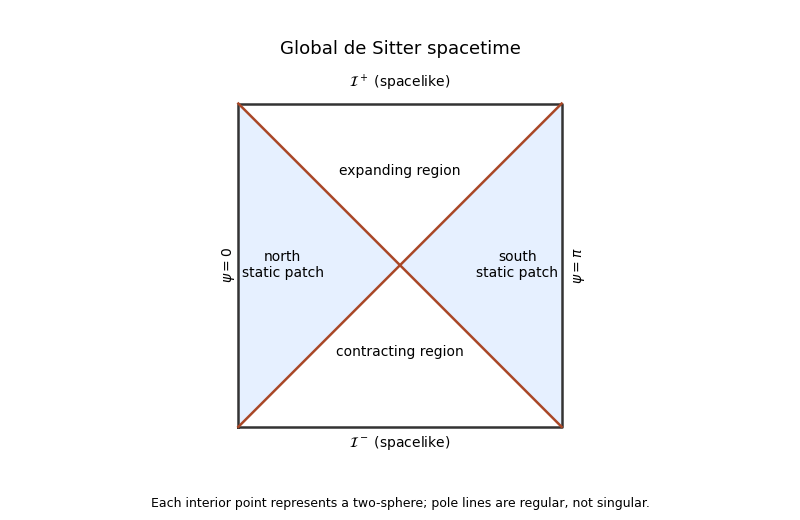
The complete analytic extension is the hyperboloid . Static coordinates are , , and . Global coordinates giveWith this isThe Penrose diagram is a rectangle, with spacelike past/future infinity, regular pole lines , and radial null rays at degrees. Observer horizons divide static patches from inaccessible regions; they are not curvature boundaries.

Articles by others on the same topic
There are currently no matching articles.