A Killing horizon is a null hypersurface with a Killing vector field as its normal and generator. Write along its orbits. These are null geodesics, but their Killing parameter need not be affine:The coefficient is the surface gravity for the chosen normalization; nondegeneracy means . If is affine and , then and . For constant , .
The Killing equation yields . On the horizon, . Multiplying by a positive constant multiplies by that constant; physical temperature therefore needs a stated time normalization.
A static observer has four-velocity . Its only nonzero acceleration component is . Using , the magnitude isIt vanishes only at , where and . Thus is proper time for the central inertial static observer. Other static observers need inward acceleration to resist de Sitter separation and have a redshifted proper time.
For the static patch of de Sitter spacetime, . With or , respectively,Both radial blocks have determinant and smooth coefficients at . The normal has norm , so that surface is null. There has covector , or has covector , making it normal as well as tangent: it is a Killing horizon.
For the signed surface gravity of a de Sitter horizon, since , part a gives in the ingoing chart on the past branch, and in the outgoing chart on the future branch, with future-directed in the static patch. The physical magnitude is , normalized by central proper time. A negative signed must not become a negative temperature.
In units, the Hawking temperature is for the stated time normalization. The inertial central observer sees the de Sitter horizon temperature . The Tolman temperature law states in static thermal equilibrium. HenceWith part b, and at the horizon. This tends to the Unruh effect temperature for the increasingly accelerated observer.
Let be proper distance inward from the horizon. Then , , givingThe radial factor has Rindler coordinates: and make it Minkowskian. Fixed has acceleration and temperature , agreeing with the leading behavior. At the center but the finite de Sitter temperature remains; is only the near-horizon limit here.
With , the static metric isThe radial coefficient is regular at , but the time coefficient vanishes and these coordinates cease to be a chart. Part c supplies smooth horizon-crossing coordinates; the local Rindler coordinates also prove the degeneracy is a coordinate one. Extending while keeping the same static alone is not a regular coordinate extension.
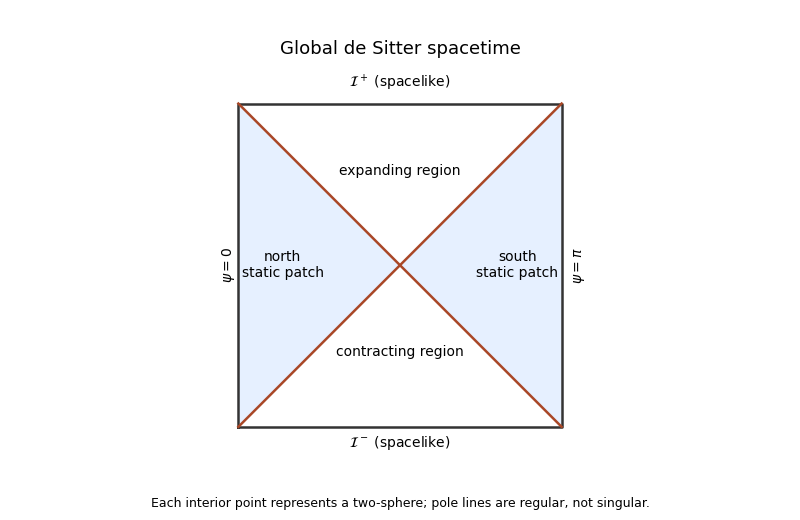
The complete analytic extension is the hyperboloid . Static coordinates are , , and . Global coordinates giveWith this isThe Penrose diagram is a rectangle, with spacelike past/future infinity, regular pole lines , and radial null rays at degrees. Observer horizons divide static patches from inaccessible regions; they are not curvature boundaries.
Axisymmetry preserves the horizon, so the axial Killing vector field is tangent to it, so its null normal obeys and . Therefore andThus there. A generator has , , making its angular velocity relative to the nonrotating stationary frame at infinity. For Kerr it is the Kerr horizon angular velocity ; the argument itself is not Kerr-specific.
For nonzero , requires , . Oblate Cartesian coordinates satisfy , , so this is the Kerr ring singularity of radius . Curvature components and generic invariants diverge there. The whole surface is not singular: away from the ring it is a disk through which the extension continues to a sheet with . This oblate radial parameter is not a nonnegative Euclidean distance.
In units, . Horizon candidates solve , giving . For , equivalently , there are no real roots. The over-rotating Kerr solution has no event horizon hiding its naked ring singularity. The term black hole in this regime names the Kerr family, not a hidden-singularity black hole.
The periodic axial orbits have norm . On the equator,Thus a neighborhood on the negative sheet has . A fixed- curve running once around periodic is a closed timelike curve: its timelike tangent returns to the same event.
No horizon in the over-rotating solution prevents passage from positive- infinity through the nonsingular disk to this region. Timelike periodic axial orbits provide the time-machine mechanism. This property of the analytic solution does not establish that such a naked geometry can be manufactured stably from generic regular collapse, as envisaged by the weak cosmic censorship conjecture.
An ergoregion of a stationary spacetime is where the stationary Killing vector field, normalized as time translation at infinity, is spacelike; a fixed-coordinate stationary observer cannot remain timelike there. For the Kerr metric, , so the outer stationary-limit surface isFor a subextremal rotating hole , with equality only at the poles. At the equator . The ergosphere touches the horizon on the rotation axis and is outside it elsewhere. Its boundary is not the horizon, whose generator is .
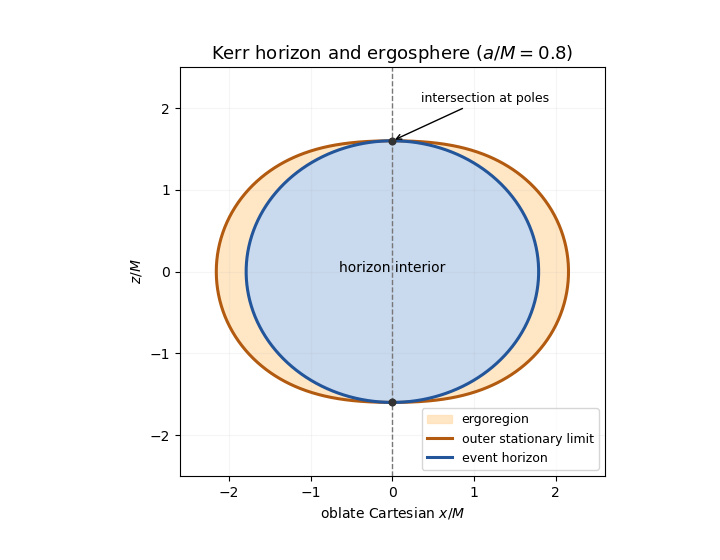
Kerr horizon and outer stationary-limit surface in an oblate-coordinate meridional sketch
. The drawing uses oblate Cartesian coordinates to display the intersection and is not an isometric embedding of the spatial geometry.
Choose spin orientation so that ; the printed threshold assumes nonzero positive . Put and . The axial metric has components and determinant . Conserved energy and timelike normalization giveEliminating gives the Kerr axial timelike effective potentialIt extends through the zeros of in the regular original coordinates. Since , reaching zero requires . At equality the infalling orbit reaches zero with zero radial velocity and turns back, because the nearby negative sheet is forbidden. Along the axis zero is regular, unlike the off-axis ring.
For , and the global maximum is . If , an inward particle has no negative-sheet turning point. It passes through zero and continues toward , another asymptotically flat end, with and infinite proper time to infinity. It first crosses the outer and inner horizons. Perturbative Cauchy-horizon instability can invalidate this ideal Kerr axial analytic extension physically.
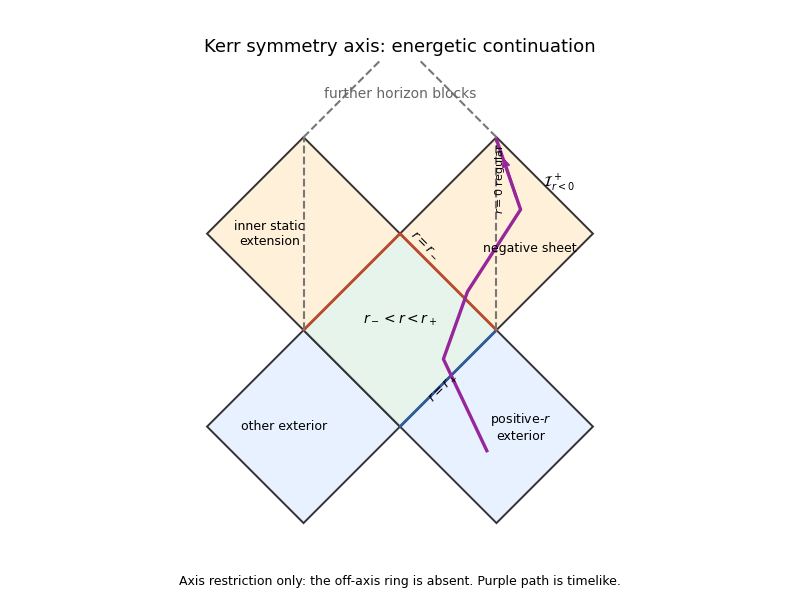
This is the two-dimensional axis restriction. The dashed curve is regular; the four-dimensional ring lies off-axis and is not an axial singular boundary.
The laws of black-hole mechanics establish the classical analogy with thermodynamics. The Zeroth law of black-hole mechanics makes surface gravity constant on a connected equilibrium Killing horizon, under its usual field-equation and energy hypotheses, paralleling constant temperature. For neighboring stationary Einstein–Maxwell solutions, the First law of black-hole mechanics isThis parallels plus work terms; denotes energy in units. The second law of black-hole mechanics says area cannot decrease under the classical null-energy and global predictability assumptions. The third law of black-hole mechanics is unattainability: regular finite physical processes satisfying its hypotheses cannot drive to zero. It parallels unattainability of absolute zero, not a universal assertion of zero extremal entropy.
Classically a hole absorbs without emitting, so the analogy alone does not identify a measured temperature. Quantum Hawking radiation supplies , with and future-horizon normalization at infinity. Comparing the area terms in the first laws gives the Bekenstein-Hawking entropyup to a conventionally fixed additive constant. In ordinary units it is . Entropy scales with area, not interior volume.
For the massless scalar in quantum field theory in curved spacetime, global hyperbolicity ensures well-posed Cauchy evolution. The conserved Klein-Gordon inner product isIts current has zero divergence by the wave equation, making it slice-independent with appropriate boundary behavior. Positive frequency relative to the asymptotic past and future Minkowski times defines complete bases , with , and vanishing mixed products. Expand the field asContinuous labels replace sums by integrals; wave packets avoid artificial normalization infinities. Particle creation by a nonstationary spacetime occurs when evolution mixes frequency signs through a Bogoliubov transformation:The inner product gives and . For the initial vacuum annihilated by all , . Thus nonzero negative-frequency mixing makes the in-vacuum non-vacuum for final observers. The vacuum state in a stationary spacetime depends on its positive-frequency splitting; this is not inconsistent with deterministic mode evolution. A unitary implementation on one fixed infinite-mode Fock space further needs the Hilbert–Schmidt condition on .
For collapse forming a Schwarzschild black hole, a late outgoing ray traced back to past null infinity obeys the Hawking exponential ray mapPulling back gives for . Its past Fourier transform has both frequency signs. For and damping , the Gamma function evaluates the Fourier integrals asAs , the two denominator arguments approach , so . Thus the thermal ratio of Hawking Bogoliubov coefficients is . Together with the bosonic normalization difference, this yields . Potential scattering adds a greybody factor:The collapse state has outgoing flux at future infinity without an incoming thermal bath and is regular for infall. It is not the eternal-hole equilibrium state. Horizon-entering modes complete the future basis; tracing over their correlated partners gives the approximately thermal exterior state. The collapsing geometry is not literally Minkowskian everywhere in the far future: asymptotically flat null-infinity modes are the relevant application of the earlier in/out construction.
Emission reduces the isolated hole's mass. Schwarzschild temperature is proportional to , giving the negative heat capacity of a Schwarzschild black hole: losing energy makes it hotter. Dimensional estimates give luminosity proportional to and evaporation time proportional to , with species and greybody factors determining coefficients. Area may shrink because quantum stress violates the energy assumptions of Hawking's area theorem. The generalized second law instead concerns , incorporating radiation entropy and preventing ordinary thermodynamic violations by disposal of entropy into a hole.
Pair correlations also distinguish thermal reduced states from the complete pure state. The black hole information paradox asks whether complete evaporation preserves quantum information: an exactly thermal final exterior with no remaining partners would appear inconsistent with unitary pure-state evolution. The semiclassical calculation controls late-time flux, not the Planck-scale endpoint, and does not itself settle this question. Quantum emission gives the temperature–entropy identification physical meaning; generalized entropy replaces the classical area alone when radiation back-reacts.
Articles by others on the same topic
There are currently no matching articles.