A null geodesic congruence is a smooth family of null geodesics filling a region without intersections there. For affine tangent , the null expansion is the trace of the optical tensor: for an infinitesimal pencil's area. Positive expansion means spreading; negative expansion means focusing.
For hypersurface-orthogonal generators in four dimensions, the Null Raychaudhuri equation readsThe null twist vanishes. The null energy condition implies through the Einstein field equations. An initial would force a focal point within affine distance at most . A future-complete generator cannot develop such a point while remaining on an achronal event horizon. Thus under the energy and global predictability/future-completeness hypotheses of Hawking's area theorem. Quantum energy-condition violations or failure of those global assumptions remove the conclusion.
The event horizon is the global boundary and depends on the whole future. An apparent horizon on a chosen spacelike slice is the outermost marginally outer trapped surface, ordinarily , . It is quasi-local and slice-dependent; its tube need not be null.
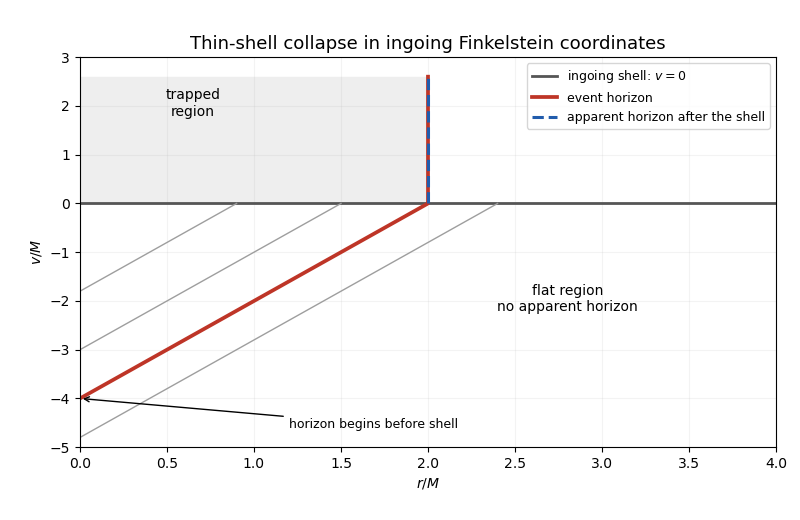
For a shell arriving at , the final horizon is . Before arrival, outgoing flat-space rays obey . Tracing this horizon backward gives until its beginning at , . No apparent horizon exists in that earlier flat region, explicitly illustrating the event horizon's dependence on future collapse.
Articles by others on the same topic
There are currently no matching articles.