Use metric signature and a future-oriented worldline. Variation of the worldline einbein gives the mass-shell condition; variation of momentum givesEliminating first leaves . Its equation is . Choose the positive lapse branch ; substituting gives . Thus , the proper time action. The lapse branch fixes the sign convention. Eliminating auxiliary variables on their algebraic equations preserves the worldline equations, which are timelike geodesics up to parametrization.
Locally write the null hypersurface as , , with normal , . A vector is tangent exactly when . Nullness gives on the hypersurface. Hence : its normal direction lies inside its tangent space.
Put and . Torsion freedom gives . Since vanishes on , all tangential derivatives vanish there and there for a scalar . ConsequentlyThis is the unparametrized null geodesic equation. The integral curves are therefore generators of . An affine rescaling of a null normal removes the proportionality coefficient locally: if , set with .
The future domain of dependence consists of points through which every past-inextendible causal curve meets the partial Cauchy hypersurface . Data on determine evolution there for suitable hyperbolic equations. Its future boundary is the Cauchy horizon ; one precise definition is .
For a nonextremal Reissner-Nordstrom spacetime, , the metric function is , with . The outer event horizon lies at . The future trapped region leads toward the inner null surface , a future Cauchy horizon for bridge data on the illustrated . Beyond it some past causal curves arrive from other analytic blocks or timelike singularities without meeting . The CP diagram repeats these analytic blocks; is a timelike curvature singularity.
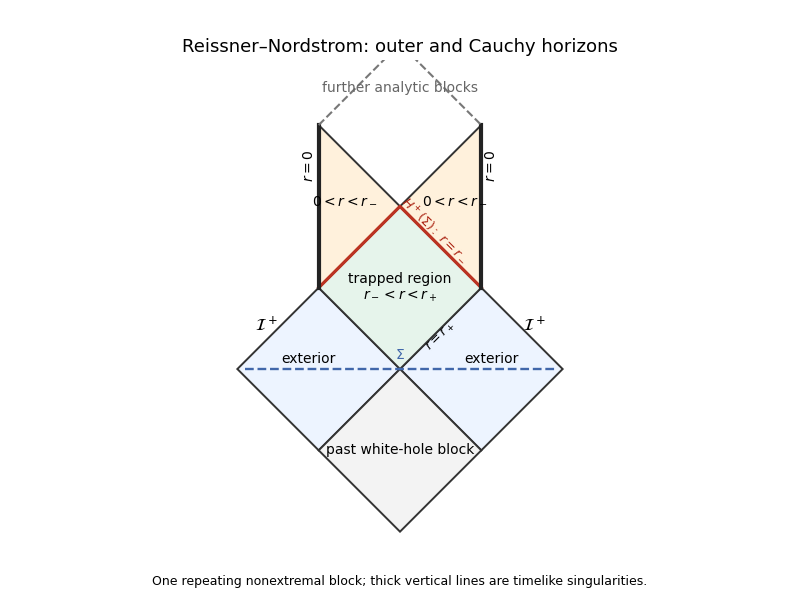
Reissner-Nordstrom conformal block with bridge data and future Cauchy horizons
. Near the inner horizon, arbitrarily late exterior radiation is compressed into finite infaller proper time. Its frequency is exponentially blueshifted, with scale , so even a decaying flux can have diverging measured stress. Generic ingoing and outgoing perturbations produce mass inflation, growing internal mass and curvature. The smooth RN Cauchy horizon is expected to be unstable to back-reaction. This is a generic instability argument, not a universal theorem from every specially tuned test trajectory; the approximation of a harmless test particle becomes inconsistent.
A null geodesic congruence is a smooth family of null geodesics filling a region without intersections there. For affine tangent , the null expansion is the trace of the optical tensor: for an infinitesimal pencil's area. Positive expansion means spreading; negative expansion means focusing.
For hypersurface-orthogonal generators in four dimensions, the Null Raychaudhuri equation readsThe null twist vanishes. The null energy condition implies through the Einstein field equations. An initial would force a focal point within affine distance at most . A future-complete generator cannot develop such a point while remaining on an achronal event horizon. Thus under the energy and global predictability/future-completeness hypotheses of Hawking's area theorem. Quantum energy-condition violations or failure of those global assumptions remove the conclusion.
The event horizon is the global boundary and depends on the whole future. An apparent horizon on a chosen spacelike slice is the outermost marginally outer trapped surface, ordinarily , . It is quasi-local and slice-dependent; its tube need not be null.
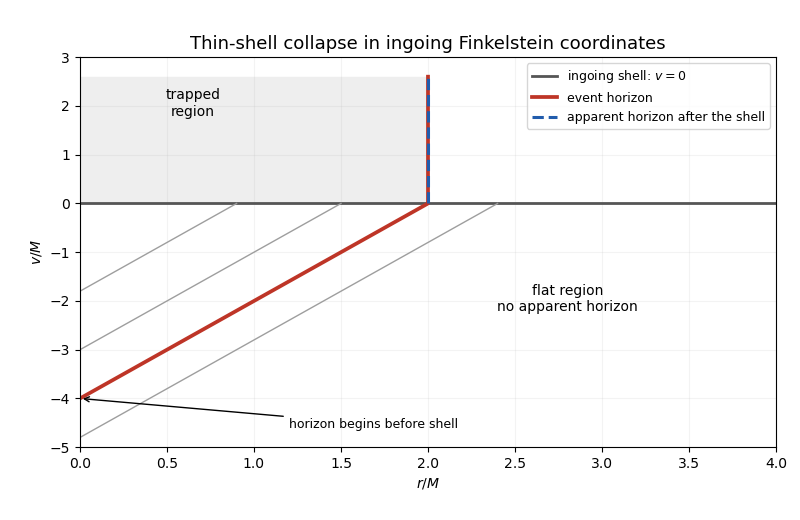
For a shell arriving at , the final horizon is . Before arrival, outgoing flat-space rays obey . Tracing this horizon backward gives until its beginning at , . No apparent horizon exists in that earlier flat region, explicitly illustrating the event horizon's dependence on future collapse.
The qualification concerns gravitational energy. Local matter energy exists: an observer measures . What is absent is a generally covariant local gravitational stress-energy density with the required universal conservation properties. The Equivalence principle allows the connection to vanish at a point in freely falling coordinates; standard gravitational energy expressions depend on coordinates. Curvature does remain, but supplies no unique gravitational energy tensor of the required kind. A nonstationary geometry also lacks a preferred time-translation Killing vector field. For a trial timelike , stress-energy conservation gives , not generally zero.
An internal charge instead has a current independently of spacetime time translations. Its hypersurface flux is conserved with suitable boundary conditions. For electric charge, the Gauss law expresses it as a surface flux. Observer-dependent charge density does not prevent a well-defined total charge.
For an asymptotically flat spacetime, take asymptotically Cartesian slice coordinates with and appropriate falloff. In units, the ADM energy isIt is an asymptotic gravitational energy. The dominant energy condition requires to be future-directed nonspacelike or zero for every future timelike , in particular . Together with the constraint equations, completeness and appropriate asymptotic/boundary hypotheses, it yields . The energy condition alone is not the complete positive-energy theorem.
For a Killing vector field , set . Choose surface orientation conventions so that the Komar charge, up to overall normalization, isThis is the Komar current from trace-reversed stress-energy construction. The equality is the spacetime Stokes theorem. With , the Killing equation and give . In four dimensions, at zero cosmological constant, the Einstein field equations give the currentReversing orientation changes the common overall sign, not conservation. The contracted Bianchi identity givesAn isometry preserves scalar curvature, and the second term contracts symmetric and antisymmetric tensors. Equivalently stress-energy conservation, the Killing equation, and cancel the matter expression; its trace derivative needs this last observation. Hence . Nonzero cosmological constant adds to the geometric current, also divergence-free.
Articles by others on the same topic
There are currently no matching articles.