A tricritical point joins continuous and first-order transition loci and requires tuning an additional temperature-independent control. In the scalar sextic potentialit occurs at : both the quadratic and quartic terms vanish. At , the transition is continuous at ; at , it is first-order at . The jump tends to zero as , so these loci meet at the tricritical point.
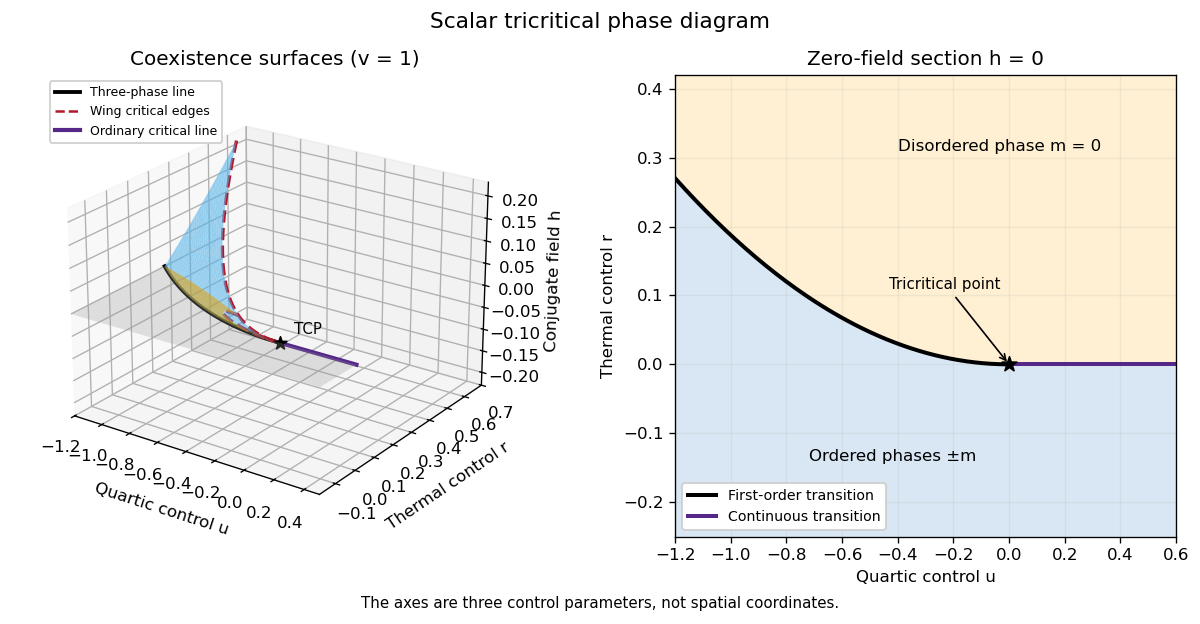
For the three-control phase diagram with coordinates , the sheet below these transition loci has coexistence of the two ordered phases. For its boundary is the ordinary continuous critical line . For the boundary is a tricritical three-phase line, where and all coexist. Two symmetry-related tricritical wings extend from that line into and , describing first-order coexistence between small- and large-magnitude phases of the same sign. Each wing ends along an ordinary wing critical edge.
The critical-edge conditions giveHere , so these are ordinary quartic endpoints. The two wing critical edges and the zero-field ordinary critical line are three continuous critical lines meeting at the tricritical point; the three-phase first-order line also ends there. The “3D” phase diagram refers to three independent controls; it is distinct from the spatial dimension of the field theory.
The figure uses actual sextic-potential coexistence surfaces rather than drawing arbitrary wings. For two coexisting nonnegative minima , put . The tricritical wing coexistence factorizationholds when , and . It proves that both minima are globally stable. The limits and produce the three-phase line and critical edge, respectively; reflection gives the other wing.

At , on the ordered side and . At the critical isotherm . Thus the tricritical mean-field critical exponents areThe source's extra control is required to tune to zero; simply changing temperature in a generic quartic system does not produce tricriticality. The tricritical upper critical dimension is three, as established in Question 3.
Articles by others on the same topic
There are currently no matching articles.