Use geometrized units and metric signature , with . In the exterior of Schwarzschild spacetime, put . The Schwarzschild tortoise coordinate satisfiesThe retarded and advanced null coordinates and then give . The logarithmic divergence of suggests exponentiating these null coordinates. In the right exterior define the Kruskal–Szekeres coordinatesTheir product eliminates :Since and , the Schwarzschild metric becomesHere is an implicitly defined function of . The derivative of the right side with respect to is , which is nonzero at . The inverse function theorem therefore makes smooth across that surface, and the coefficient of tends to . Thus the Schwarzschild event horizon is a coordinate singularity of the original chart, while this Lorentzian metric remains regular there.
Extend the Kruskal–Szekeres coordinates to all real with . The signs give two exterior regions, and , a future black hole region , and a past white hole region . The event horizons are or , intersecting at the bifurcation surface. The boundary has and is a genuine Schwarzschild singularity, as the Kretschmann scalar diverges there.
Finally, and give and a radial metric proportional to . Hence radial null geodesics have slopes , the event horizons are , and the singular boundaries are . This constructs the maximal Kruskal extension; a black hole produced by collapse need not contain the second exterior or the white hole of that eternal extension.
Start with the four-dimensional Minkowski metric , where . Choose an arbitrary length , and use the retarded and advanced null coordinates , . For the Minkowski conformal compactification, setBoth lie between and . Since , we have ; the remaining inequalities are . Moreover,Multiply by the square of the conformal factor . The resulting metric is regular on the appropriate boundary pieces and preserves the null directions. Suppressing the angular two-spheres gives a triangular Penrose diagram with radial null geodesics at degrees.
The line is the ordinary timelike centre . The upper sloping edge is future null infinity, reached with and finite ; the lower sloping edge is past null infinity, reached with and finite . The vertices and are future and past timelike infinity, denoted and . The vertex is spacelike infinity, . These are limiting endpoints in the conformal completion, rather than ordinary physical events. In particular, finite diagram coordinates at null infinity do not imply finite physical affine parameter.
The four-dimensional radial diagram is the triangle , . If one instead draws two-dimensional Minkowski spacetime with a signed Cartesian spatial coordinate, the diagram is the full diamond. The centre is a boundary of the radial quotient, not a boundary of the physical four-dimensional Minkowski spacetime.
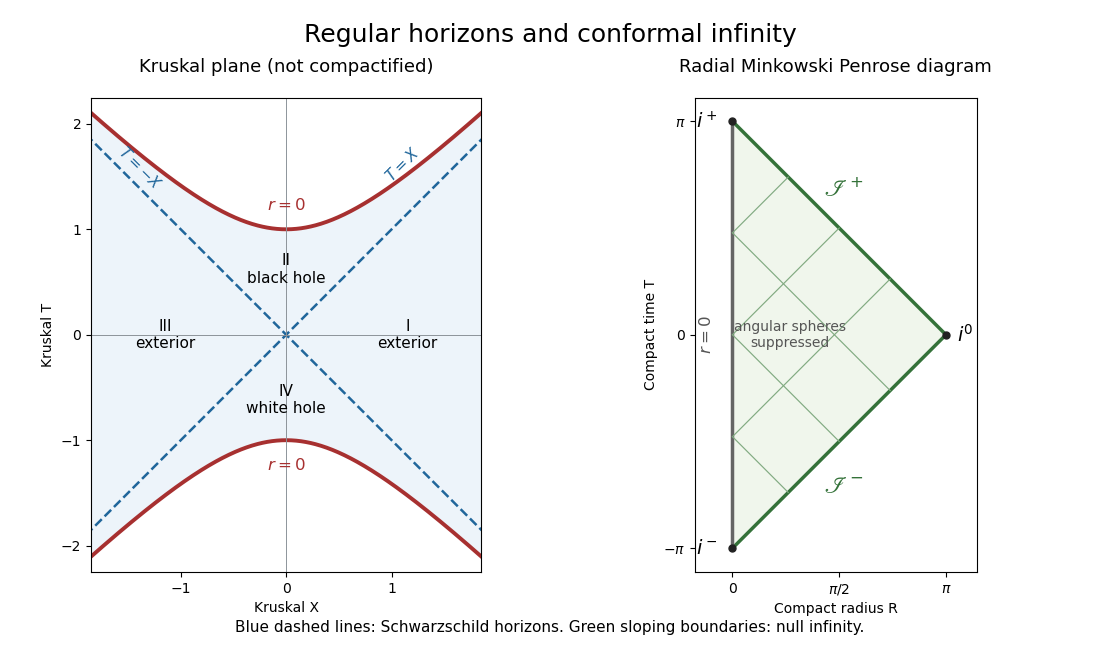
Kruskal extension and the radial Minkowski Penrose diagram
. Details. 
The physical argument for the Penrose inequality combines weak cosmic censorship conjecture, the dominant energy condition, and relaxation to a stationary black hole. Work in geometrized units. Let and be the final Kerr black hole mass and horizon area. Positive energy radiated to infinity gives , where is the initial ADM energy. For a Kerr black hole with ,If the initial apparent horizon obeys the necessary apparent-horizon area comparison with the enclosing event horizon, and Hawking's area theorem applies during the evolution, thenConsequently the anticipated answer, under those additional hypotheses, isThe bound is saturated by a nonrotating Schwarzschild black hole with no energy loss. Rotation or outgoing radiation makes the argument's inequalities stricter.
There is an essential qualification: inclusion inside an event horizon does not by itself compare areas. An arbitrary apparent horizon on general, non-time-symmetric initial data need not satisfy the displayed apparent-horizon area comparison; the unqualified version with its area is not universally true, even with the dominant energy condition. On time-symmetric data the relevant outermost minimal surface is an outer area-minimizing surface, as used in the Riemannian Penrose inequality, with nonnegative scalar curvature. In more general formulations an appropriate enclosing-area quantity is needed. The physical expectation is conditional on this area comparison, as well as on censorship, predictability, settling, and the energy assumptions; the mere presence of a trapped surface does not supply every step.
Articles by others on the same topic
There are currently no matching articles.