With the mostly-plus metric signature and coordinates , the Minkowski metric is the nondegenerate bilinear formIt is a symmetric bilinear form, but not a positive-definite bilinear form. For example, is nonzero yet , making it a null vector. This does not make the Minkowski metric degenerate: some other vectors have nonzero pairing with .
Applied to infinitesimal displacements, the Minkowski metric givesFor a timelike curve, a clock records . For a null curve, . For spacelike separation, the positive Minkowski interval measures a different kind of separation. A Lorentz transformation preserves this form, expressed in matrix notation by , although it need not preserve ordinary Euclidean distance in the four-component coordinate list.
Use signature and future-pointing timelike vectors . Their time components exceed their spatial magnitudes, so the same holds for their sum by the Euclidean triangle inequality. In the rest frame of , write , , and let . Then . Expanding the squared norm of proves the displayed inequality. Equality requires to have zero spatial component in this frame, equivalently is a positive scalar multiple of . The shared future time orientation is essential.
The squared interval between two events in Minkowski spacetime is the quadratic form of their coordinate difference under the Minkowski metric. In signature it is . Lorentz transformations preserve this quadratic form; timelike, spacelike and null separation correspond to negative, positive and zero values.
The opposite metric signature reverses the sign of the Minkowski interval, giving ; the physical classification and proper time stay the same. State the convention before using a sign to identify a separation. With the mostly-plus convention here, a straight clock segment has , while a light signal has . [ref].
Two distinct spacetime events have timelike separation when their displacement has negative Minkowski interval in metric signature , equivalently . A massive observer can connect them along a straight timelike curve. If the later spacetime event has , every Lorentz transformation in the orthochronous Lorentz group keeps it later. The elapsed proper time on the straight inertial segment is .
In the light-second units of the Minkowski spacetime example, to has . Its straight moving clock therefore records , approximately , while the coordinate time difference is . Coordinate time and proper time answer different questions.
Distinct spacetime events have null separation when their displacement has zero Minkowski interval, equivalently . They can be joined by a straight vacuum light ray. Their nonzero displacement is a null vector, so the zero squared interval does not mean that the spacetime events coincide. For example, is null separated from the origin.
For mostly-plus signature, and give . In this convention raising a plus or minus derivative exchanges the two labels.
This quadratic form belongs to the geometry of Minkowski spacetime; the spacetime itself is a broader concept than this squared norm.
The light cone of a spacetime event consists of together with the spacetime events having null separation from it. In the coordinates of an inertial frame centered on , it obeysFor it traces an expanding spherical flash of light, with radius at time ; for it describes possible incoming light rays. A spacetime diagram with one spatial coordinate shows the two lines . The apparent angle uses equal scales for and and is not a separate physical angle.
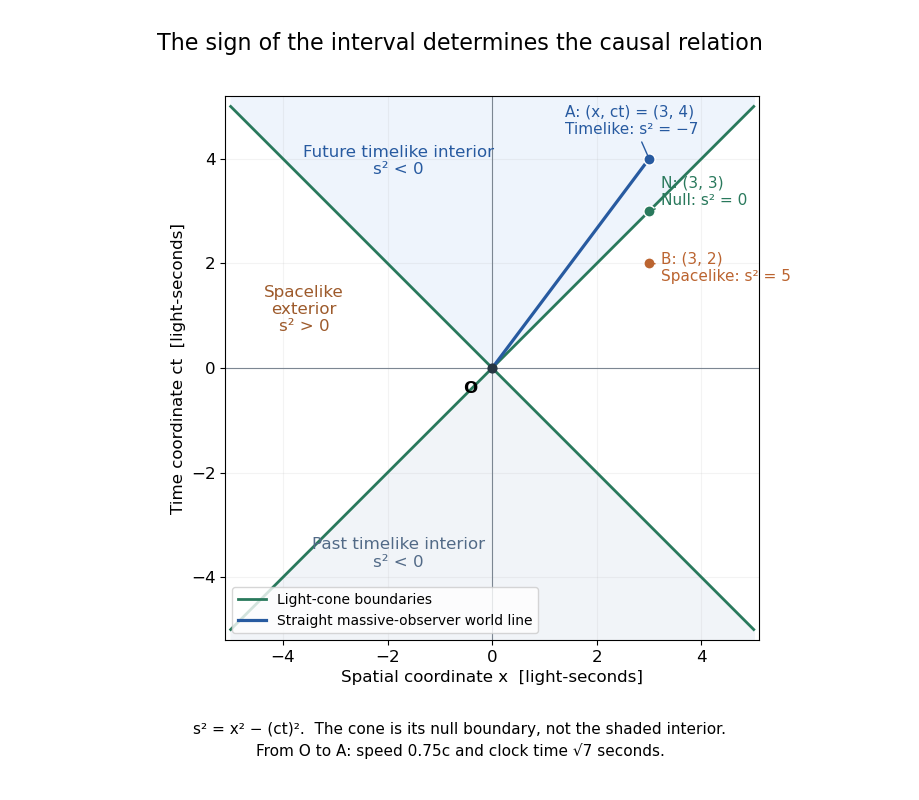
Light-cone boundaries separate timelike, null and spacelike events relative to the origin
. Details. 
The light cone is the boundary, while its interior has timelike separation from . An outgoing light ray follows the boundary; a future-directed massive observer's world line remains inside it. The exterior has spacelike separation: no signal travelling at or below the speed of light can connect its spacetime events directly to . This separates possible causal influence from merely being assigned a later coordinate time.
In the diagram, is inside the future boundary, is on it, and is outside. Their squared Minkowski intervals are respectively in . Thus occurs later than in the displayed inertial frame while still being unable to receive a light-speed-or-slower signal sent from .
The usefulness is immediate for an experiment: a detector's reading can depend on a source event only if a causal influence can reach it. A Lorentz boost changes coordinates but preserves this classification. For a boost with and Lorentz factor , applying the Lorentz transformation gives, in light-second length units,The corresponding squared Minkowski intervals remain . In particular is now earlier than , which is allowed for spacelike separation; remains later.
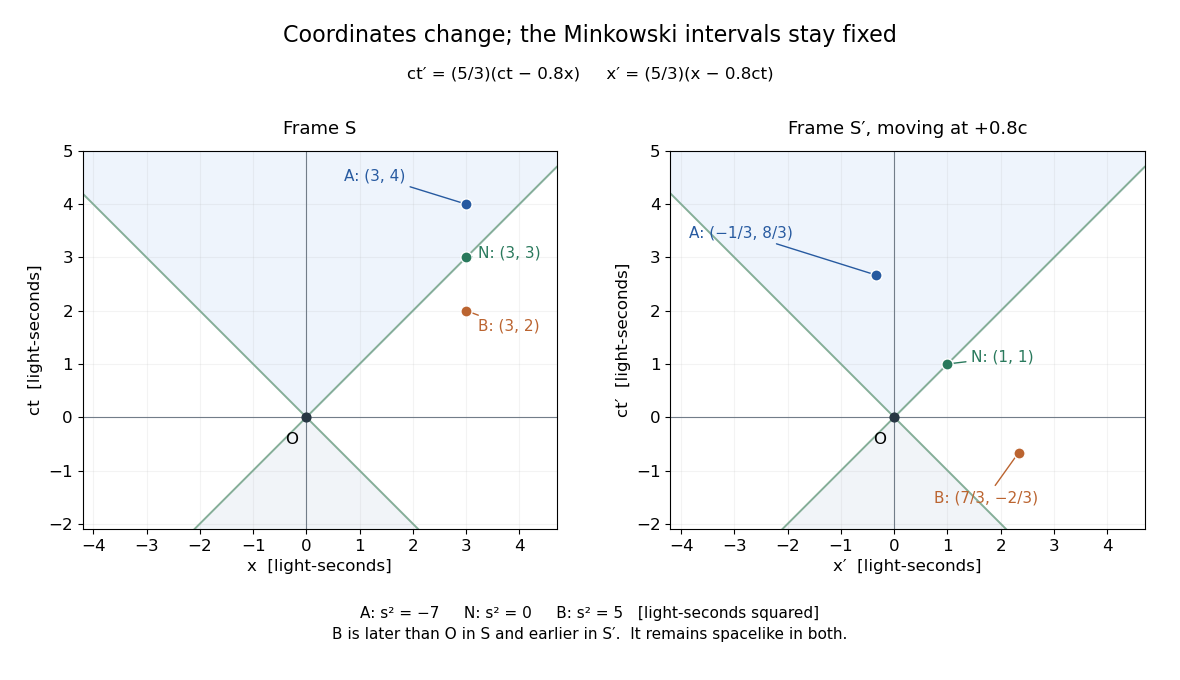
A boost at 0.8c changes event coordinates and spacelike time order while preserving every Minkowski interval
. Details. 
The past light cone of a spacetime event is the past-directed part of its light cone. In Minkowski spacetime, its spacetime events satisfy with . They are the possible emission events of light rays arriving at . The interior also contains events that can send slower signals to . The retarded potential of a moving point electric charge, given by the Liénard–Wiechert potential, uses the emission event where the source's world line intersects this boundary.
The future light cone is the future-directed part of the light cone of a spacetime event. Its boundary consists of the events reached by outgoing light rays. Events reached by slower causal signals lie inside the boundary; relativistic causality forbids a controllable signal from reaching the spacelike exterior.
The speed of light is the invariant speed of every inertial frame and the limiting speed of causal propagation in special relativity.
A one-way speed of light measurement assigns a travel time between spatially separated emission and reception events and therefore requires a distant-clock synchronization convention. In an inertial frame, Einstein synchronisation assigns the vacuum value in either direction. A completed-loop comparison such as the Sagnac effect is a different observable.
A light-second is a unit of length: the distance vacuum light travels in one second. It is useful in a spacetime diagram because a time of one second corresponds to a coordinate of one light-second, making the slopes of the light cone particularly easy to read. The unit is a distance, rather than an elapsed time.
A direction represented by a nonzero null vector has zero Minkowski norm. Such directions form the generators of the light cone.
Its nonzero tangent is a null vector at every regular point; this distinguishes the curve from a single null direction.
A null geodesic is both a null curve and a geodesic. In geometric optics, light rays follow null geodesics.
In a flat two-dimensional Penrose diagram, a straight line tangent to a null vector; with radial metric tensor it is or . Such lines represent radial null geodesics after a conformal transformation.
A radial null geodesic in a spherically symmetric spacetime has zero angular momentum and fixed angular coordinates. Its projection is a null curve of the two-dimensional radial Lorentzian metric.
Articles by others on the same topic
There are currently no matching articles.