Specific orbital energy, orbital eccentricity and the distribution. Let , and . Choose positive to mean an outward radial kick. At release the tangential and radial velocities are and . The specific orbital energy and specific angular momentum areUsing and therefore givesThe denominator must be positive for an elliptic Kepler orbit. A vanishing denominator describes a parabolic Kepler orbit; negative is the signed semi-major axis of a hyperbolic Kepler orbit.
Differentiating the squared orbital eccentricity givesIn the small-kick regime , . Thus the minimum is at , withThe entire expression, including the term, lies under the square root in the PDF. This minimum is not a universal statement for arbitrary kick size. For example , reverses the circular velocity and gives a retrograde circular orbit with ; the displayed stationary value is then not the global minimum.
For , every kick direction gives a bound prograde Kepler orbit. The two endpoint maxima, one at each end of the accessible curve, areThe positive endpoint is the global maximum. There is one interior minimum, at the location just found. Uniform gives the kick-orbit distributionBoth signs of the radial kick occupy the same – curve; they have opposite apsidal orientations. The distribution is concentrated near its endpoints, with integrable square-root singularities. For larger kicks retain the parametric curve and its bound portion ; an unbound branch begins at , . In particular, a sketch of a wholly elliptic population presupposes the bound-kick restriction above.
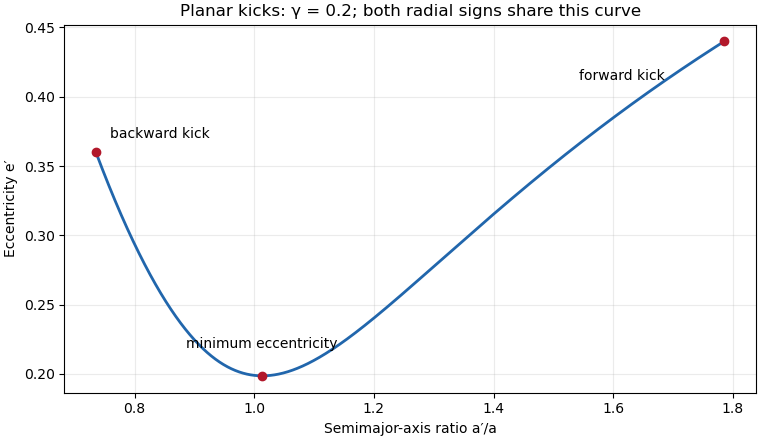
Eccentricity and semimajor-axis distribution for isotropic planar velocity kicks of magnitude 0.2 times the circular speed
. Details. 
The eccentricity vector at release has radial component and tangential component . With the release radius chosen as zero longitude,This also directly verifies the squared orbital eccentricity above and fixes the sign convention for the longitude of periapsis.
The 1:1 encounter window. Exact equality of orbital periods requires , hence . There are two kick directions with this cosine when . To quantify a finite window one must specify a return time: near exact commensurability, consider the particle's first complete return to its release point. During that time the source advances through . Its longitudinal miss distance is, to first order,Thus gives the two-sided cosine windowIntegrating over that window gives, to leading order for a narrow window away from ,The printed fraction is half this value. It is obtained by retaining only one side of the semi-major axis window, or only one of the two kick-angle branches. Neither restriction is in the question. Thus the printed coefficient cannot be shown for the stated uniform population and a symmetric first-return distance criterion. This already exhibits the discrepancy under the usual longitudinal approximation; minimizing the distance over the encounter interval introduces a further velocity-direction correction, not a missing branch. With arbitrarily long observation times, noncommensurate bound trajectories can also return arbitrarily close to the common release point, so an eventual-encounter fraction is a different, time-dependent question.
Rotating-frame sketches. In the rotating reference frame of the source put radially outward, along the source's motion and , where . The linear Hill equations for a stellar Kepler orbit, with initial displacement zero, give the velocity-kick epicycleThese solve , and reproduce the initial kick. For , the particle starts forward, moves outward and drifts backward; the curve has a loop each orbital cycle, with net per cycle. For , both coordinates reverse: it moves inward and drifts forward by . For , the leading trajectory is a closed epicyclic ellipse,It starts at the top of the ellipse moving radially outward and returns to the source after one period to this order. Its exact semi-major axis differs from at order , so exact closure is not implied. The local sketches require , in particular for the drifting cases.
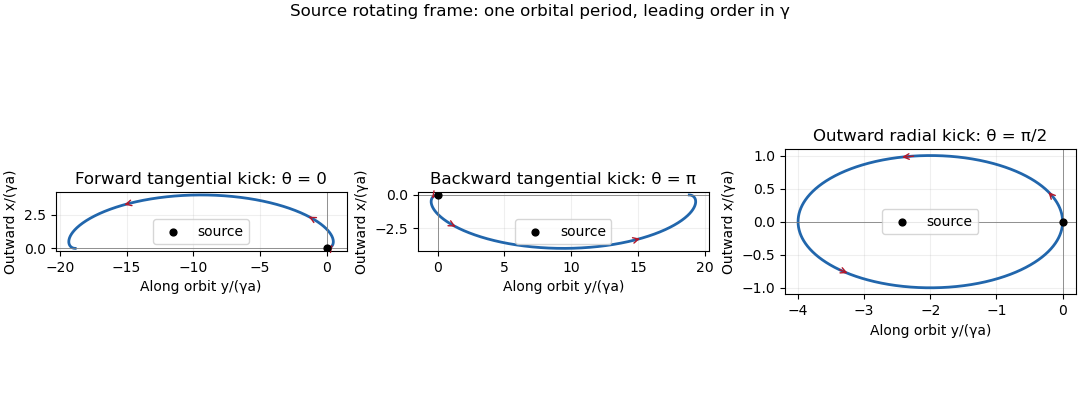
Particle trajectories after tangential prograde, tangential retrograde and outward radial kicks in the source rotating frame
. Details. 
Articles by others on the same topic
There are currently no matching articles.