The J gate is , with . Prepare a fresh qubit in and apply the Controlled-Z gate between it and the input . The resulting state isMeasure the input in the equatorial qubit measurement basis . The unnormalized output isEach outcome has probability . Thus one-bit teleportation realizeson the new qubit. Apply the known Pauli X gate correction for the literal output, or keep the correction in a Pauli frame and adapt later measurements. The old qubit is measured, so this is not cloning the input.
Direct multiplication of the given matrices gives . The displayed negative exponent in the supplied relation has the wrong sign for exact matrix equality. The discrepancy is only a global phase in a fixed measurement branch, so it does not change this measurement implementation or its outcome probabilities. The positive-sign identity is used when tracking exact matrices.
An explicit measurement-based quantum computation pattern uses six vertices . Prepare a graph state with every vertex in and apply a Controlled-Z gate for each edgeThe first two links on each wire permit graph-state preparation of a computational-basis input followed by the logical J gate. Use the following single-qubit measurements:
All entangling edges can be made at preparation time because Controlled-Z gates commute. A future edge that does not touch a currently measured vertex can equivalently be deferred, which allows the one-bit teleportation identities to be applied in their logical order.
The two initial measurements implement with Pauli frames on the logical inputs. The first adaptive J gate then has output frame on . Propagating through gives framesup to branchwise global phase. The second adaptive J gate converts the latter intoA correction does not alter a computational-basis measurement, while an correction flips its bit. Consequently the deterministic classical postprocessing isThis reproduces the output-bit distribution of the original quantum circuit, including its known byproduct corrections.
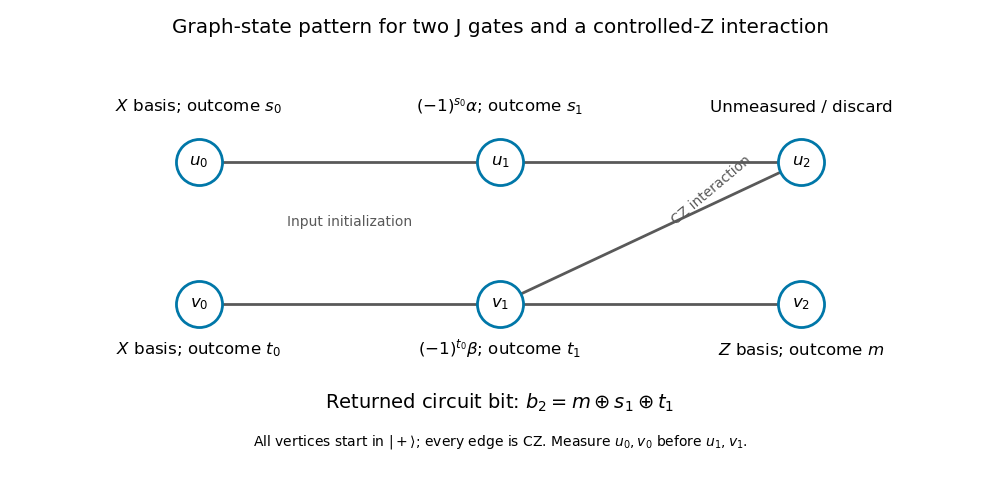
Six-vertex graph state, adaptive equatorial measurements and classical parity correction for the two-wire circuit
. Details. 
There is an additional simplification for these particular zero inputs. Since , , and , the exact final state is , independently of the angles. The requested bit is therefore fair. A single isolated graph-state vertex measured in already simulates that bit distribution; the six-vertex pattern also explicitly realizes the circuit and its corrections.
Use the operator norm induced by the usual vector norm, and assume the input quantum state is normalized. Since and the Hadamard gate is unitary, the J-gate phase-error operator norm isWrite the exact and implemented quantum circuits as ordered products and . The quantum circuit gate-error telescoping bound follows fromEvery surrounding factor is unitary, including gates tensored with identities on other qubits, so the triangle inequality and the submultiplicativity of the operator norm giveThe exact Controlled-Z gates contribute zero to that sum. ThusThe endpoint is sufficient because each implemented angle error is strictly smaller than . If , the circuits are identical and any positive works. The bound controls the stated vector distance with actual gate phases retained, so no adjustment of the global phase of one output is needed.
Articles by others on the same topic
There are currently no matching articles.